Navigating HVAC Financing Terms When Replacing a Full System
Caught Off Guard: The Stress of Sudden System Failures
Your air conditioner is blowing warm air, and the realization quickly sets in: you are not just looking at a minor repair. Navigating HVAC financing terms when replacing a full system is suddenly at the top of your to-do list, and it is likely the last thing you want to deal with during the September transition after peak summer. At Reliabee Air Electric Plumbing, our technicians see this exact scenario play out year after year. The urgency to restore a comfortable, livable environment in your home often overrides the desire to carefully read through pages of dense financial agreements. When the house is hot and your family is uncomfortable, the instinct is to sign whatever paperwork gets the new equipment installed the fastest.
However, rushing into a long-term financial commitment without understanding the underlying terms can lead to unexpected monthly costs and hidden fees down the road. Taking just a few moments to review your HVAC financing options can mean the difference between a manageable monthly investment and a stressful financial burden. Before you authorize any work, it is critical to decode the industry jargon and understand exactly how different lending agreements are structured. This guide breaks down the essential terminology, empowering you to make safe, informed choices regarding your home comfort investment.
Why Rushed Replacements Lead to Financing Pitfalls
In our years of serving San Antonio area homes, we have learned that the environment plays a massive role in how homeowners approach major purchasing decisions. Extreme weather often dictates the timeline for equipment upgrades. With San Antonio's intense heat frequently persisting well into September, cooling equipment remains under immense strain long after the calendar says summer is over. Our service teams regularly find that this prolonged workload pushes aging equipment past its limits, resulting in abrupt, complete system failures rather than a slow, manageable decline.
The Problem: When a system dies unexpectedly after running constantly through the summer, the psychological pressure to fix the problem immediately is overwhelming. Desperate to get the air conditioning back online, homeowners often skim over the fine print of lending contracts. They look at the estimated monthly payment and simply sign on the dotted line, missing crucial details about interest accrual, promotional expiration dates, and origination fees.
The Cause: Financial agreements are inherently complex, and lending institutions frequently use terminology that sounds appealing on the surface but carries strict conditions. When you are focused entirely on restoring a livable temperature, your brain is in emergency triage mode, not financial analysis mode. The combination of physical discomfort and complex paperwork creates an environment where predatory or misunderstood lending terms thrive.
The Solution: The most effective defense against unfavorable terms is a brief, intentional pause. Stepping back to understand that not all lending agreements are structured the same way protects your long-term financial health. Before moving forward with an air conditioning replacement, require the contractor to explain the financing terms in plain English. A reputable professional will never pressure you to sign a document you do not fully understand, regardless of how uncomfortable the indoor temperature is.
Decoding the Basics: APR vs. Interest Rate
When our comfort advisors sit down to review a lending agreement for a new cooling system with a homeowner, two numbers usually stand out: the interest rate and the APR. While they sound interchangeable, they represent different aspects of your financial obligation. Understanding the distinction is the first step in accurately comparing different financing offers for San Antonio area homes.
Understanding the True Cost of Borrowing
The standard interest rate is simply the basic cost of borrowing the principal amount, expressed as a percentage. However, the interest rate does not tell the whole story. The APR, or Annual Percentage Rate, is a broader, more comprehensive measure. It includes the base interest rate plus any additional fees, such as origination fees, processing charges, or closing costs, rolled into one annual percentage.
Because APR accounts for these extra costs, it is almost always higher than the base interest rate. When comparing two different agreements, the APR provides a much more accurate picture of your true out-of-pocket costs over the life of the loan. A lower interest rate does not automatically mean a better deal if the lender tacks on hefty origination fees that drive the APR up.
When reviewing the disclosure form, we always recommend looking for the following items:
• The Principal Balance: The total cost of the equipment and installation being financed.
• The Base Interest Rate: The percentage charged solely on the borrowed amount.
• The APR: The total cost of borrowing, including all mandatory fees.
• The Term Length: The exact number of months you have to repay the balance.
• Origination Fees: Any upfront costs charged by the lender just for processing the application.
The Reality Behind Promotional Periods and Deferred Interest
One of the most common financing structures our team sees offered during the September transition after peak summer is the promotional period. Advertisements frequently highlight "0% Interest for 18 Months" or "No Payments for a Year." While these promotions can be incredibly beneficial for managing cash flow, they often contain specific conditions that require careful attention.
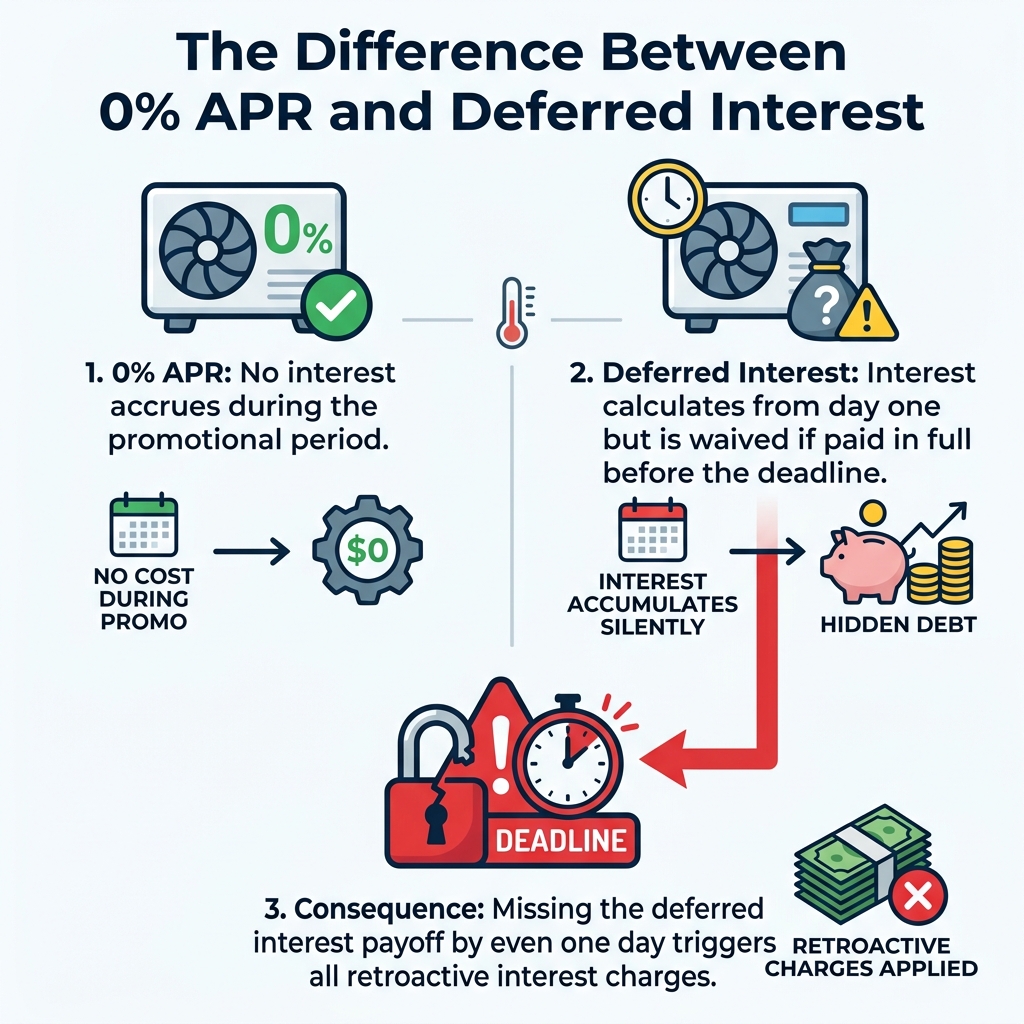
A true 0% APR promotional period means that the lender waives all interest charges for the specified timeframe. If you pay off the principal balance before the promotion expires, you pay exactly the cost of the system and nothing more. However, many agreements use a different structure known as deferred interest, which operates under entirely different rules.
The deferred interest trap is a significant hazard for rushed buyers. In a deferred interest agreement, interest actually accrues from day one at a standard, often high, rate. The lender simply defers, or pauses, billing you for that interest during the promotional window. If you pay the entire balance off before the deadline, the accrued interest is permanently waived. However, if you miss the payoff deadline by even one day, or if you leave even a tiny fraction of the principal unpaid, all of that retroactive interest from the original purchase date is suddenly applied to your account.
Federal consumer protection guidelines strongly recommend carefully reviewing promotional terms to determine whether you are getting a true 0% APR or a deferred interest plan. To beat the deferred interest deadline, never rely on the "minimum monthly payment" listed on your statement. Minimum payments are rarely designed to clear the balance before the promotion ends. Instead, take the total principal amount and divide it by the number of months in the promotional period. That calculated number is what you must pay each month to safely avoid retroactive charges.
At Reliabee Air Electric Plumbing, we take pride in acting as a trusted local advisor who prioritizes your long-term safety. Our commitment is to provide transparent, easy-to-understand financing without hidden fees. We ensure every homeowner knows exactly how their promotional periods function before our technicians install any equipment.
Secured vs. Unsecured Agreements: What Homeowners Must Know
Beyond interest rates and promotional periods, financing agreements are generally categorized into two main types: secured and unsecured. The type of agreement you choose dictates what collateral is on the line and significantly impacts your approval odds and term lengths.
An unsecured loan is based entirely on your creditworthiness. The lender reviews your credit history and income to determine your eligibility. Because there is no physical collateral tied to the agreement, unsecured loans present a higher risk to the lender. As a result, they often carry slightly higher interest rates and shorter repayment terms. However, our team typically sees these processed much faster, making them popular for emergency replacements in San Antonio area homes.
A secured loan, on the other hand, requires an asset to back the agreement. In some cases, the new HVAC equipment itself serves as the collateral; in other programs, the loan might be tied to your home's equity. Because the lender has a way to recover their funds if you default, secured agreements usually offer lower interest rates and longer repayment terms, which can significantly lower your monthly payment.
• Collateral Required — Unsecured Agreement: None (Based on credit score) — Secured Agreement: Yes (Equipment or Home Equity)
• Approval Speed — Unsecured Agreement: Fast (Often instant or same-day) — Secured Agreement: Slower (Requires asset verification)
• Typical Interest Rates — Unsecured Agreement: Generally higher — Secured Agreement: Generally lower
• Term Lengths — Unsecured Agreement: Shorter (Typically 3 to 7 years) — Secured Agreement: Longer (Can extend 10+ years)
Navigating Credit Challenges and Alternative Structures
Sudden system deaths rarely check your financial calendar before occurring. During the September transition after peak summer, a complete breakdown might happen at a time when your credit score is not in an ideal position. Our staff works closely with families to find solutions, emphasizing that perfect credit is not a strict requirement for restoring home comfort.
Standard unsecured agreements generally require a good to excellent credit score to qualify for the most attractive promotional rates, such as long-term 0% APR offers. If your score falls below the lender's prime threshold, you may still be approved, but likely at a higher standard APR and without the promotional perks. Lenders use a tiered system, adjusting the interest rate based on the perceived risk associated with your credit history.
If traditional lending pathways are not an option, alternative structures exist to bridge the gap. For example, exploring lease-to-own HVAC options can provide a viable path forward. These alternative programs focus less on traditional credit scores and more on standard income verification and banking history. While the long-term cost structures differ from traditional loans, they ensure that you are not left suffering in an unlivable home environment due to temporary credit challenges.
Pairing Financing with High-Efficiency System Upgrades
When you utilize financing to manage the upfront cost of a replacement, it opens the door to evaluating higher-tier equipment. A common mistake our technicians see homeowners make is opting for the absolute lowest-efficiency base model to keep the financed amount down, without considering the long-term operational costs in San Antonio area homes.
Investing in high-efficiency equipment often yields significant monthly utility savings. In many cases, the reduction in your monthly energy bill can help offset the monthly payment of the financing agreement. Furthermore, generally applicable energy rebates or federal tax credits may apply to qualifying high-efficiency installations, helping to reduce the overall financial burden. Always verify current incentive programs with your utility provider or a tax professional.
Exploring Advanced Comfort Technology
1. Evaluate Variable-Speed Technology: Unlike older systems that blast air at one speed, variable-speed compressors adjust their output in tiny increments. This maintains a precise temperature and drastically reduces energy consumption.
2. Consider Heat Pump Integration: Advanced systems provide both high-efficiency cooling and capable winter heating in a single footprint. A professional heat pump installation can streamline your home's energy usage year-round.
3. Calculate Total Cost of Ownership: Compare the financed monthly payment of a base model against a high-efficiency model, then factor in the estimated utility savings. The premium system often proves to be the better long-term value.
A pattern our installation team sees often involves unexpected repairs escalating into comprehensive upgrades. For instance, our crew recently responded to a pre-heating-season inspection where a homeowner needed a flexible duct and a plenum box replaced in their attic. After evaluating the aging components, it became clear that financing a complete system upgrade made more sense than sinking funds into piecemeal repairs. They now enjoy a highly efficient new heating and air conditioning system and have become a faithful customer, proving that addressing the root cause with the right equipment is often the smartest financial move.
Frequently Asked Questions About HVAC Financing Agreements
When our team installs advanced equipment like Daikin Fit systems, homeowners often have questions about how the lending process works and what specific terms mean for their household budget. Here are answers to the most common queries we receive during the September transition after peak summer.
What does deferred interest mean on an HVAC loan?
Deferred interest means that interest calculates from the first day of the agreement but is temporarily paused during a promotional window. If you pay the entire principal balance off before that promotional window ends, the accrued interest is completely waived. However, if you leave any balance unpaid past the deadline, all the interest that has been quietly adding up since day one is retroactively applied to your account. This makes paying close attention to the expiration date absolutely vital.
How do HVAC promotional periods work?
Promotional periods offer a temporary incentive, usually in the form of waived interest or reduced monthly payments, for a set number of months. During this time, your financial obligation is lighter, giving you a chance to pay down the principal without extra fees. To maximize the benefit, you must understand whether the promotion is a true 0% APR offer or a deferred interest plan, and you must adhere strictly to the payment schedule outlined in the terms.
Is financing a new HVAC system worth it?
Financing is highly worthwhile when it allows you to install a reliable, high-efficiency system without depleting your emergency savings. By spreading the cost over several years, you gain immediate access to better comfort and lower utility bills. The key to making it a smart investment is securing an agreement with favorable terms and avoiding high-interest traps that inflate the total cost of ownership over time.
Can you finance an AC unit with bad credit?
Yes, options are available for homeowners with less-than-perfect credit profiles. While you may not qualify for prime promotional rates or unsecured zero-interest loans, many secondary lenders offer approvals with adjusted interest rates. Additionally, alternative structures like lease-to-own programs focus on income verification rather than strict credit scores, providing a pathway to restore your home's comfort regardless of past financial hurdles.
What is the difference between a secured and unsecured HVAC loan?
An unsecured loan is approved based solely on your credit history and income, requiring no physical collateral. A secured loan requires you to back the agreement with an asset, such as the equity in your home or the HVAC equipment itself. Unsecured loans process faster but may have higher rates, while secured loans often provide lower rates and longer terms in exchange for the collateral requirement.
Are there penalties for paying off an HVAC agreement early?
Most modern HVAC financing agreements do not include prepayment penalties, meaning you can pay off the balance ahead of schedule without incurring extra fees. However, this is not a universal rule across all lending institutions. You should always explicitly ask the contractor or check the loan disclosure documents to confirm that no prepayment penalties exist before you sign the final paperwork.
Take Control of Your Home's Comfort with Confidence
As your local San Antonio experts, we know that a sudden equipment failure does not have to force you into a stressful, poorly understood financial commitment. By taking the time to decode the jargon—understanding the critical difference between APR and interest rates, and recognizing how deferred interest functions—you protect your household from predatory lending traps. The key to a stress-free replacement in San Antonio area homes is transparency and education.
You deserve to feel completely confident in both the equipment you are purchasing and the terms of your payment plan. If you are facing an unexpected replacement and feel overwhelmed by the paperwork, reach out to a transparent, local professional who will review your specific situation without high-pressure sales tactics. Schedule an inspection with our team today to discuss all your options and secure a clear, jargon-free path to restoring your home's comfort.

Ready to Transform Your Home?