The Impact of Hard Water on Your Home's Plumbing Fixtures
Recognizing the Hidden Toll on Your Plumbing Infrastructure
You are scrubbing the showerhead again, but that stubborn, chalky white crust refuses to budge. The impact of hard water on your home's plumbing fixtures goes far beyond these daily cosmetic annoyances. While white spots on glassware and stiff laundry are frustrating, the real danger is happening entirely out of sight. Deep inside your pipes, behind your walls, and at the bottom of your water heater, microscopic minerals are slowly building up, hardening into a rock-like scale that chokes water flow and destroys expensive appliances.
In our years of serving San Antonio area homes at Reliabee Air Electric Plumbing, we've learned that this isn't just an occasional nuisance—it is a continuous attack on your plumbing infrastructure. Our team frequently sees homeowners reach a critical decision point: do you continue the endless cycle of soaking fixtures in vinegar and replacing prematurely failed appliances, or do you step back and rely on our expertise to address the root cause of the problem? Proactive defense, rather than reactive repair, is the only way to permanently break this cycle.
Looking for immediate help? Explore our water quality solutions or schedule water heater repair and replacement today.
The Science Behind the Scale: Why Local Water is So Unforgiving
To understand why your plumbing is under constant stress, you have to look underground. The severity of mineral buildup in your home is a direct result of the specific regional geology beneath our feet. The Edwards Aquifer, which supplies the vast majority of our local water, is a karst aquifer. This means it is primarily composed of highly porous limestone and dolomite rock.
As rainwater falls and percolates through the soil, it becomes slightly acidic. When this water travels through the limestone of the Edwards Aquifer, it acts as a natural solvent, dissolving massive amounts of calcium carbonate and magnesium along the way. By the time this water reaches your municipal supply and flows out of your tap, it is heavily saturated with these dissolved minerals.
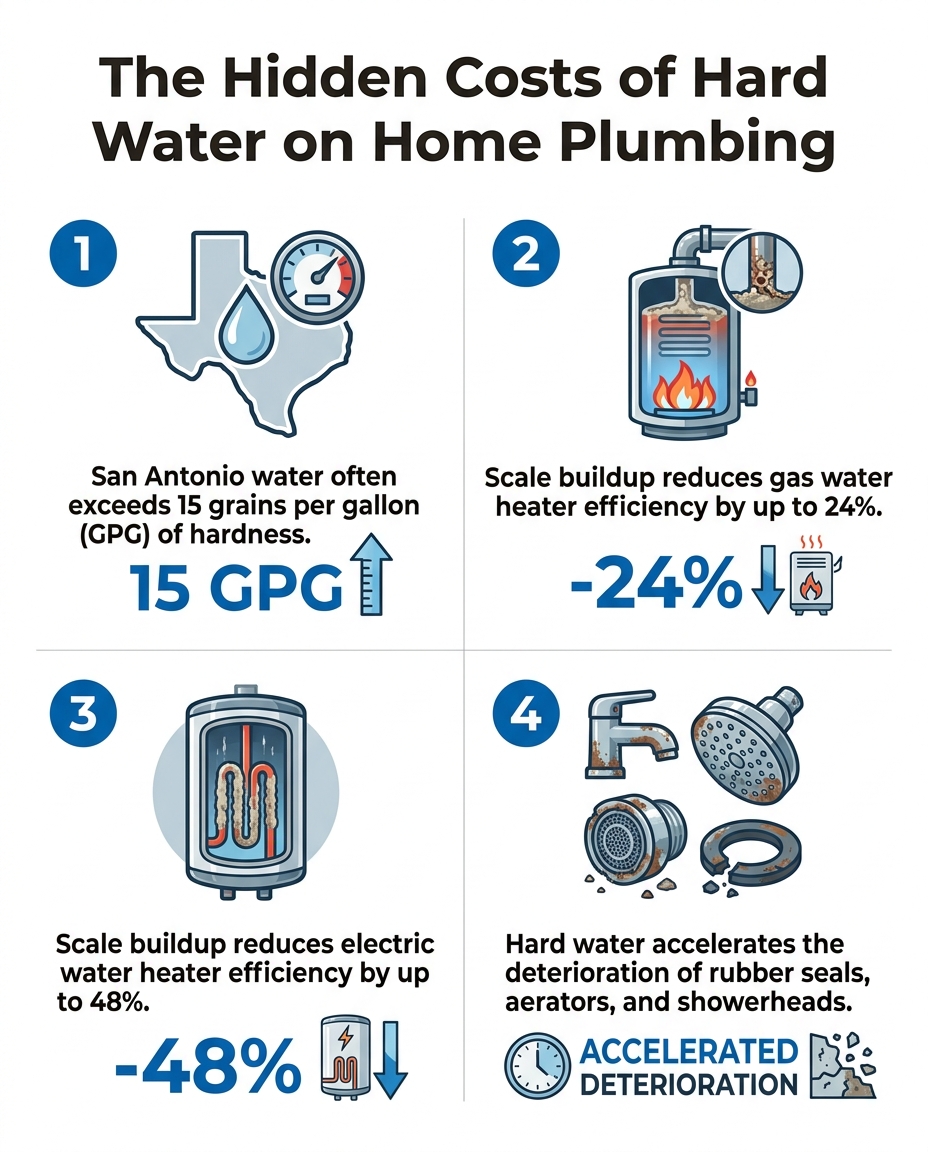
Understanding the Data: Water hardness is typically measured in grains per gallon (GPG) or milligrams per liter (mg/L). The San Antonio Water System (SAWS) consistently classifies the local supply as "very hard."
• Soft — Grains Per Gallon (GPG): 0 - 3.5 — Milligrams Per Liter (mg/L): 0 - 60
• Moderate — Grains Per Gallon (GPG): 3.5 - 7.0 — Milligrams Per Liter (mg/L): 61 - 120
• Hard — Grains Per Gallon (GPG): 7.0 - 10.5 — Milligrams Per Liter (mg/L): 121 - 180
• Very Hard (Local Average) — Grains Per Gallon (GPG): Over 10.5 (Often 15+) — Milligrams Per Liter (mg/L): Over 180 (Often 250+)
As long as the water is cold and flowing, these minerals stay dissolved. However, the moment the water is heated in an appliance, or left to evaporate on a surface, a chemical reaction occurs. The dissolved calcium and magnesium precipitate out of the water, crystallizing into the stubborn, rock-hard scale that wreaks havoc on your home.
Surface Damage: How Mineral Buildup Destroys Daily Fixtures
The most visible evidence of this geological phenomenon happens right at your sinks and showers. When you turn on a faucet, you expect a smooth, aerated stream of water. Instead, mineral scale disrupts the entire process, turning daily routines into a battle against low pressure and constant cleaning.
The damage extends far beyond the metal finishes. Inside your faucets, small rubber seals, O-rings, and gaskets are responsible for keeping water contained. Calcium and magnesium are highly abrasive. Every time you turn the handle, these microscopic mineral shards grind against the soft rubber components. Over time, this constant friction tears the seals apart, leading to the relentless drip-drip-drip of a failing faucet. When our local customers constantly need residential plumbing services just to fix leaky taps, our plumbers usually find that the underlying water quality is to blame.
Furthermore, hard water completely changes how cleaning products work. Instead of creating a rich lather, the calcium and magnesium react chemically with the fatty acids in soap. This reaction forms an insoluble precipitate known as soap scum. This sticky residue coats your tubs, shower doors, and even your skin, trapping dirt and requiring harsh chemical cleaners to remove. Cleaning these fixtures might make them look better temporarily, but as our plumbing experts will tell you, it does absolutely nothing to stop the ongoing mechanical wear happening inside the valves.
The Lifecycle of a Scaled Showerhead
In our experience walking through hundreds of local bathrooms, your showerhead is often the first casualty of untreated water. The progression of damage usually follows a predictable pattern:
• Erratic spray patterns: Scale begins to form around the tiny rubber nozzles. Instead of shooting straight down, water starts spraying sideways or at odd angles, making a mess of your bathroom.
• Progressive loss of water pressure: As the mineral deposits grow thicker inside the showerhead's internal chambers, they physically block the flow of water. You might assume your home's overall water pressure is dropping, but the restriction is entirely localized to the fixture.
• Eventual mechanical failure: The scale eventually hardens to the point where soaking the showerhead in descaling solutions no longer works. The internal threads seize up, the plastic components crack under the pressure of the expanding minerals, and the entire unit requires complete replacement.
The Silent Threat to Your Water Heater's Efficiency
While a ruined showerhead is annoying, our technicians know firsthand that the most expensive damage is happening inside your utility closet. Heating water acts as a catalyst for mineral precipitation. This means your water heater is effectively functioning as a giant scale-collection tank, pulling calcium and magnesium out of the water and trapping it inside.
The impact on efficiency is staggering. According to a comprehensive study by the Water Quality Association (WQA) and the Battelle Memorial Institute, scale buildup has a devastating effect on energy consumption. The study found that running hard water through a gas water heater can drop its efficiency by up to 24%. For electric water heaters, the numbers are even worse, with efficiency plummeting by up to 48% over the unit's lifespan.
When we flush or repair local systems, we see exactly how this failure happens. In a gas water heater, the burner sits at the bottom of the tank. As minerals precipitate, they sink and form a thick layer of rock across the bottom. This scale acts as a powerful insulator. The gas burner now has to heat the rock layer before it can heat the water, forcing the unit to run longer, hotter cycles. This excessive heat causes the metal tank to warp and stress, drastically increasing the risk of unexpected leaks, which means delaying a leaky water heater replacement becomes a dangerous gamble.
In an electric water heater, the heating elements are submerged directly in the water. The scale coats these elements in a thick, white crust. Because the element cannot transfer its heat to the water efficiently, it overheats inside its mineral shell and eventually burns out completely. As we enter the early fall pre-heating season, ambient temperatures drop, and the groundwater entering your home gets colder. This colder starting temperature forces a scaled-up, inefficient water heater to work even harder to reach your desired thermostat setting, pushing an already stressed system past its breaking point.
Timing Your Defense: Preparing for Peak Hot Water Demand
Understanding the seasonal shifts in your home's plumbing demands is critical for preventing catastrophic failures. As the sweltering heat fades and cooler weather arrives, household habits naturally change. People take longer, hotter showers to warm up in the mornings. Families spend more time indoors, leading to more frequent loads of laundry and heavier dishwasher usage. All of this translates to a massive spike in hot water demand.
Entering this heavy-usage season with a compromised, scale-filled water heater is a recipe for disaster. If your tank is already struggling to transfer heat through a layer of mineral rock in September, our service records show that the increased workload in November and December will likely push it to failure. The constant thermal expansion and contraction of an overheating tank weaken the metal, leading to sudden ruptures that can flood your garage or utility room.
This is why our team strongly recommends addressing water quality as an essential part of your fall home maintenance routine. Proactive infrastructure protection during the early fall pre-heating season ensures your system is clean, efficient, and ready to handle the winter workload. By stopping the scale before the heavy usage begins, you protect your appliances from the extreme stress that leads to mid-winter breakdowns.
Weighing Your Options: The Water Softening Decision Matrix
Once you recognize the hidden toll hard water takes on your home, the next step is determining how to fight back. In our experience consulting with homeowners, you generally face two paths: the status quo of endless descaling and reactive replacements, or the preventative approach of implementing whole-home water softener systems.
Whole-home softening relies on a proven scientific process called ion exchange. Instead of trying to filter out the dissolved rock—which is nearly impossible since the minerals are dissolved at a molecular level—a softener swaps them out. Inside the system's main tank are thousands of tiny resin beads charged with sodium or potassium ions. As the hard water flows through the tank, the calcium and magnesium ions are drawn to the resin beads like magnets. The beads grab the hard minerals and release a harmless sodium ion in exchange. The result is completely soft water flowing into your home's plumbing infrastructure.
We've found the long-term return on investment (ROI) for this technology is substantial. By physically removing the rock before it enters your pipes, you protect your water heater, dishwasher, and washing machine from premature failure. Your clothes last longer, your skin feels better, and your energy bills stabilize because your appliances are no longer fighting through layers of insulation.
Signs It's Time for a Whole-Home Solution
How do you know when it is time to call us for an upgrade? Look for these distinct patterns in your daily life:
• Constant chalky buildup despite regular cleaning: If you find yourself scrubbing white crust off your faucets weekly, the water is too hard for your fixtures to handle.
• Noticeable drops in hot water duration: If your showers are getting colder faster than they used to, your water heater is likely losing volume to scale buildup at the bottom of the tank.
• Dry skin and brittle hair after showering: The same soap scum that coats your glass shower doors also coats your skin and hair, blocking moisture and causing irritation.
• Frequent appliance repairs: If you are constantly replacing the heating elements in your dishwasher or the valves in your washing machine, the water quality is degrading the components.
Streamlining the Solution: Plumbing and Electrical Integration
Deciding to install whole-home water softener systems is a smart move for your property, but the installation process itself introduces a unique set of challenges. This is not a simple matter of cutting a pipe and gluing on a new appliance. Modern water treatment systems require a dedicated power source to operate their digital control valves and run their automatic regeneration cycles.
In many homes, the ideal location for the water softener—usually near where the main water line enters the house or in the garage—does not have an accessible electrical outlet nearby. This creates a common frustration for homeowners. We often hear stories of people hiring a plumber to install the system, only to be told they must pause the project and hire a separate licensed electrician to run new high-voltage wiring and install a dedicated receptacle.
Coordinating multiple contractors delays the project, increases costs, and adds unnecessary stress. Furthermore, attempting a DIY installation when both pressurized water lines and high-voltage electricity are involved is highly discouraged due to the severe safety risks and strict local building codes.
This is where our comprehensive expertise makes a difference. Because our Reliabee crew is fully licensed in Air, Electric, and Plumbing, you don't have to juggle multiple companies. We seamlessly handle both the complex plumbing integration and the necessary electrical wiring in a single, streamlined visit. The system is plumbed correctly, powered safely, and brought up to code without the hassle of coordinating separate tradesmen.
Frequently Asked Questions About Hard Water Damage
Does hard water damage pipes?
Yes, in our routine inspections, we see that hard water causes significant damage to pipes over time. As water flows through your plumbing, dissolved calcium and magnesium precipitate out and stick to the inner walls of the pipes. Over years of use, this scale buildup gradually narrows the pipe's diameter, severely restricting water flow and reducing water pressure throughout the entire house. In extreme cases, the restriction can cause pressure to build up behind the blockage, leading to stress on joints and potential leaks.
Can hard water ruin a water heater?
Hard water is one of the leading causes of premature water heater failure that our plumbers encounter. The heating process accelerates the separation of minerals from the water, causing thick layers of scale to accumulate at the bottom of gas tanks or coat the heating elements of electric models. This forces the unit to run longer cycles, overheat, and consume far more energy, ultimately causing the metal tank to weaken, crack, and leak long before its expected lifespan is reached.
How does hard water affect plumbing fixtures?
Mineral buildup destroys plumbing fixtures both cosmetically and mechanically. Cosmetically, it leaves stubborn white crusts and spots on metal finishes that are difficult to remove. Mechanically, the abrasive nature of calcium and magnesium tears apart the soft rubber O-rings, seals, and gaskets inside the faucet valves, leading to constant dripping. It also clogs aerators and showerhead nozzles, ruining the water pressure and spray patterns.
What are the signs of hard water in a house?
The most obvious signs we point out to homeowners include white, chalky residue around faucets and drains, and water spots on clean glassware straight out of the dishwasher. You will also notice that soap does not lather well, leaving a sticky soap scum on shower walls and causing dry, itchy skin after bathing. Stiff, faded laundry and appliances that consistently break down or lose efficiency are also strong indicators of high mineral content.
Is a whole home water softener worth it in San Antonio?
Given the specific geological makeup of our region, we always advise that a whole-home system is highly beneficial. The local municipal water is drawn from limestone aquifers, resulting in exceptionally high levels of calcium carbonate. A softening system physically removes these minerals before they enter your home, protecting your expensive plumbing infrastructure, extending the life of your water heater, and eliminating the daily frustration of scrubbing scale off surfaces.
How do you fix hard water damage in plumbing?
Fixing existing damage usually requires a combination of descaling and component replacement. Showerheads and aerators can sometimes be soaked in mild acids like vinegar to dissolve light scale, but heavily calcified internal valves and rubber seals must be completely replaced by a professional. To prevent the damage from immediately returning, the permanent fix is installing a whole-home water treatment system to remove the minerals at the source.
Protecting Your Home's Infrastructure Moving Forward
The impact of hard water on your home's plumbing fixtures is a continuous, silent process that degrades your daily comfort and threatens your major appliances. Treating your water quality is not merely a luxury upgrade; it is the ultimate form of preventative maintenance for your entire plumbing infrastructure. By addressing the root cause of the mineral buildup, you save your water heater, dishwashers, and faucets from early failure, especially as hot water demands peak in the cooler months.
Stop fighting a losing battle against chalky buildup and failing heating elements. Taking the time to understand your home's specific water profile allows you to make an informed decision that protects your property for decades to come. If you are tired of replacing fixtures and want to explore comprehensive whole-home solutions, our expert team at Reliabee Air Electric Plumbing is here to help. Reach out to discuss your water quality options or to schedule professional water heater repair and replacement to get your system back on track.

Ready to Transform Your Home?