Preparing Your Plumbing for the First Unexpected Freeze
Don't Wait for the Evening News: The Late September Freeze Warning
When the calendar turns to late September / early fall, Preparing Your Plumbing for the First Unexpected Freeze becomes the most important task on your home maintenance checklist. At Reliabee Air Electric Plumbing, we know firsthand that South Texas weather is notorious for masking sudden, sharp temperature drops behind mild, beautiful autumn days. It is easy to be lulled into a false sense of security when the afternoon high is still comfortable, but this region's weather patterns can shift drastically overnight.
Waiting until a freeze warning hits the local evening news guarantees a stressful rush to empty hardware store shelves. By the time the meteorologist points to a blue mass on the radar, your neighbors have already cleared out every foam pipe sleeve, faucet cover, and roll of weather-resistant tape in the county. We always advise taking proactive steps right now to secure the home and provide peace of mind long before the weather actually turns hostile. Understanding the specific vulnerabilities of your property is the first step to effective winterization, which is why securing comprehensive residential plumbing services before an emergency strikes is a vital part of seasonal preparation.
Being proactive rather than reactive means you are in control. You have the time to inspect your home carefully, identify hidden vulnerabilities, and apply the right protective measures without the panic of plummeting temperatures. Early preparation is not just about avoiding inconvenience; it is about protecting one of your most significant investments from sudden, catastrophic water damage.
Why South Texas Architecture Leaves Plumbing Vulnerable
Homes in this region are optimized for extreme summer heat, not prolonged hard freezes. The architectural focus in San Antonio residential homes has historically been on keeping interiors cool, which means builders prioritize ventilation, radiant barriers, and air conditioning efficiency over heavy thermal insulation in exterior walls. Because deep, prolonged freezes were historically rare, the local building codes do not require the deep frost lines standard in northern climates.
Shallow pipe routing is a prime example of this vulnerability. In our years of servicing local neighborhoods, our plumbers consistently find water lines buried only slightly below the surface or run through uninsulated attic spaces and exterior walls. This lack of heavy wall insulation means cold air penetrates plumbing lines much faster than it would in a home built for a northern winter. When the ambient temperature drops, the structural buffer between your pipes and the freezing air is dangerously thin.
Exposed exterior hose bibs and irrigation lines are almost always the first points of failure during a sudden drop. These fixtures protrude directly into the elements, acting as thermal bridges that pull freezing temperatures straight into your home's interior plumbing network. Furthermore, wind chill can accelerate the freezing process in exposed plumbing, even when ambient temperatures are slightly above 20 degrees Fahrenheit. A strong northern wind strips away the microscopic layer of ambient heat surrounding your pipes, causing the water inside to freeze much faster than the thermometer might suggest.
The Physics of Frozen Pipes: The 9 Percent Expansion Rule
To understand why a sudden freeze is so destructive to San Antonio residential homes, you have to look at the basic physics of water. Water is one of the few substances on earth that expands when it transitions from a liquid to a solid. Specifically, water expands by approximately 9 percent when it freezes. This expansion exerts immense, localized pressure on both metal and plastic pipes, pushing outward with thousands of pounds of force per square inch.
However, the actual bursting of the pipe is rarely caused by the ice expanding directly outward. Instead, as the ice blockage forms and expands, it pushes the remaining liquid water toward closed faucets. Because water cannot be compressed, this trapped liquid acts like a hydraulic ram, building up incredible pressure between the ice blockage and your closed tap. Eventually, the pipe material simply gives way. When this happens, you will likely need emergency plumbing repairs the moment the system thaws and water begins pouring through the breach—a scenario our dispatchers field dozens of calls for after every hard freeze.
• Copper — Freeze Vulnerability: High — Typical Failure Mode: Splits along the seam or bursts at soldered joints under pressure.
• CPVC / PVC — Freeze Vulnerability: High — Typical Failure Mode: Becomes brittle in freezing temperatures and shatters or cracks.
• PEX — Freeze Vulnerability: Moderate — Typical Failure Mode: Can expand slightly to accommodate freezing, but fittings and joints remain highly vulnerable to blowouts.
• Galvanized Steel — Freeze Vulnerability: Moderate to High — Typical Failure Mode: Corroded interior walls create friction points for ice; bursts at threaded joints.
Even a short overnight freeze can cause unseen micro-fractures in your plumbing. You might survive a cold snap without a major blowout, only for those weakened pipes to burst weeks later under normal water pressure. Understanding this immense pressure underscores exactly why exterior insulation is non-negotiable for local homeowners.
Your Early Fall Exterior Plumbing Checklist
Taking action in late September / early fall is the safest, most effective way to protect your property. While complex winterization should be left to professionals, there are several safe, basic DIY steps every homeowner should complete before the temperatures begin their downward slide.
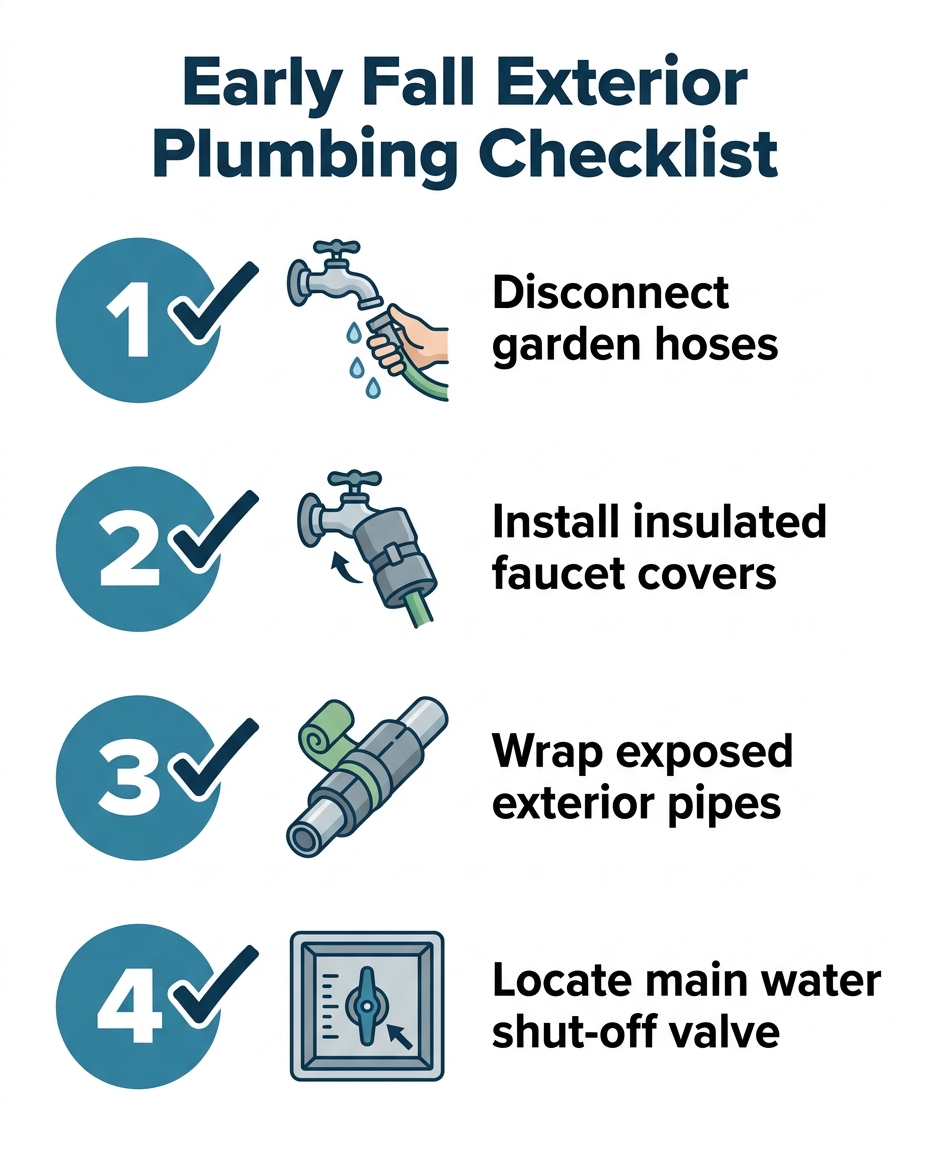
• Disconnect and drain garden hoses: Leaving a hose connected is one of the most common winterization mistakes our team sees in San Antonio. A connected hose traps water inside the exterior faucet. When that water freezes, the ice travels backward into the pipe inside your wall. Disconnect, drain, and store all hoses in a garage or shed.
• Install insulated faucet covers: Once the hoses are removed, cap every exposed exterior hose bib with an insulated dome cover. These inexpensive foam or hard-plastic covers trap the ambient heat radiating from your home's interior, creating a micro-climate that prevents the bib from freezing.
• Wrap accessible exterior pipes: Any exposed pipes—such as those near your water meter, pool equipment, or irrigation backflow preventer—must be wrapped. Use high-quality foam insulation tubing and secure it tightly with weather-resistant tape. Do not leave any gaps at the corners or joints where cold air can penetrate.
• Locate and test the main water shut-off valve: In the event of a burst pipe, every second counts. Locate your main water shut-off valve now. Clear away any dirt, debris, or overgrown landscaping, and ensure the valve turns easily. If it is stuck or corroded, you have time to have it professionally replaced before an emergency strikes.
Inspecting Essential Utilities Before the Cold Snaps
While exterior pipes are the most obvious victims of a sudden freeze, they are not the only systems at risk. Sudden cold forces water heaters to work significantly harder to maintain temperatures, especially when located in uninsulated garages or utility spaces common in late September / early fall preparations. As the ambient air temperature in your garage plummets, the water heater loses standby heat rapidly, forcing the burner or heating elements to run almost continuously.
Flushing the tank to remove insulating sediment buildup and checking the pressure relief valve ensures the system can handle the upcoming winter demand efficiently. Routine water heater maintenance prevents the system from failing just when you need a hot shower the most. When a water heater fails during a freeze, the water inside the tank and the surrounding supply lines becomes highly susceptible to freezing and bursting, turning a simple appliance failure into a major flood.
Securing Your Heating Fuel Sources
Cold weather naturally means an increased reliance on gas-powered heating systems. Ensuring the gas lines connected to your furnace, water heater, and other heating appliances are secure and fully inspected is critical before the first heavy use of the season. Professional maintenance is always safer than DIY when dealing with combustible utilities and pressurized tanks. Professional inspections identify microscopic leaks, corrosion, or pressure issues before they become dangerous, ensuring your home stays warm safely throughout the coldest nights.
Cascading Winter Emergencies: When Cold Strains Every System
A sudden hard freeze in San Antonio residential homes rarely isolates its damage to just one system. Instead, it pushes heating, electrical, and plumbing systems to their absolute limits simultaneously. When temperatures drop into the teens, heating systems run nonstop. If the electrical grid falters or a breaker trips under the heavy load, the home loses heat. Without heat, the interior pipes are suddenly exposed to freezing temperatures, leading to burst pipes and severe water damage.
Simultaneous failures—such as a burst pipe coupled with a failing furnace—require comprehensive expertise. Having a single, multi-trade provider capable of handling HVAC, electrical, and plumbing ensures that complex, overlapping winter emergencies are resolved safely and efficiently without the homeowner needing to call three different contractors. You need a team that can restore the power, fix the furnace, and repair the burst pipe all in one coordinated effort.
Clear communication is essential during these high-stress situations. During a previous winter cold snap, our team at Reliabee Air Electric Plumbing helped a local customer who experienced a sudden heating system failure just as the temperatures plummeted. Our technician arrived promptly, explained the heating issue in simple terms, and ensured the job was done right. This kind of transparent, caring service is exactly what we believe homeowners need when cascading emergencies threaten their property and comfort.
Frequently Asked Questions About Texas Freeze Preparation
Before diving into our most common questions, it is important to remember that proactive safety checks, including professional gas line inspections, are a crucial part of preparing San Antonio residential homes for the winter season. Here are the answers to the questions our technicians hear most often as the weather begins to change.
At what temperature do pipes freeze in Texas?
Pipes typically freeze when the ambient temperature drops to 20 degrees Fahrenheit or lower for at least six consecutive hours. However, in South Texas, exposed exterior pipes and elevated homes can experience freezing at slightly higher temperatures due to wind chill stripping away ambient heat. Wind can rapidly accelerate the freezing process on uninsulated exterior hose bibs.
How do you prepare outside pipes for a freeze?
Preparing outside pipes requires creating a thermal barrier between the water in the pipe and the cold air. You should wrap all exposed pipes in thick foam insulation sleeves, making sure to tape the seams so no cold air can penetrate. Additionally, install hard plastic or foam dome covers over all exterior hose bibs after disconnecting any attached garden hoses.
Should I drip faucets during a hard freeze?
Yes, dripping your faucets during a hard freeze is a highly effective way to prevent burst pipes. Allowing a slow, steady drip relieves the immense hydraulic pressure that builds up inside the plumbing lines when ice begins to form. You should drip the faucets located on the exterior walls of your home, using both the hot and cold handles to keep water moving through all lines.
Where is my main water shut-off valve?
Your main water shut-off valve is typically located in one of two places: near the street inside a covered utility box (often requiring a special meter key to turn), or attached to the exterior wall of your home where the primary water line enters the foundation. It is vital to locate this valve and test it before a freeze so you can quickly shut off the water if a pipe bursts.
Why is late September the best time to winterize exterior plumbing?
Late September is the ideal time because it allows you to secure supplies and complete the work before the first unpredictable cold snap hits. Once a freeze warning is announced on the evening news, local hardware stores quickly sell out of pipe insulation and faucet covers. Prepping in early fall guarantees you have the materials and the time to protect your home properly without panic.
Secure Your Home's Plumbing Before the Temperature Drops
Taking action in late September / early fall prevents severe structural damage and avoids the immense stress of emergency repairs in the dead of winter. By insulating your exterior pipes, disconnecting hoses, and locating your shut-off valve now, you are securing your home against the unpredictable nature of South Texas weather. Professional inspections provide an added layer of security for complex utility lines and overlapping systems. Do not wait for the evening news to tell you a freeze is coming—schedule your comprehensive winterization check today and enjoy the peace of mind that comes with being fully prepared.

Ready to Transform Your Home?