Comparing Tankless vs Traditional Water Heaters for Large Families
Is Your Current Water Heater Keeping Up with the Morning Rush?
When you are comparing tankless vs traditional water heaters for large families, the most pressing question is usually whether your current setup can actually handle the morning demand. If you live in a busy household, you already know the frustration of the September back-to-school morning rushes. Multiple family members need to get ready simultaneously, the dishwasher is running from breakfast, and a load of laundry is starting—all drawing from the exact same finite supply of hot water. By the time the third person steps into the shower, the water is lukewarm at best.
If you are tired of scheduling your family's hygiene around your appliance cycles, our residential plumbing services and comprehensive installation solutions can help restore balance to your daily routine. However, fixing this bottleneck requires more than just picking a new unit out of a catalog.
Choosing between the endless supply of a tankless unit and the simpler installation of a traditional storage tank is a major structural decision for your home. It requires evaluating not just your daily lifestyle benefits, but the underlying infrastructure hidden behind your walls. Upgrading your hot water capacity means looking closely at your home's gas lines, electrical panel, and ventilation systems to see what they can safely support.
To make an informed decision, you have to weigh the immediate comfort of continuous hot water against the reality of what it takes to install these advanced systems in an existing home. Here is a balanced look at how both approaches function under heavy daily use.
The Continuous Hot Water Advantage: How Tankless Performs Under Pressure
For households that frequently run out of hot water, tankless systems offer a compelling solution. Instead of keeping a large reservoir of water heated 24/7, these units flash-heat water on demand as it flows through a heat exchanger. When properly sized for your home, this means the hot water simply never runs out, no matter how many September back-to-school morning rushes your family endures.
Understanding how these systems handle heavy demand requires looking at a few specific operational factors:
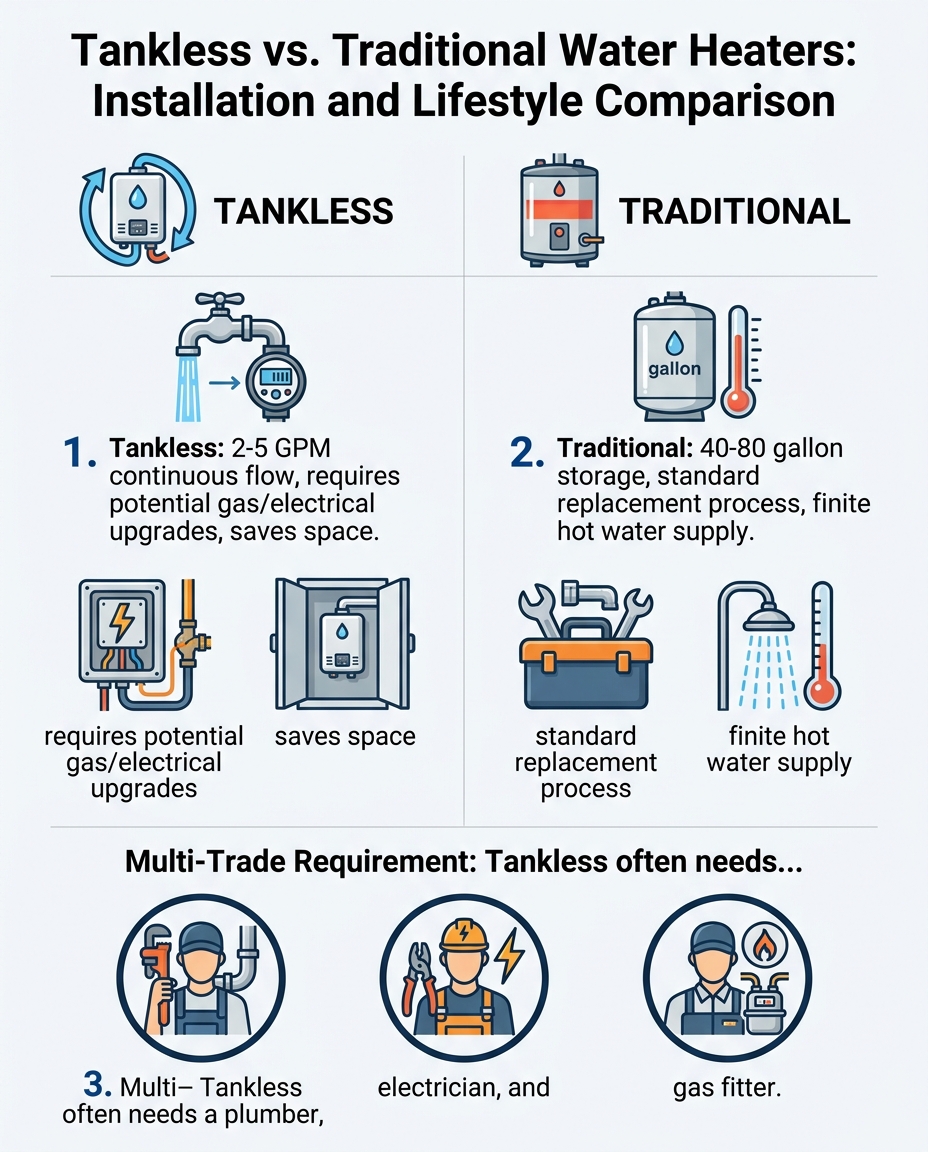
1. On-Demand Flow Rates: Tankless water heaters typically provide hot water at a rate of 2 to 5 gallons per minute (GPM). When multiple fixtures are open at once, the system divides this flow among them. Sizing the unit correctly ensures that running a shower (which uses about 2 GPM) and a kitchen sink simultaneously won't cause a drop in water pressure or temperature.
2. The Role of Temperature Rise (Delta T): A water heater's capacity is heavily influenced by the temperature of the incoming city water. Because San Antonio's warmer average groundwater temperatures are generally higher than those in northern climates, the system requires a lower temperature rise (Delta T) to reach a comfortable 105°F for a shower. This means a tankless unit in our region doesn't have to work as hard, allowing it to deliver better continuous output capacity and handle more simultaneous fixtures than the exact same unit installed up north.
3. Space-Saving Physical Footprint: Traditional tanks take up significant floor space in a garage, utility closet, or attic. Tankless units are compact and wall-mounted, freeing up valuable square footage for storage or other appliances. This smaller footprint is especially beneficial in homes where utility space is tight.
4. Efficiency Incentives: Because they eliminate standby heat loss (the energy wasted keeping a tank hot while you sleep or work), these systems are highly efficient. General federal tax credits and local utility rebates may apply to qualifying high-efficiency water heater installation and replacement projects, helping to offset the initial investment.
While the operational benefits are clear, achieving this level of continuous performance requires a robust energy supply. That brings us to the most critical factor in the upgrade process: your home's existing infrastructure.
Structural Realities: Why Older Homes Demand Upgrades
A common misconception is that switching to a tankless system is a simple one-for-one swap. You pull the old tank out, hang the new box on the wall, and connect the pipes. In reality, high-capacity tankless units draw significantly more instantaneous energy than a traditional tank, which means older homes frequently require structural modifications to support them safely.
Consider the gas requirements. A standard 50-gallon gas water heater typically uses a burner rated for around 40,000 BTUs. A high-efficiency gas tankless unit, which must heat water instantly as it rushes past the heat exchanger, can require up to 199,000 BTUs. In older San Antonio neighborhoods with standard gas lines, the existing half-inch pipe simply cannot deliver that volume of fuel safely. Upgrading to a tankless system often necessitates gas line upgrades, which involves running a new, wider (usually three-quarter-inch) dedicated gas line from the meter directly to the unit.
Venting is another major consideration. High-efficiency condensing tankless units use PVC piping to vent exhaust gases horizontally through a side wall, whereas older traditional tanks usually draft vertically through a metal flue in the roof. Rerouting this ventilation requires careful planning to ensure exhaust safely clears the home's exterior windows and doors.
Electrical Panel Considerations
Even if you are installing a gas-powered tankless unit, it still requires electricity to power the internal computer board, sensors, and electronic ignition. Many older traditional gas tanks use a standing pilot light and require no electricity at all. If there isn't a dedicated 120V outlet near the installation site, one must be added.
If you are considering a fully electric tankless unit for a large family, the electrical demands are massive. These units often require three or four dedicated 40-amp breakers to operate. Older electrical panels—especially those installed before the 1990s—frequently lack the total amperage capacity to handle this new load alongside your HVAC system and major appliances. Upgrading the main panel ensures safe, code-compliant operation without constantly tripping breakers during peak usage times.
The Traditional Tank Approach: Simplicity in Replacement
Given the structural demands of a tankless conversion, it is important to evaluate the merits of sticking with a traditional storage tank. These systems keep 40 to 80 gallons of water hot continuously, ready for immediate use. While they do have a finite capacity, modern traditional tanks have evolved significantly in terms of insulation and recovery speed.
The primary advantage of a traditional tank is the straightforward nature of the replacement process. If your home is already set up for a 50-gallon gas tank, replacing it with a similar modern unit usually avoids the need for new gas lines, complex venting reroutes, or extensive electrical modifications. The footprint is the same, the fuel delivery is the same, and the installation can often be completed in a few hours rather than a few days.
High-Recovery Options: If your main concern is surviving the September back-to-school morning rushes, a high-recovery traditional tank might bridge the gap. These units feature more powerful burners that heat replacement water much faster than standard models. While they don't offer the truly endless supply of a tankless unit, a properly sized high-recovery tank can often keep up with back-to-back showers for a large family without requiring a total overhaul of the home's infrastructure.
The Trade-Off: The decision here comes down to weighing the lower initial installation complexity against the eventual limit of the tank's capacity. A traditional tank will always have a ceiling on how much hot water it can provide at once. Furthermore, traditional tanks are more susceptible to hard water sediment buildup over time, which can reduce their internal volume and efficiency if not flushed annually.
Side-by-Side Comparison: Lifestyle Benefits vs. Installation Needs
To help clarify the decision-making process, here is a direct comparison of how these two approaches stack up against each other. Keep in mind that homes in older San Antonio neighborhoods with standard gas lines will lean heavily on the "Structural Upgrades" column when making a choice.
• Hot Water Availability — Tankless Water Heater: Endless supply; heats on demand as water flows. — Traditional Storage Tank: Finite supply based on tank size (40-80 gallons).
• Installation Complexity — Tankless Water Heater: High. Often requires new venting, gas, and electrical work. — Traditional Storage Tank: Low. Typically a direct swap with existing connections.
• Structural Upgrades — Tankless Water Heater: Frequently requires larger gas lines and dedicated circuits. — Traditional Storage Tank: Rarely requires modifications unless changing fuel types.
• Space Requirements — Tankless Water Heater: Minimal. Compact, wall-mounted footprint. — Traditional Storage Tank: Significant. Requires dedicated floor space and clearance.
• Lifespan & Maintenance — Tankless Water Heater: 15-20 years. Requires annual descaling to protect sensors. — Traditional Storage Tank: 8-12 years. Requires annual flushing to remove sediment.
• Best Fit For... — Tankless Water Heater: Large families needing continuous hot water and willing to upgrade home infrastructure. — Traditional Storage Tank: Households looking for a straightforward, fast replacement with reliable standard capacity.
Reviewing these factors helps clarify whether your priority is maximizing daily comfort or minimizing the scope of the installation project.
The Multi-Trade Coordination Challenge
If you decide that the endless hot water of a tankless system is the right choice for your family, you will immediately face a logistical hurdle: the multi-trade requirement. Because a tankless conversion in older San Antonio neighborhoods with standard gas lines almost always involves altering plumbing, gas, and electrical systems, it typically requires expertise across multiple distinct trades.
The scheduling nightmare: Hiring separate contractors for a single home upgrade is notoriously frustrating. You might have a plumber successfully mount the unit and connect the water lines on a Monday, but if the electrician can't arrive to wire the dedicated circuit until Thursday, your family is left without hot water for three days. Misaligned schedules, delayed permits, and communication breakdowns between different companies can turn a straightforward upgrade into a prolonged disruption of your household routine.
The streamlined solution: This is where comprehensive service makes a massive difference. Since Reliabee provides Air, Electric, and Plumbing services under one roof, our teams can seamlessly handle the plumbing installation, the necessary gas line up-sizing, and the electrical panel modifications required for a tankless conversion in a single, coordinated visit. Having all the necessary modifications handled by one unified team minimizes downtime, ensures all work meets local codes simultaneously, and gets your family's hot water turned back on as quickly as possible.
Overcoming the Initial Upgrade Barrier
It is important to acknowledge that the combination of a premium tankless unit, plus the necessary gas and electrical upgrades, represents a significant initial investment. The upfront commitment is undeniably higher than simply swapping out an old storage tank for a new one.
However, for busy households, the long-term benefits often justify this initial barrier. Never running out of hot water, reclaiming garage space, and enjoying higher energy efficiency provide daily returns on that investment. The key is ensuring that the upfront costs don't prevent your family from getting the system that actually meets your long-term needs.
To make comprehensive installations more accessible, we offer flexible payment solutions that break the total project into manageable monthly amounts. Exploring our lease-to-own financing options can help you cover the cost of the unit, the gas line upgrades, and the electrical modifications without draining your savings all at once. We encourage homeowners to explore all available avenues, including general utility rebates, to ensure they aren't forced to settle for a system that will leave them taking cold showers again next year.
Make the Right Choice: Comparing Tankless vs Traditional Water Heaters for Large Families
Ultimately, comparing tankless vs traditional water heaters for large families comes down to balancing your desire for continuous hot water with your home's current structural readiness. If you are exhausted by the September back-to-school morning rushes and have a home that can accommodate (or be easily upgraded to support) higher gas and electrical loads, a tankless system is a transformative upgrade. If you prefer a simpler, faster installation and can manage your family's usage schedule, a high-capacity traditional tank remains a highly reliable choice.
Because every home's infrastructure is different, the best next step is a professional assessment. A licensed technician can evaluate your current gas meter capacity, inspect your electrical panel, and provide a clear, realistic plan for what an upgrade would actually entail for your specific property. Schedule an evaluation today to get the answers you need and ensure your family enjoys reliable, consistent hot water all year long.
Frequently Asked Questions
Is a tankless water heater good for a large family?
Yes, they are excellent for large families because they heat water on demand, meaning the supply never runs out. As long as the unit is sized correctly for your home's peak flow rate, it can comfortably support back-to-back showers, laundry, and dishwashing without the risk of a cold shower.
Can a tankless water heater run two showers at once?
Absolutely, provided the unit has a high enough Gallons Per Minute (GPM) rating. A typical shower uses about 2 GPM, so a tankless water heater rated for 5 GPM or higher can easily handle two simultaneous showers, especially in warmer climates where the incoming groundwater doesn't require drastic heating.
What structural upgrades are needed for a tankless water heater?
Converting from a traditional tank to a tankless system often requires up-sizing the gas line to handle higher BTU demands. It may also require installing dedicated electrical circuits to power the unit's computer board, as well as rerouting the ventilation pipes to safely exhaust gases through a side wall.
What size traditional water heater do I need for a family of 6?
For a family of six, a traditional storage tank should generally hold between 65 and 80 gallons to handle peak morning usage. Alternatively, a 50-gallon high-recovery tank with a powerful burner might suffice, as it can replenish the hot water supply much faster than a standard model.
What are the downsides of switching to a tankless water heater?
The primary downside is the higher initial installation complexity and upfront commitment, as older homes frequently require gas and electrical modifications. Additionally, tankless units require strict annual maintenance, including a vinegar flush to remove scale buildup, to keep the internal sensors and heat exchanger functioning properly.

Ready to Transform Your Home?