Why We Inspect Ductwork for Pests Before Starting the Furnace
The Hidden Hazard Above: Preparing Your System for the First Fall Chill
If you notice a strange, ammonia-like odor drifting from your vents on the first cold night of the year, it perfectly illustrates exactly why we inspect ductwork for pests before starting the furnace. At Reliabee Air Electric Plumbing, our team has spent years serving San Antonio homeowners, and a pattern we see often is that when evening temperatures finally begin to drop, local rodents seek refuge in the warmest, most insulated parts of your home. The attic, specifically the sprawling network of flexible air ducts, becomes prime real estate for nesting. Before you switch your thermostat from cooling to heating mode, it is absolutely critical to verify that your air distribution system hasn't been compromised. For comprehensive protection, scheduling professional heating system services ensures your indoor air quality remains safe during this vital seasonal transition.
The Shift from Summer Cooling to Fall Heating
During the long, hot months, your furnace sits dormant. While the air conditioner handles the cooling load, the heating components and certain sections of ductwork may remain relatively undisturbed. This quiet, dark environment creates a false sense of security. Homeowners often treat the transition to fall heating as a simple flick of a switch on the thermostat. However, in our experience, this transition is one of the most critical periods for home maintenance. The system is shifting operations, engaging different mechanical parts, and pushing air across heat exchangers that haven't been active since last winter.
Why Sanitary Checks Are Just as Important as Mechanical Checks
Most pre-season maintenance focuses heavily on mechanical readiness—checking the ignitor, testing the blower motor, and calibrating the thermostat. While these are essential, our technicians typically find that the sanitary condition of the air distribution system is often overlooked. A pre-heating season inspection serves as a critical sanitary and safety safeguard. Firing up a compromised furnace without verifying the integrity of the ductwork can turn a minor pest intrusion into a severe, whole-home contamination event.
• Primary Goal — Mechanical Readiness: Ensure efficient, reliable heating operation. — Sanitary Readiness (Pest Inspection): Prevent airborne biological contaminants.
• Key Components — Mechanical Readiness: Heat exchanger, blower motor, gas valve. — Sanitary Readiness (Pest Inspection): Plenum box, flexible ductwork, return vents.
• Consequence of Neglect — Mechanical Readiness: System breakdowns, poor energy efficiency. — Sanitary Readiness (Pest Inspection): Foul odors, spread of pathogens, fire hazards.
Why Pests Target Attic Ductwork During the September Temperature Drop
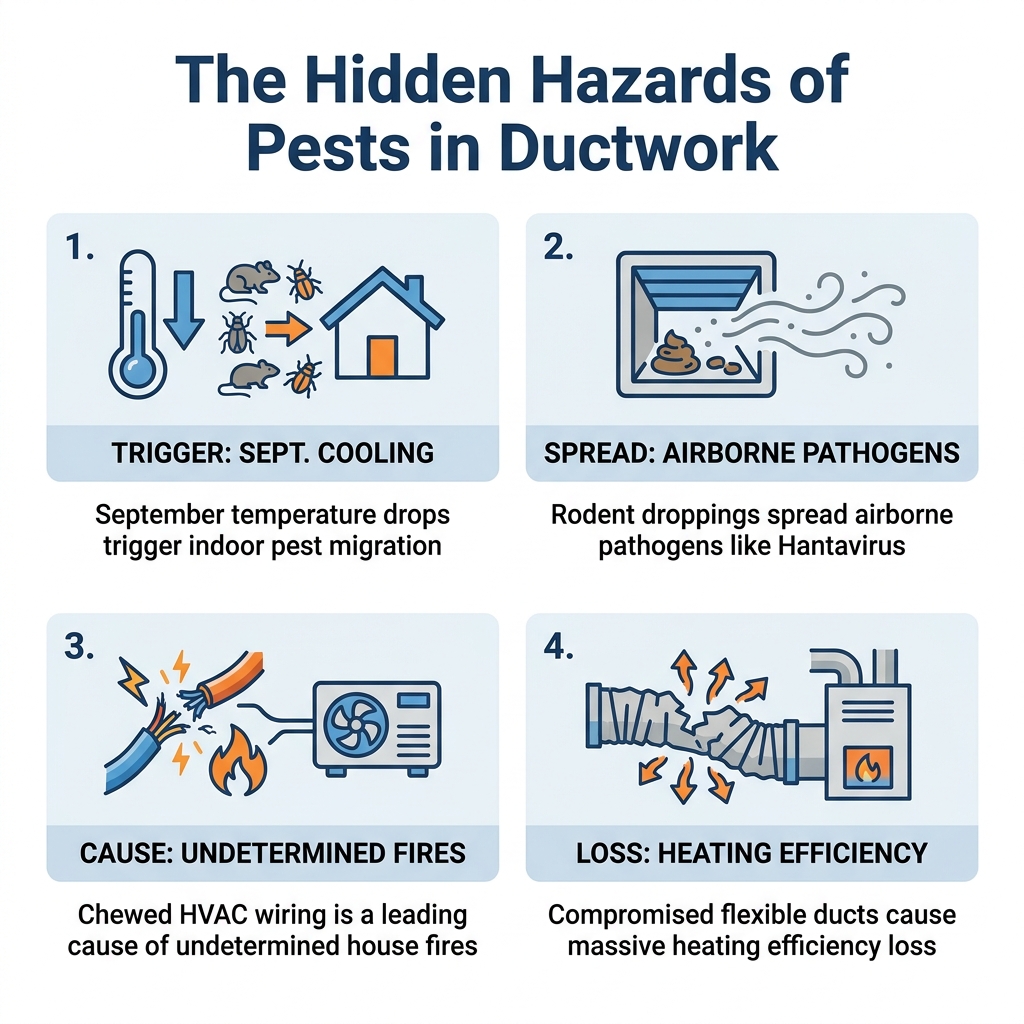
The biological drivers behind pest migration are heavily influenced by seasonal weather patterns. In San Antonio, the climate allows pests to remain active year-round, but a distinct shift occurs during the September early fall temperature drop. As evening temperatures begin to cool, roof rats, mice, and other local pests instinctively seek out warm, insulated shelters to survive the upcoming winter months. Your attic provides the perfect sanctuary, shielded from predators and the elements.
The Appeal of Flexible Ductwork
Attic spaces are inherently attractive to rodents, but the flexible materials used in modern HVAC ductwork are the ultimate prize. A standard flexible air duct consists of an inner wire-reinforced core, a thick layer of fiberglass insulation, and an outer vapor barrier. For a rodent, this is a ready-made home.
• Nesting materials: Rodents easily tear through the thin outer foil or plastic jacket to harvest the soft fiberglass insulation for their nests.
• Radiant warmth: Even when the furnace isn't running constantly, the ductwork often retains ambient heat from the home below, providing a cozy microclimate.
• Concealed pathways: The sprawling layout of attic ducts gives pests a hidden highway system to travel across the footprint of your home undetected.
The Timeline of Intrusion
The most dangerous aspect of these pest intrusions is the timeline. We frequently notice that the damage occurs weeks or even months before the homeowner actually turns on the heat. A family of mice might move into the ductwork during the first mild cold front in September. By the time a hard freeze hits in late November and the furnace is finally engaged, the pests have had ample time to breed, leave droppings, and tear through critical airflow barriers. Pests can exploit even minor vulnerabilities, such as unsealed joints, loose tape, or slightly disconnected collars, to gain entry into the main air stream.
The Immediate Indoor Air Quality Consequences of a Compromised Startup
Turning on a furnace when pests have infiltrated the ducts carries severe health and respiratory risks. The consequences are immediate, affecting every room connected to the central air system.
The Danger of the "First Start"
When you switch the thermostat to "heat" for the first time, the furnace ignites and the blower motor kicks on, generating high static pressure inside the ductwork. If rodents have been living inside the vents, this sudden rush of forced air acts as a delivery mechanism. It instantly distributes pest dander, dried droppings, nested debris, and microscopic urine particles throughout the home. Instead of breathing clean, conditioned air, the household is exposed to a concentrated blast of biological contaminants.
Airborne Pathogens and CDC Warnings
The Centers for Disease Control and Prevention (CDC) continuously warns about the dangers of aerosolized rodent droppings. When dried rodent waste is disturbed by high-velocity airflow, it breaks down into microscopic particles that can be easily inhaled.
• Hantavirus Pulmonary Syndrome (HPS): A severe, sometimes fatal respiratory disease transmitted by infected rodents through urine, droppings, or saliva.
• Salmonellosis: Bacterial infections that can be spread when rodent waste contaminates airborne dust that settles on food preparation surfaces.
• Allergic reactions: High concentrations of pest dander and shed fur can trigger severe asthma attacks and upper respiratory distress, particularly in children and the elderly.
Heat Exacerbates Odors
Beyond the invisible pathogens, the sudden introduction of heat creates an immediate olfactory nightmare. Warm air flowing over biological contaminants or deceased pests trapped inside the vents intensifies the odors of decay and ammonia. What might have been a faint, unnoticeable smell during the summer cooling season suddenly becomes an overwhelming stench that permeates the entire house. At Reliabee Air Electric Plumbing, our comprehensive approach goes beyond basic mechanical maintenance; our technicians prioritize whole-home safety and indoor air quality by identifying these hidden pest damages before they can pollute your home's environment.
Beyond Air Quality: Electrical Fire Hazards and Chewed Ductwork
While indoor air quality is an immediate health concern, the physical and structural dangers pests pose to the HVAC system are equally severe. Rodents possess continuously growing incisors, which forces them to constantly gnaw on hard materials to file their teeth down. Unfortunately, the components surrounding your HVAC system provide the perfect chewing resistance.
The Risk of Undetermined House Fires
Rodents frequently chew on the electrical wiring within the HVAC unit and the surrounding attic space. They will gnaw through the protective insulation of low-voltage thermostat wires, safety switch connections, and even high-voltage power lines supplying the furnace. According to data from the National Fire Protection Association (NFPA), rodent-chewed wiring is a leading cause of undetermined house fires. When wires are stripped bare, they can easily short circuit. If this occurs near dry nesting materials or exposed fiberglass paper, a spark can quickly ignite a devastating attic fire.
Structural Damage and Massive Heat Loss
Pests do not gently enter ductwork; they tear through it. They rip open flexible ductwork and chew through the rigid insulation of plenum boxes to harvest nesting materials. When the structural integrity of the duct is compromised, the system suffers massive heat loss. Instead of pushing warm air into your living room, the furnace pumps heated air directly into the uninsulated attic.
This forces the furnace to run continuously, attempting to satisfy the thermostat while fighting a losing battle against the cold air in the attic. In one real-world instance during a San Antonio winter cold snap, our Reliabee technicians responded to a home experiencing exactly this kind of catastrophic heat loss. Upon inspecting the attic, we discovered severe pest damage that required the complete replacement of a flexible duct and a plenum box. The system was overworking itself to the point of failure simply because the delivery system had been destroyed by rodents. To prevent this, routine home performance and ductwork inspections are essential for verifying that your heated air is actually reaching your living spaces.
Identifying the Warning Signs Before Turning On the Heat
Educating yourself on how to recognize potential pest issues in your ductwork is the best defense before switching the thermostat to heating mode. Because ductwork is largely hidden behind walls, ceilings, and in the attic, you must rely on secondary clues to identify an intrusion.
Olfactory and Auditory Clues
Your senses of smell and hearing are often the first to detect a problem. Do not ignore these subtle changes in your home's environment during the early fall.
• Ammonia-like smells: A strong, sharp scent resembling ammonia near vent registers is a classic indicator of rodent urine accumulating inside the ductwork.
• Odors of decay: If a pest has died inside the system, you will notice a distinct, foul odor of decay that becomes significantly worse when the blower motor runs.
• Scratching or scurrying noises: During the quiet nighttime hours, listen closely to your ceiling and wall vents. Scratching, scurrying, or light thumping sounds originating from the ductwork indicate active pests moving through the system.
Visual Indicators and System Performance
While you may not see the pests themselves, they leave behind undeniable visual evidence and impact the physical performance of your HVAC system.
• Visible droppings: Finding small, dark, pellet-like droppings around the edges of floor registers or inside the return air grill is a guaranteed sign of a breach.
• Chewed materials: If you safely inspect the visible portions of your attic and find shredded foil, scattered yellow or pink fiberglass, or gnawed wood near the HVAC equipment, pests are present.
• Sudden reductions in airflow: If one room suddenly feels colder than the rest of the house, or if the air pressure coming from a specific register drops noticeably, a chewed or collapsed duct may be the culprit. Understanding the impact of clogged air ducts on your system can help you differentiate between a simple dirty filter and a severe structural breach caused by pests.
What a Professional Pre-Season Duct Inspection Entails
A professional pre-season duct inspection goes far beyond simply looking at the equipment. It is a comprehensive evaluation of the system's structural integrity and sanitary conditions, designed to catch hidden hazards before they cause harm.
The Step-by-Step Evaluation Process
When our qualified Reliabee technicians evaluate your home for the fall heating season, we follow a rigorous protocol to ensure the entire air distribution network is safe to operate.
1. Visual Inspection of the Attic Space: We begin by examining the external condition of the ductwork. We look for sagging lines, torn outer jackets, and scattered insulation. Special attention is paid to the plenum box (the main distribution hub attached to the furnace), as this is a common target for nesting rodents.
2. Internal Camera Inspections: Because you cannot see inside a 20-foot run of flexible ductwork from the outside, our professionals use specialized inspection cameras (borescopes). These cameras are snaked through the vents to check deep inside the ductwork for blockages, nested debris, deceased pests, and accumulated droppings.
3. Electrical Component Evaluation: The technician carefully inspects the wiring harnesses, control boards, and low-voltage lines connected to the furnace. We look for any signs of gnawing, exposed copper, or frayed insulation that could present a fire hazard when the system is energized.
4. Documentation and Clearance: If damage is found, we document the extent of the contamination and structural failure. We will then determine whether the system is safe to operate or if remediation is required before the heat can be turned on. Enrolling in a seasonal HVAC maintenance plan ensures these thorough checks are performed automatically every year.
Clearing the System for Safe Fall and Winter Operation
If a pre-season inspection reveals that pests have compromised your ductwork, the system cannot simply be turned on. Professional remediation is required to restore the safety, efficiency, and sanitary conditions of your home's heating system.
Why DIY Approaches Are Insufficient
Pest removal and duct remediation require specialized sanitization protocols to protect the home's occupants. Attempting a DIY cleanup of rodent-infested ductwork is highly dangerous. Standard household vacuums lack the proper HEPA filtration required to trap aerosolized pathogens, meaning a DIY attempt will likely blow Hantavirus or Salmonella particles directly into your face and throughout the room. Professionals use negative air pressure machines, specialized containment strategies, and EPA-registered antimicrobial treatments to neutralize biological threats safely.
Replacement vs. Patching
A common misconception we hear from homeowners is that a chewed duct can simply be patched with foil tape. In reality, heavily damaged flexible ducts or compromised plenum boxes must be entirely replaced. Once a rodent has nested inside a flexible duct, the porous fiberglass insulation becomes permanently saturated with urine and feces. No amount of surface cleaning can sanitize the internal fiberglass layers. Replacing the affected sections is the only way to guarantee the air quality remains safe.
Sealing and Peace of Mind
Once the contaminated materials are removed and replaced, the final step is properly sealing the system. Our technicians use professional-grade mastic sealant and tension ties to ensure every joint, collar, and connection is airtight. This not only restores the heating efficiency of the system but prevents future pest intrusions from occurring. During a recent fall service call, a local homeowner experienced a sudden heating issue related to system airflow. Our responding Reliabee technician thoroughly explained the heating issue in simple terms, correctly identifying the root pest cause and ensuring the job was done right. This level of professional clearance provides absolute peace of mind, ensuring your family can enjoy a safe, warm, and highly efficient heating season without worrying about the hidden hazards above.
Frequently Asked Questions
Can mice get into heating ducts?
Yes, mice and other rodents can easily get into heating ducts, especially if there are unsealed joints, loose connections, or degraded materials. They possess sharp teeth that allow them to chew through the thin plastic or foil outer layers of flexible ductwork. Once inside, they use the insulated environment for warmth and nesting during the colder months.
Is it safe to use a furnace with mice in vents?
No, it is highly unsafe to operate a furnace when mice are actively living in the vents. Turning on the system forces high-velocity air over their droppings, urine, and dander, blowing aerosolized pathogens and allergens directly into your living spaces. This can lead to severe respiratory distress and the spread of dangerous diseases like Hantavirus.
What happens if a mouse dies in your air vent?
If a mouse dies inside an air vent, the decomposition process will create a severe, highly concentrated odor of decay that permeates the entire home. When the heating system runs, the warm air accelerates the decomposition and actively pushes the foul smell through every connected vent. Professional removal and sanitization are required to eliminate the biological hazard and the lingering odor.
How do you know if you have rats in your ductwork?
You can identify rats in your ductwork by paying attention to auditory, visual, and olfactory clues. Common signs include scratching or scurrying noises above the ceiling at night, sudden ammonia-like smells coming from the registers, and visible droppings near the vents. Additionally, unexplained drops in heating efficiency may indicate that rats have chewed open a duct in the attic.
Can pest damage to flexible ductwork be repaired, or must it be replaced?
In almost all cases, pest-damaged flexible ductwork must be completely replaced rather than repaired. The porous fiberglass insulation inside the duct absorbs urine, feces, and pathogens that cannot be effectively sanitized or cleaned out. Patching the outer jacket only hides the structural damage and leaves the biological contamination trapped inside your air supply.
Ready to secure your home for the winter? Don't wait until the first freezing night to discover a hidden problem in your attic. Ensuring your ductwork is clean, sealed, and pest-free guarantees a safe, efficient, and comfortable heating season. Reach out to Reliabee Air Electric Plumbing today to schedule your comprehensive pre-season inspection and rest easy knowing your indoor air quality is protected.

Ready to Transform Your Home?