The Importance of Dedicated Circuits for High-Draw Appliances
When the Early Fall Chill Meets Lingering Heat: The Recipe for Tripped Breakers
September in San Antonio brings a unique kind of weather whiplash, making the importance of dedicated circuits for high-draw appliances incredibly clear as residents juggle cooling and heating needs in the same 24-hour period. The early fall transition often means you are running a lingering window AC unit during a sweltering afternoon, only to plug in a heavy-duty space heater when the temperature drops sharply at night. Suddenly, the power cuts out in the bedroom. You walk down the hall, flip the breaker back on, but an hour later, it trips again. This constant breaker tripping during the September/early fall transition is more than just a minor household annoyance—it is a glaring warning sign that your electrical panel is dangerously overloaded.
The decision you face at this juncture is critical: do you keep resetting that nuisance breaker and risk severe wire degradation, or do you seek a permanent, professional solution? Ignoring the problem forces your home's wiring to operate at its absolute maximum thermal limit, which can lead to melted insulation and hidden electrical fires behind your drywall. For homeowners dealing with these overlapping seasonal demands, upgrading your home's capacity through residential electrical services is the safest path forward. By addressing the capacity issue head-on, you ensure your home can handle modern electrical loads safely, no matter how unpredictable the transitional weather gets.
The Math Behind the Outage: How Heavy Loads Overwhelm Standard Wiring
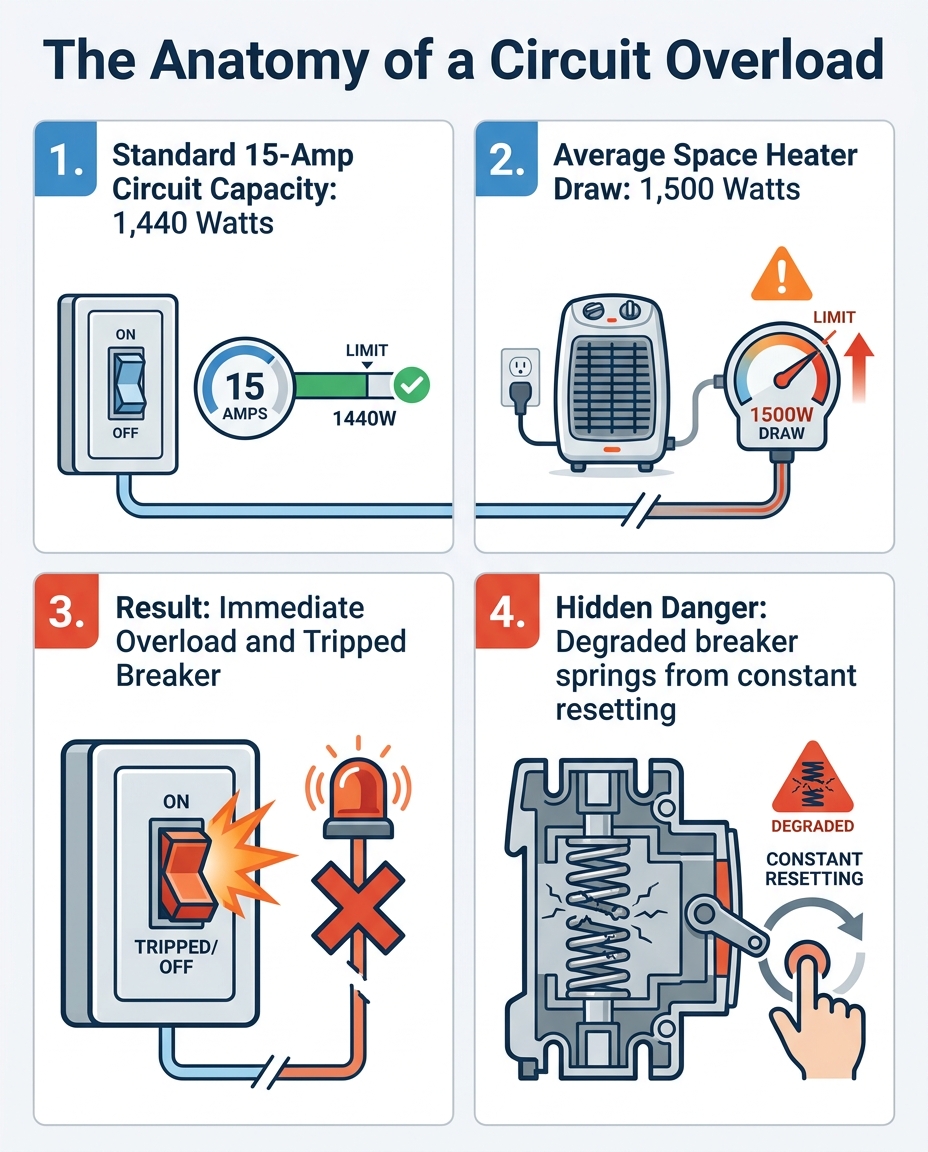
To understand why your power keeps cutting out, you have to look at the basic math of your home's electrical capacity. Across many San Antonio residential homes, standard bedroom and living room receptacles are wired to 15-amp circuits. A circuit is essentially a closed loop of wire that delivers power from the breaker panel to a series of outlets and back again. A standard 15-amp circuit can safely handle a continuous load of about 1,440 watts before the breaker steps in to prevent the wires from overheating.
The Heavy Toll of Supplemental Heating and Cooling
The problem arises when you introduce high-draw appliances into this limited equation. A typical portable space heater draws roughly 1,500 watts all on its own while running on its highest setting. If you plug that heater into a bedroom outlet, it is already exceeding the safe continuous capacity of that 15-amp circuit. Now, consider that this circuit is likely shared with other devices in the room. If you turn on a television, boot up a desktop computer, or switch on a vacuum cleaner while that heater is running, you guarantee an immediate electrical overload.
• Portable Space Heater — Average Wattage Draw: 1,500 Watts — Impact on a Standard 15-Amp (1,440W) Circuit: Exceeds safe continuous capacity alone
• Window AC Unit — Average Wattage Draw: 900 - 1,440 Watts — Impact on a Standard 15-Amp (1,440W) Circuit: Consumes 60-100% of available capacity
• Standard Microwave — Average Wattage Draw: 1,000 - 1,200 Watts — Impact on a Standard 15-Amp (1,440W) Circuit: Leaves little room for other kitchen devices
• Hair Dryer — Average Wattage Draw: 1,500 - 1,800 Watts — Impact on a Standard 15-Amp (1,440W) Circuit: Guarantees a trip if shared with lighting/fans
The physical reaction: When an overload occurs, the electrical current moving through the copper wiring generates excess heat. If that heat exceeds the temperature rating of the wire's protective insulation, the insulation begins to melt. The breaker trips to cut the power before this catastrophic failure can occur. This is why many homeowners eventually upgrade their comfort strategy entirely, opting for highly efficient ductless mini-split systems that operate on their own hardwired, dedicated lines, completely eliminating the need to juggle dangerous portable heaters and window units on shared wiring.
The Hidden Danger of Constantly Resetting a Nuisance Breaker
One of the most dangerous habits a homeowner can develop is treating a tripped breaker like an inconvenient light switch. A circuit breaker is a highly sensitive safety device engineered to protect your home from thermal damage and electrical fires. When it trips during the September/early fall transition because you are running too many appliances, it is successfully doing its job. However, forcing it back on without removing the heavy load causes severe, hidden damage to the panel.
Mechanical Degradation Inside the Panel
Inside a standard circuit breaker is a carefully calibrated bimetallic strip or an electromagnet, held in place by a spring mechanism under tension. When the wire gets too hot from an overload, the bimetallic strip bends, releasing the spring and snapping the circuit open to stop the flow of electricity. Every time you reset a breaker that immediately trips again, you are weakening that internal spring. Over time, the tension degrades. A degraded breaker loses its calibration and may eventually fail to trip when a genuine power surge or catastrophic overload occurs.
The Risk of Hidden Electrical Fires
If a weakened breaker fails to trip, the excess current continues to flow through the shared lines. The copper wires inside your walls will heat up far beyond their safe operating limits. This extreme heat bakes the plastic insulation surrounding the wires, causing it to crack, melt, and eventually expose bare copper. When bare wires touch each other or nearby combustible building materials like wood studs or drywall paper, an electrical fire ignites behind the wall, often going unnoticed until it is too late. Resetting a breaker repeatedly is never a solution; it is a gamble with your home's structural safety.
Signs You Need a Dedicated Circuit for Your Appliances
Knowing when an appliance requires its own independent power supply can prevent dangerous overloads before they cause damage. A dedicated circuit is exactly what it sounds like: a single line of wire running from its own breaker in the main electrical panel directly to a single receptacle, serving only one appliance. Across many San Antonio residential homes, older wiring simply wasn't designed for the heavy electrical demands of modern living.
Here are the critical warning signs that your appliances are stressing shared lines and require a dedicated circuit:
• Dimming or flickering lights: If the lights in your living room or kitchen dim momentarily when a heavy appliance kicks on, it means the motor is drawing so much startup current that it is starving the rest of the shared circuit.
• Warm faceplates or cords: If the plastic outlet cover or the appliance cord feels noticeably hot to the touch after running for a few minutes, the wiring is actively overheating due to excessive electrical resistance.
• Buzzing or crackling sounds: A faint humming or crackling noise coming from an outlet or the main breaker panel indicates electrical arcing, a severe fire hazard caused by loose connections or overloaded contacts.
• Frequent breaker trips: If you find yourself walking to the panel more than once a month to reset a specific switch, that line is overburdened. This is especially true when dealing with tripping breakers linked to AC compressors or heavy heating elements.
• Underperforming appliances: When a microwave takes twice as long to heat food, or a window AC struggles to blow cold air, it may be experiencing a voltage drop because it is fighting for power on a crowded circuit.
As a general rule, any appliance with a large electric motor or a heating element—such as refrigerators, deep freezers, ovens, microwaves, window ACs, and space heaters—should be isolated on its own dedicated 20-amp circuit to ensure safe, reliable operation.
Treating the Root Cause: Why Are You Relying on Space Heaters?
While upgrading your electrical panel to accommodate heavy loads is a critical safety measure, it is equally important to step back and ask why you are relying on supplemental appliances in the first place. If you are constantly plugging in space heaters during the September/early fall transition, treating the electrical symptom might be ignoring a larger comfort problem. Often, the dangerous overuse of portable heaters is driven by drafty rooms, poor insulation, or a failing central heating system that simply cannot push warm air into certain zones of the house.
Looking Beyond the Breaker Box
Because Reliabee offers both HVAC and electrical services, our cross-trained technicians can evaluate these overlapping issues during a single service visit. Instead of just installing a new electrical line for a space heater that will consume massive amounts of energy, a comprehensive evaluation might reveal that your home needs a better airflow strategy. For example, during a recent spring service call, a commercial client assumed their 5-ton AC unit required a complete replacement due to poor performance. Instead, the technician identified that only a precise adjustment to the outdoor unit was needed, resolving the issue and saving the client significant time and headache by avoiding an unnecessary installation. That same diagnostic rigor applies to residential heating.
By assessing the root cause of your cold spots, a professional can accurately diagnose whether you truly need an electrical panel upgrade or if you would benefit more from exploring whole-home heating solutions. Fixing ductwork leaks, adjusting blower speeds, or installing a zoned system can eliminate the need for dangerous space heaters entirely, lowering your monthly utility bills while keeping your electrical panel operating well within its safe limits.
Code Requirements and the Case for Professional Upgrades
When it becomes clear that your home needs new wiring to support modern appliances, attempting to solve the problem yourself is highly dangerous and, in most jurisdictions, illegal. The National Electrical Code (NEC) sets strict standards for residential wiring, specifically mandating that fixed appliances and specific heavy-draw equipment must be placed on dedicated circuits. These codes exist to prevent the exact types of thermal overloads and electrical fires that plague older San Antonio residential homes.
The Professional Installation Process
Modifying an electrical panel involves working directly with lethal amounts of voltage. A licensed professional follows a rigorous, code-compliant process to ensure the new circuit operates safely for decades:
1. Comprehensive Load Calculation: Before any wire is run, an electrician calculates the total existing draw on your main panel to ensure your home's incoming service can actually handle the addition of a new dedicated circuit without requiring a full heavy-up.
2. Routing the Correct Wire Gauge: High-draw appliances require thicker copper wiring to handle the current without heating up. A professional will fish the appropriate gauge wire (typically 12-gauge for a 20-amp circuit) safely through your walls, avoiding plumbing lines and structural hazards.
3. Installing the Right Breaker: The electrician selects a breaker that perfectly matches the wire gauge and the appliance's specifications, ensuring the safety mechanism trips exactly when it is supposed to.
4. Ensuring Proper Grounding: Finally, the new circuit is properly grounded and bonded at the panel, providing a safe path for rogue electricity to dissipate in the event of a power surge or short circuit.
Beyond the immediate physical safety, relying on a licensed professional protects your financial investment. DIY electrical work instantly voids most homeowner's insurance policies and appliance warranties. If a fire occurs due to unpermitted panel modifications, you will be held entirely liable for the damages.
Frequently Asked Questions About Dedicated Circuits and Panel Safety
Why does my space heater keep tripping the breaker?
Space heaters draw immense power, usually maxing out a standard circuit's safe capacity on their own. When you plug a 1,500-watt heater into a 15-amp bedroom circuit that is already supplying power to lights, televisions, or chargers, the total demand exceeds the wire's physical limit. The breaker trips as a necessary safety mechanism to prevent the wires inside your walls from melting and starting a fire during the cool September/early fall transition.
What appliances require a dedicated circuit?
Microwaves, refrigerators, window AC units, ovens, and space heaters all require their own independent power supply. The National Electrical Code generally mandates dedicated lines for any fixed appliance, any appliance with a heavy-duty motor, or any device that continuously draws more than half of a circuit's total safe capacity.
Does a microwave need its own circuit?
Yes, modern microwaves draw enough power that the NEC generally requires them to be on a dedicated 20-amp circuit. Because a microwave uses a powerful magnetron to generate heat quickly, it pulls a massive surge of electricity when first turned on, which will easily trip a shared kitchen breaker if the refrigerator or toaster is running simultaneously.
Is it dangerous to keep resetting a tripped breaker?
Yes, it degrades the breaker's internal mechanisms and can lead to electrical fires. A breaker is not a standard on/off switch; it relies on a tension spring that weakens every time it is forced to trip. Over time, a degraded breaker will fail to open during a real overload, allowing the hidden wiring to overheat and potentially ignite surrounding building materials.
How can I tell if a circuit is dedicated?
A dedicated circuit serves only one appliance or receptacle, which a licensed electrician can verify directly at the main panel. You can perform a basic test by turning off the specific breaker in question and walking through your home to see if any other lights, outlets, or devices have lost power. If multiple things turn off, the circuit is shared.
Restore Your Home's Electrical Safety and Comfort This Season
Constant breaker tripping is a serious warning sign, not just a seasonal nuisance to be tolerated. When your electrical panel repeatedly cuts power to your heavy-draw appliances, it is actively protecting your home from catastrophic wire damage and hidden fires. Validating these warning signs and scheduling a professional assessment is the only way to keep your property safe as temperatures fluctuate across San Antonio residential homes.
Whether you need a heavy-duty dedicated line safely integrated into your electrical panel, or a comprehensive assessment to fix the drafty rooms forcing you to rely on space heaters in the first place, professional intervention provides permanent peace of mind. Don't risk your home's safety by repeatedly resetting a tired breaker—reach out to a licensed expert to explore comprehensive electrical and heating solutions that will keep your household secure and comfortable all season long.

Ready to Transform Your Home?