The Benefits of Combining HVAC and Plumbing Maintenance Visits
The Scheduling Headache of Fall Home Preparation
You know the drill as the weather starts to shift: your to-do list grows, and finding time for household upkeep feels impossible. The benefits of combining HVAC and plumbing maintenance visits can completely change how you handle this seasonal chore. At Reliabee Air Electric Plumbing, we hear from homeowners every day who are familiar with the frustration of noticing an issue, calling a contractor, and waiting around during a four-hour service window. When you have multiple mechanical systems needing attention, that frustration multiplies. You might spend a Tuesday afternoon waiting for an air conditioning technician, only to repeat the exact same process on Thursday for a plumber.
For homeowners in the San Antonio area, the shift from intense summer heat to milder fall weather means several systems need attention at once. Our technicians frequently see cooling equipment that is completely exhausted, heating equipment that has been sitting dormant, and water heaters about to face increased demand. Managing the time and hassle of scheduling separate service calls for a water heater flush and a furnace tune-up quickly becomes a logistical nightmare. Instead of coordinating separate contractors, choosing to book a single, combined appointment with a multi-trade technician streamlines your entire seasonal checklist.
To learn more about streamlining your seasonal upkeep, explore our comprehensive maintenance plan.
The Hidden Drain of Multi-Day Service Calls
The traditional approach: Historically, the home service industry has operated in strict silos. You call a dedicated heating company for your furnace and a dedicated plumbing company for your pipes. While this made sense decades ago, modern home mechanics are deeply interconnected. Continuing to use siloed contractors means you are paying—in time and energy—for multiple dispatch fees, multiple diagnostic assessments, and multiple days of disrupted schedules.
The unified approach: Consolidating these tasks into a single visit eliminates the overlap. A unified approach to home maintenance saves time and ensures a safer, more efficient home. When our professionals handle both major systems, we can cross-reference the overall health of your utility spaces, spotting issues that a single-trade contractor might overlook because it falls outside their specific purview.
Why the September Pre-Heating Transition Matters
The Problem: As we enter the September pre-heating transition, your home's mechanical systems are in a vulnerable state. Your air conditioner has just survived months of brutal summer operation, accumulating dust, suffering from minor wear and tear, and losing efficiency. At the same time, your heating system has been sitting completely idle. Dust has settled on the burners, electrical connections may have loosened, and the system is entirely unprepared for the first unexpected cold snap. Meanwhile, your water heater is about to face a significant increase in workload as the incoming municipal water temperature drops, forcing the unit to work harder to reach your desired shower temperature.
The Cause: Equipment failure rarely happens out of nowhere; in our experience, it is usually the result of compounded seasonal stress. San Antonio's transition from intense summer heat to milder fall weather in September provides a brief, critical window of moderate weather. If you skip maintenance during this window, you carry the summer's wear and tear directly into the winter's heavy usage period. A dirty air conditioning coil left uncleaned will corrode over the winter. A furnace fired up for the first time on a freezing morning without an inspection can crack its heat exchanger due to restricted airflow.
The Solution: The logistical advantage of knocking out both major mechanical checks in a single September window cannot be overstated. You are simultaneously recovering from brutal summer AC usage, ensuring the cooling system is clean and stable for its dormant months, preparing furnaces before the cold hits, and timing a water heater flush before heavy winter demand increases the workload on the unit.
Seasonal System Stressors
• Air Conditioning — Summer Impact: Continuous high-capacity running, dirty condenser coils, stressed capacitors. — Winter Risk if Ignored: Corrosion of dirty components, premature failure upon spring restart.
• Heating / Furnace — Summer Impact: Sitting dormant, accumulating dust on burners and sensors. — Winter Risk if Ignored: Delayed ignition, poor indoor air quality, potential carbon monoxide risks.
• Water Heater — Summer Impact: Moderate usage with warmer incoming groundwater. — Winter Risk if Ignored: Increased strain as cold incoming water forces longer, harder heating cycles.
To ensure your plumbing system is ready for the seasonal shift, scheduling a professional water heater flush and maintenance is an essential part of this September transition.
Addressing Overlapping Mechanical Safety in Your Home
When you look at the equipment in your garage, basement, or utility closet, you might see a collection of separate boxes. A trained professional sees a single, interconnected mechanical ecosystem. Recognizing the shared infrastructure between your heating and plumbing systems is critical for your family's safety. For example, many homes feature both gas furnaces and gas water heaters. These units often share the same primary gas supply line, the same gas manifold, and the same ventilation pathways.
Treating the utility room as a single mechanical ecosystem prevents dangerous safety oversights. If a plumber only checks the water heater's gas valve and ignores the furnace's connection right next to it, a slow leak could go unnoticed. Our multi-trade technicians evaluate the home's entire mechanical ecosystem at once, unlike siloed contractors who only look at the specific appliance they were called to service.
Just last fall, our team at Reliabee Air Electric Plumbing helped a local San Antonio homeowner who reached out when they noticed a persistent heating issue. Our technician arrived, evaluated the entire system, explained the problem in layman's terms, and focused on doing the job right the first time rather than just applying a quick patch. Because our technician took a holistic view of the home's heating and ventilation setup, the underlying issue was fully resolved, ensuring the home was safe and warm for the season.
Shared Utility Spaces and Ventilation
Most homes house the HVAC indoor unit and the water heater in the exact same closet or garage space. This physical proximity means they share the same breathing air. Both gas-fired furnaces and gas water heaters require adequate combustion air to operate safely. If the utility room lacks proper airflow, both systems will struggle to burn fuel cleanly.
Furthermore, the importance of holistic ventilation and flue inspections cannot be overstated. A single technician can easily inspect the surrounding area for leaks, proper drainage, and adequate airflow for both systems. If a bird builds a nest in the shared exhaust flue, both your furnace and your water heater could begin backing up dangerous exhaust gases into your home. A combined maintenance visit ensures these overlapping carbon monoxide risks are caught and mitigated immediately.
To make sure your heating system operates safely alongside your plumbing, investing in a thorough furnace tune-up is the smartest preventative step you can take.
Tackling Hard Water and Sediment Buildup Efficiently
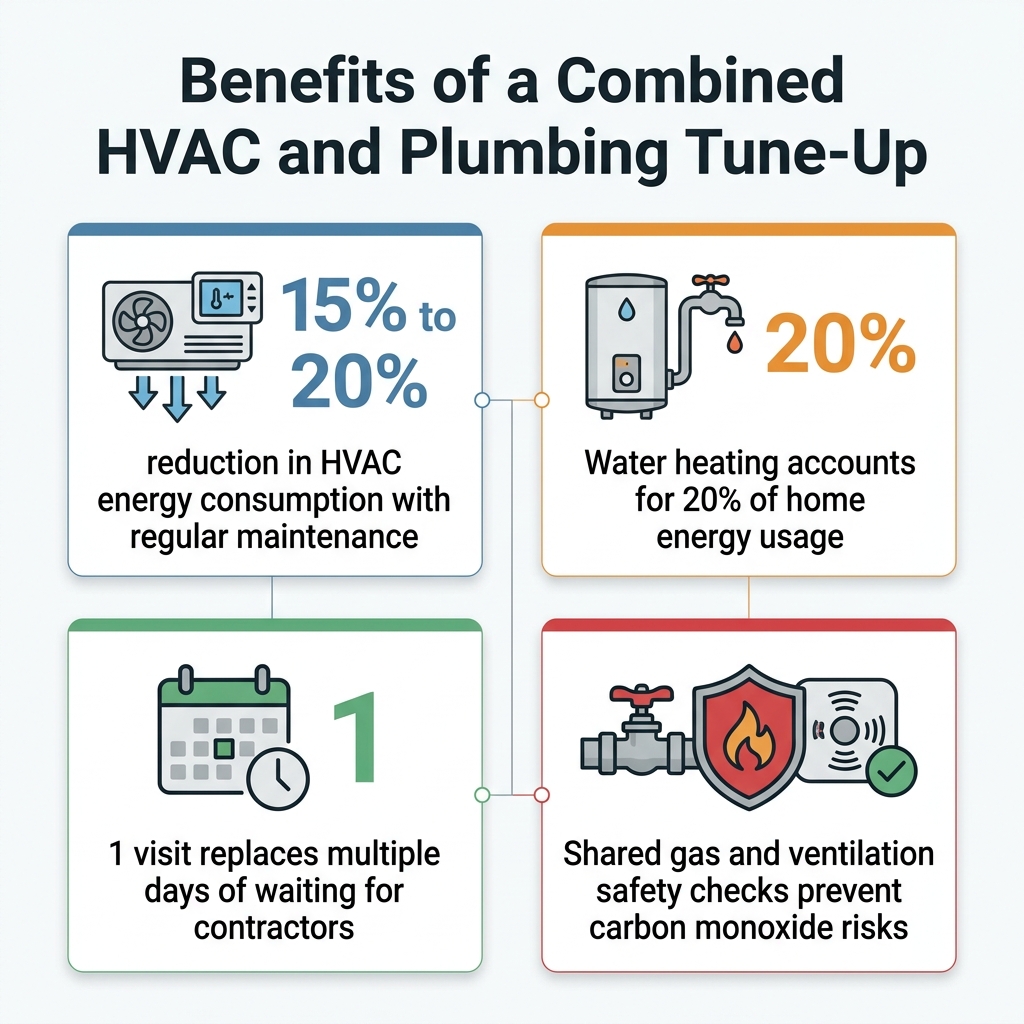
Water heating accounts for roughly 20% of a home's total energy usage. Despite this massive energy footprint, the water heater is often the most neglected appliance in the home. Homeowners in the San Antonio area face a unique challenge: the local water supply, drawn from the Edwards Aquifer, is notoriously hard. Our plumbers deal with this daily, seeing firsthand how this hard water is packed with dissolved minerals like calcium and magnesium. When this water is heated inside your tank, those minerals separate and fall to the bottom, creating a thick layer of sediment.
Over the year, this sediment builds up at the bottom of the tank, effectively insulating the heating element. If you have a gas heater, the burner has to heat the metal tank, then heat the thick layer of rock-like sediment, and only then can it heat your water. This wastes a tremendous amount of energy and causes the tank to overheat, which can lead to premature leaks. Tackling this issue alongside your HVAC check is highly efficient.
Because this process involves high temperatures and pressurized systems, it requires a licensed professional. Here is how our technicians approach this critical maintenance task during a combined visit:
1. System isolation and safety checks: Our technician begins by safely shutting off the power or gas supply to the water heater and turning off the cold water inlet valve to isolate the tank.
2. Controlled draining: A heavy-duty hose is attached to the drain valve at the bottom of the tank, routing the hot, mineral-heavy water safely outside or to a nearby floor drain.
3. Sediment agitation and flushing: Once the tank is partially empty, our technician pulses the cold water supply valve on and off. This agitation stirs up the stubborn calcified sediment at the bottom, forcing it out through the hose until the water runs completely clear.
4. Component inspection: While the tank drains, our professional inspects the anode rod—a sacrificial metal rod that attracts corrosive elements to protect the tank lining. We also test the pressure relief valve to ensure it opens and closes properly, preventing dangerous pressure buildup.
5. System restoration: The tank is carefully refilled to purge all trapped air before the heating elements or gas burners are reignited, ensuring safe and efficient operation.
Protecting the lifespan of your tank by ensuring these components are functional requires specialized knowledge. Relying on professional residential plumbing services ensures this vital process is done safely and correctly.
Maximizing Time and Energy Efficiency
The primary goal of the September pre-heating transition is to optimize your home for the months ahead with minimal disruption to your daily life. Eliminating multi-day contractor waiting periods by handling everything in one visit gives you back your most valuable asset: your time. Instead of tracking multiple appointment windows, clearing your schedule twice, and dealing with separate billing systems, you handle your entire fall mechanical prep in a single morning or afternoon.
Beyond the logistical convenience, the energy savings are substantial. According to U.S. Department of Energy data, regular preventative maintenance can reduce HVAC energy consumption by 15% to 20%. When you combine that with the efficiency restored by flushing a sediment-filled water heater, you are ensuring both major energy-consuming systems in your home are optimized simultaneously. An efficient furnace uses less gas or electricity to heat your air, and a clean water heater uses less energy to maintain your water temperature. Together, these optimizations significantly reduce the daily operational strain on your home's infrastructure.
The Value of a Single Service Partner
Because Reliabee Air Electric Plumbing is a true multi-trade service provider, our customers get expert HVAC, electrical, and plumbing maintenance handled in one convenient visit. In our experience, building a long-term relationship with a single, trusted service provider changes the dynamic of home maintenance. When our team monitors your air conditioner, your furnace, and your plumbing over several years, we build a comprehensive medical history of your home. We know exactly when your water heater was last flushed, we know the exact condition of your furnace's heat exchanger, and we can anticipate issues before they become emergencies.
The Maintenance Rule of Thumb: If an appliance requires a dedicated circuit or a dedicated gas line, it requires dedicated annual maintenance to operate safely and efficiently.
To understand more about keeping your cooling systems running at peak performance before shutting them down for the season, review these essential AC maintenance tips.
What to Expect During a Multi-Trade Tune-Up
Understanding exactly what happens during a combined maintenance visit helps highlight the incredible value of this service. During the September pre-heating transition, a multi-trade technician will perform a comprehensive sweep of your mechanical systems. This is not a cursory visual inspection; it is a deep, mechanical calibration designed to restore factory-level efficiency and verify absolute safety.
Here is a breakdown of the critical checkpoints our team covers during your combined visit:
• Furnace ignition and burner checks: Our technician cleans the burner assembly, tests the ignition sequence for delays, and measures the flame sensor's microamp draw to ensure the furnace fires safely every time.
• Heat exchanger inspections: Using specialized cameras, our professionals inspect the heat exchanger for microscopic cracks that could allow carbon monoxide to slip into your home's breathing air.
• AC coil cleaning and refrigerant checks: Even though summer is ending, our technician clears debris from the outdoor condenser, cleans the indoor evaporator coil, and verifies the refrigerant charge so the system is pristine when you need it next spring.
• Condensate line clearing: The drain lines that carry away moisture from your AC are flushed and treated to prevent algae clogs and potential water damage over the winter.
• Water heater flushing and calibration: The tank is fully drained to remove calcified sediment, the anode rod is inspected for wear, and the thermostat is calibrated to provide safe, consistent hot water without scalding risks.
• Holistic utility room safety audit: Our technician conducts a thorough inspection of all shared gas lines, tests for microscopic gas leaks at the manifolds, and verifies that all exhaust flues have an unobstructed draft to the outside of the home.
Simplify Your Fall Home Maintenance Today
Preparing your San Antonio area home for the changing seasons does not have to be a stressful, drawn-out process. The value of single-visit holistic safety and efficiency is clear: you save time, you reduce your energy consumption, and you gain the peace of mind that comes from knowing your home's most critical systems are operating in perfect harmony.
By understanding the exact time-saving benefits and overlapping safety checks of having a multi-trade technician handle both the furnace tune-up and water heater flush in one September visit, you can take control of your seasonal to-do list. We encourage you to explore comprehensive maintenance options to streamline your fall prep, ensuring your home remains comfortable, safe, and highly efficient all winter long.
Frequently Asked Questions
What is included in HVAC maintenance?
HVAC maintenance includes a comprehensive cleaning, inspection, and calibration of your heating and cooling equipment. A technician will clean the condenser and evaporator coils, check refrigerant levels, clear the condensate drain, inspect the furnace heat exchanger, test the ignition system, and tighten all electrical connections. This process ensures the system runs efficiently and safely while extending its overall lifespan.
Can an HVAC technician do plumbing?
A standard, single-trade HVAC technician typically is not licensed or trained to perform plumbing work. However, multi-trade service companies employ technicians who are cross-trained and certified in multiple disciplines, or they dispatch a specialized team in a single coordinated visit. This allows a single company to handle your furnace, air conditioner, and water heater simultaneously without violating building codes or safety standards.
Why should I combine home maintenance services?
Combining services saves you significant time by eliminating the need to wait for multiple contractors on different days. It also allows the technician to perform holistic safety checks on shared utility infrastructure, such as gas lines and exhaust flues, which might be overlooked if trades operate in isolation. Finally, combining visits often reduces overall diagnostic and dispatch fees, making it a more efficient use of your maintenance budget.
How often should HVAC and plumbing be serviced?
Your HVAC system should be serviced twice a year: once in the spring for the cooling equipment and once in the fall for the heating equipment. Your plumbing system, particularly your water heater, requires an annual flush and inspection to remove sediment and check safety valves. Scheduling the water heater flush alongside the fall furnace tune-up is the most efficient way to meet these annual requirements.
Does flushing a water heater really improve energy efficiency?
Yes, flushing a water heater significantly improves its energy efficiency. Over time, hard water deposits form a thick layer of sediment at the bottom of the tank, which acts as an insulator between the heating element and the water. By flushing this sediment out, the burner can heat the water directly and quickly, reducing the length of heating cycles and lowering your overall energy consumption.

Ready to Transform Your Home?