Choosing HVAC Financing Instead of Patching a 15-Year-Old Unit
The Dilemma of a Sudden Breakdown During Peak Heat
Your air conditioner is blowing warm air, the indoor temperature is climbing past 82 degrees, and you are suddenly faced with the stressful reality of choosing HVAC financing instead of patching a 15-year-old unit. At Reliabee Air Electric Plumbing, our team sees this scenario play out in homes across the San Antonio region every single summer. You hear a strange noise, the airflow stops, and suddenly you are holding a diagnostic quote for a major repair on a system that is well past its prime.
During peak summer, a broken air conditioner is more than just a minor inconvenience. With San Antonio's relentless July heat regularly pushing temperatures to extremes, losing your home's cooling capacity becomes a severe safety risk. The oppressive heat forces an immediate, and often rushed, financial decision. Do you drain your savings to apply a temporary bandage to a dying machine, or do you strategically upgrade the entire system?
Making this choice requires stepping back from the immediate panic and looking at the objective math. While handing over a lump sum of cash to get the cold air flowing today might feel like the path of least resistance, it often traps homeowners in a cycle of recurring breakdowns. By exploring HVAC financing options, you can transform what feels like a sudden financial emergency into a manageable, strategic investment in your home's long-term comfort, safety, and indoor air quality.
The Sunk Cost Trap: Why an Expensive Patch is a Financial Risk
The problem: When an aging air conditioner breaks down, the initial repair quote often looks less intimidating than the prospect of a full replacement. However, spending a significant amount of cash on a 15-year-old system is a classic example of a "sunk cost"—money that is gone and will not generate a return on investment.
The cause: To understand why a patch is so risky, our technicians often explain the "age-to-repair-cost rule." This simple industry benchmark helps homeowners determine when a system is no longer worth saving. You multiply the age of the equipment by the estimated repair cost. If the total exceeds a specific industry threshold, the repair is mathematically a poor investment. For a 15-year-old unit facing a costly repair, the math clearly indicates it is time to walk away.
Furthermore, systems built over a decade ago typically rely on R-22 refrigerant. The production of R-22 was completely phased out in 2020 due to environmental regulations. Because it is no longer manufactured, the remaining supply is incredibly scarce. If your old unit develops a refrigerant leak, simply acquiring the necessary R-22 to recharge the system can be astronomically expensive, assuming it can be found at all.
The solution: An expensive repair on an obsolete unit does not reset its lifespan. It does not guarantee the compressor will survive the rest of the peak summer season. Instead of repeating these costly repairs, moving forward with an air conditioning replacement is the more mathematically sound alternative. It stops the bleeding of your cash reserves and provides a permanent fix to the underlying problem.
How Extreme Heat Accelerates Secondary Failures
Air conditioners in South Texas do not have the luxury of an easy life. During peak summer, it is common for these systems to run for 12 to 16 hours a day just to maintain a baseline level of comfort. This relentless operation places maximum thermal and electrical stress on every single component inside the cabinet.
This heavy workload is known as the "duty cycle." When an air conditioner is 15 years old, its components are already worn down from years of friction, vibration, and heat exposure. During an extreme heatwave, older compressors are forced to run at near 100% capacity for hours on end. If you apply a pricey patch to fix a single broken part—like a fan motor or a capacitor—you are placing brand-new, high-functioning components next to brittle, failing ones. The new part restores the system's power, which immediately puts increased pressure on the remaining 15-year-old components, inevitably leading to a domino effect of secondary failures.
The physical danger and psychological stress of these inevitable breakdowns cannot be overstated. One local homeowner reached out to Reliabee Air Electric Plumbing during a hot Labor Day weekend when their aging AC unit completely stopped working, leaving their family and their dogs without any cooling. While our team was able to provide immediate customer service—including offering a portable AC unit and fixing the main system after hours—this type of sudden failure highlights the danger of relying on an obsolete system during the hottest months of the year. The parts that survive the initial patch are often the very parts that give out on a holiday weekend or late at night.
The Compounding Cost of Inefficiency in Older Units
Beyond the immediate threat of a breakdown, running an obsolete system carries a hidden monthly penalty. Air conditioning efficiency is measured by a SEER (Seasonal Energy Efficiency Ratio) rating. Over the past 15 years, manufacturing standards and technology have advanced dramatically.
Modern, high-efficiency systems are typically 20% to 40% more efficient than models manufactured a decade and a half ago. Even worse, an aging, patched system loses its original efficiency over time as coils degrade and motors wear out. A unit that was rated at 10 SEER when it was installed 15 years ago might only be operating at a much lower equivalent today. This loss of performance translates directly into bloated monthly utility bills during peak summer.
We see this pattern often. During the peak summer heat, one San Antonio homeowner realized their aging system was leaving the upstairs uncomfortably hot while wasting money overcooling the downstairs. After a thorough evaluation, they realized an expensive patch wouldn't fix the fundamental design flaws and lost efficiency. Instead, they opted for an entire system replacement with a new two-zone setup and smart thermostats, resulting in highly effective, efficient cooling and much better temperature control under heavy load.
Every dollar wasted on inefficient energy consumption is a dollar that could have been redirected toward a predictable monthly payment for a new, reliable system.
Reframing the Decision: Cash Flow vs. Cash Drain When Choosing HVAC Financing Instead of Patching a 15-Year-Old Unit
When faced with a massive repair bill during peak summer, many homeowners view financing as a last resort. However, treating financing as a strategic cash-flow management tool completely changes the mathematical landscape. The choice is rarely just about fixing a machine; it is about protecting your family's financial flexibility.
Consider the impact of a massive lump-sum cash drain. That is liquid capital pulled directly from your emergency savings to pay for a temporary patch on a dying system. If your car transmission fails next week, or you face an unexpected medical bill, that cash is gone. In contrast, utilizing flexible financing options empowers you to upgrade your family's comfort immediately without draining your liquid savings. You trade an unpredictable, recurring cash drain for a highly predictable, fixed monthly payment.
Financing also provides the financial flexibility to address your home's entire climate ecosystem at once. For example, replacing your gas furnace with your AC at the same time maximizes labor efficiency and ensures perfect system compatibility. Because the indoor heating coil and the outdoor cooling unit share the same ductwork and blower motor, upgrading them together guarantees that your system's blower can handle peak summer cooling demands and deliver the maximum SEER rating.
Calculating the True Cost of Ownership Over Time
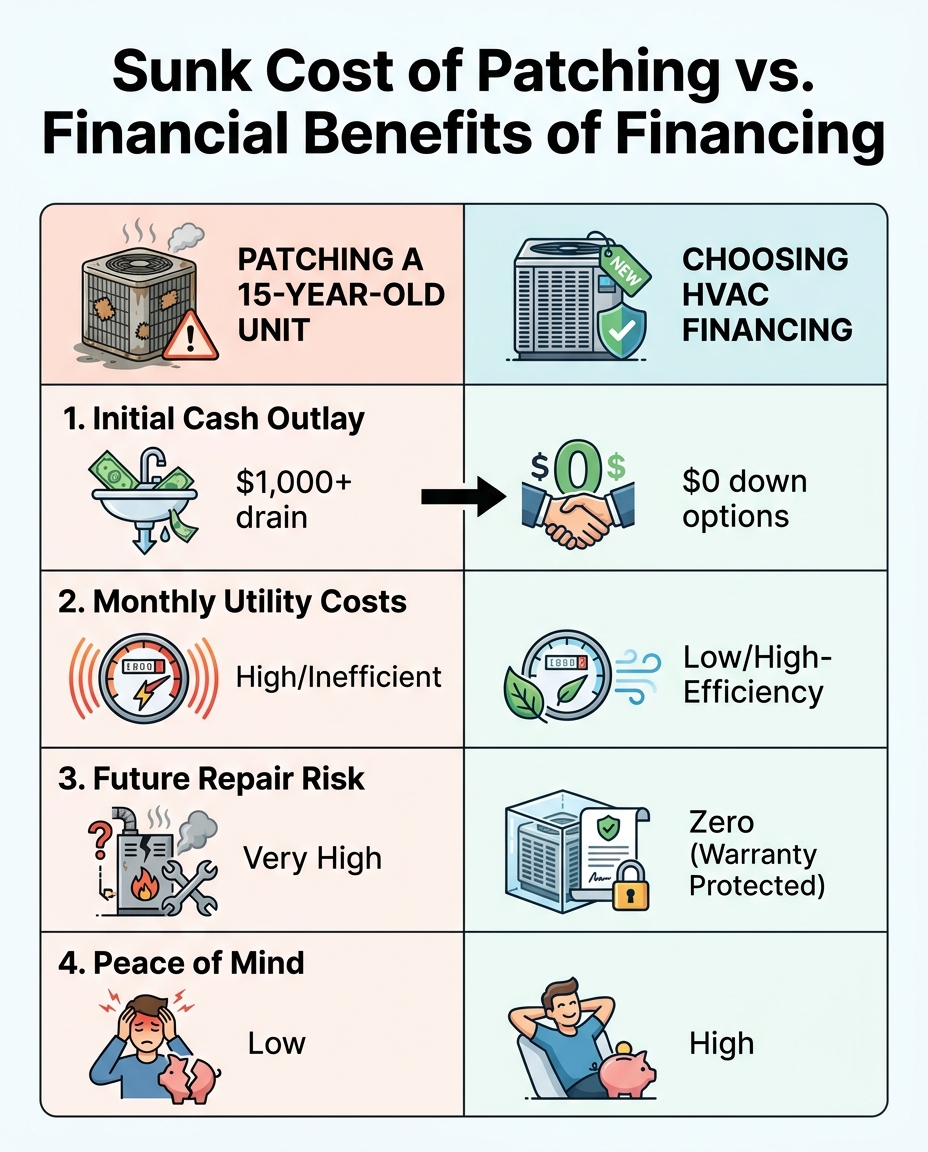
To make the most logical decision, you have to look beyond today's repair bill and calculate the total cost of ownership over a 1-to-3-year horizon. When you lay the numbers out side-by-side, the financial argument for replacement becomes incredibly clear.
The Patch Scenario:
• Initial Outlay: A massive immediate cash drain.
• Utility Penalty: Wasting 20% to 40% more on monthly electricity bills due to 15-year-old inefficiency.
• Future Risk: A statistically high probability of another major repair within 12 to 24 months.
The Financing Scenario:
• Initial Outlay: Preserved emergency savings with predictable monthly financing payments.
• Utility Savings: Significantly lower monthly electricity bills during peak summer due to high-efficiency technology.
• Future Risk: Zero surprise repair bills, as the new system is fully protected by manufacturer warranties.
Over a 3-year horizon, the financed new system consistently results in a lower total cost of ownership. This objective mathematical logic applies universally, whether you are evaluating urgent summer cooling needs or exploring heating system upgrades to ensure year-round efficiency and total system compatibility.
The Hidden Costs of Waiting
Delaying a necessary replacement carries additional hidden costs. Inflation on raw materials, parts, and labor means that a new system will likely cost more next year than it does today. There is also the daily stress of living with an unreliable system, constantly wondering if today is the day the compressor finally locks up. Most importantly, running an obsolete unit until it fails catastrophically increases the risk of property damage, such as a rusted drain pan overflowing and causing severe water damage to your ceilings or floors.
Protecting Your Investment with Comprehensive Coverage
One of the most critical factors in the repair-versus-replace calculation is warranty protection. When you authorize a major repair on a 15-year-old unit, the HVAC contractor will typically warranty the specific part they replaced, and perhaps the labor for a short period. However, they cannot warranty the rest of the aging system. If the fan motor was replaced today and the compressor fails next week, you are entirely on your own for the next repair bill.
In stark contrast, a newly financed system comes backed by robust manufacturer warranties that cover major components for up to a decade. This protection acts as a financial shield against future mechanical failures. When you choose to upgrade, you are not just buying a metal box that produces cold air; you are buying guaranteed reliability.
To maximize this protection, pairing your newly financed equipment with a comprehensive HVAC maintenance plan is a smart move. Regular, professional upkeep ensures your system operates at peak performance, keeps your monthly utility bills low, and keeps your manufacturer warranties fully valid and active. Ultimately, financing buys you a decade of predictable comfort, completely removing the anxiety of peak summer breakdowns.
Frequently Asked Questions About Upgrading Aging HVAC Systems
Is it worth fixing a 15-year-old AC?
Generally, no, it is not worth fixing a 15-year-old air conditioner if the repair is expensive. A massive repair bill on a unit this old is a sunk cost because the system is already past its expected lifespan and likely uses obsolete R-22 refrigerant. Investing that money into a new, high-efficiency system is mathematically a much safer financial decision.
At what age should you replace your HVAC system?
Most industry experts recommend planning for an HVAC replacement when the system is between 10 and 15 years old. In regions with extreme heat, systems often reach the end of their reliable lifespan closer to the 10-year mark due to the heavy workload during peak summer. If your system is over a decade old and requires frequent repairs, replacement is usually the best path forward.
Can you finance a new HVAC system?
Yes, you can absolutely finance a new HVAC system. Professional HVAC companies partner with reputable lenders to offer flexible financing terms, allowing you to pay for your new equipment through predictable monthly payments. This strategy preserves your liquid emergency savings while allowing you to upgrade to a reliable, energy-efficient system immediately.
How long do AC units last in extreme Texas heat?
In the extreme heat of South Texas, an air conditioning unit typically lasts between 10 and 15 years. The intense thermal stress and the fact that units often run 12 to 16 hours a day during peak summer significantly shorten their lifespan compared to the national average. Regular maintenance can help them reach the 15-year mark, but failures become highly likely after a decade of heavy use.
What is the age-to-repair-cost rule for HVAC replacement?
The age-to-repair-cost rule is a simple mathematical formula used to determine if a repair is worth the cost. You multiply the age of your equipment by the quoted repair cost; if the total exceeds an industry-standard financial threshold, you should replace the unit instead of repairing it. For example, a 15-year-old unit facing a major repair bill will mathematically surpass this limit, clearly signaling that a replacement is the smarter choice.
How does the R-22 refrigerant phaseout affect older AC repairs?
The R-22 refrigerant phaseout, which completed in 2020, makes repairing older AC units incredibly difficult and expensive. Because R-22 is no longer manufactured, the remaining supply is scarce and costly. If your 15-year-old system develops a refrigerant leak, the cost to simply recharge the system often justifies replacing the entire unit with a modern system that uses eco-friendly refrigerant.
Empower Your Decision with Smart Financial Solutions
Surviving the extreme temperatures of peak summer requires a reliable cooling system, not just a temporary patch on a dying machine. When you weigh the heavy financial risks of sinking substantial cash into an obsolete unit against the long-term stability of a new installation, the math speaks for itself. Upgrading your equipment protects your home, lowers your monthly utility bills, and provides unparalleled cooling performance and air quality when you need it most.
By treating this situation as an opportunity to improve your cash flow, you can keep your emergency savings intact. Choosing HVAC financing instead of patching a 15-year-old unit is a smart, strategic move that empowers you to take control of your indoor environment. Reach out to the experts at Reliabee Air Electric Plumbing today to explore your replacement options and discover how flexible financing can work for your family's budget.

Ready to Transform Your Home?