Measuring the Impact of Blown-In Insulation Upgrades on Fall Heating Loads
When Early Cold Snaps Trigger Constant Heater Cycling
As that first late-summer cold front rolls through San Antonio and triggers sudden evening temperature drops, measuring the impact of blown-in insulation upgrades on fall heating loads becomes essential for homeowners dealing with erratic heater cycling. Instead of enjoying the crisp air, you find yourself listening to the furnace kick on, run for a few minutes, shut off, and fire right back up again. This constant stopping and starting is incredibly frustrating, especially when the house never seems to reach a comfortable, consistent temperature.
In our years of servicing San Antonio homes at Reliabee Air Electric Plumbing, our team frequently sees homeowners immediately assume their furnace or heat pump is breaking down. However, we've found that this erratic behavior is often not a mechanical failure at all. Instead, it is a direct symptom of rapid heat loss in the living space. When the September/early fall temperature drops catch an uninsulated home off guard, the heating equipment is forced to overwork just to keep up with the shifting outdoor conditions. Before assuming your equipment is failing, it helps to understand how residential heating systems interact with your home's thermal boundary.
Upgrading your attic's thermal barrier is a functional, measurable solution for stabilizing your indoor climate. By addressing the envelope of the house first, you stop the rapid heat loss that triggers erratic equipment behavior. This approach treats the underlying cause of the temperature swings, rather than just forcing the mechanical equipment to work harder to compensate for a leaky house.
The Mechanics of Rapid Heat Loss in Aging Properties
The underlying problem: Heat naturally moves toward colder spaces. In the winter, the warmth generated by your furnace aggressively seeks a way out into the chilly outdoor air. In older San Antonio homes, this physical reality becomes a major comfort issue. Many of these historical properties were built long before modern building codes required stringent thermal barriers, leaving them highly vulnerable to rapid heat transfer.
The hidden cause: A phenomenon known as the "stack effect" acts like a vacuum inside your house. As warm air naturally rises toward your ceilings, it escapes through unsealed gaps, recessed lighting fixtures, and poorly insulated attic floors. As this warm air leaves the top of the house, it creates negative pressure at the bottom. This pressure pulls cold, drafty air in from the outside through doors, windows, and crawlspaces. Your home essentially becomes a chimney, constantly venting the air you just paid to heat.
The permanent solution: Stopping the stack effect requires a continuous, robust thermal boundary. Investing in blown-in attic insulation upgrades effectively caps the top of your house. This dense layer of material traps the warm air inside your living space, breaking the cycle of the stack effect and preventing cold outdoor drafts from being pulled inside.
Why the Attic is the Primary Culprit
Because hot air rises, the attic ceiling is the single most vulnerable point for heat loss in any residential structure. If the material up there has settled over the decades, degraded from moisture, or was simply never installed thickly enough to begin with, it offers zero resistance to thermal transfer. The heat your furnace produces simply passes through the drywall and vanishes into the attic. Upgrading this specific area provides the most immediate and noticeable improvement in how well your home retains its conditioned air.
How Poor Thermal Barriers Lead to HVAC Short-Cycling
Understanding the building science of heat loss is only half the equation. The other half is recognizing how that heat loss directly punishes your mechanical equipment. The continuous cycle of losing heat and immediately needing to replace it leads to a damaging condition known as short-cycling. If you are focused on fixing heater short-cycling issues, you have to look at the sequence of events happening inside your walls.
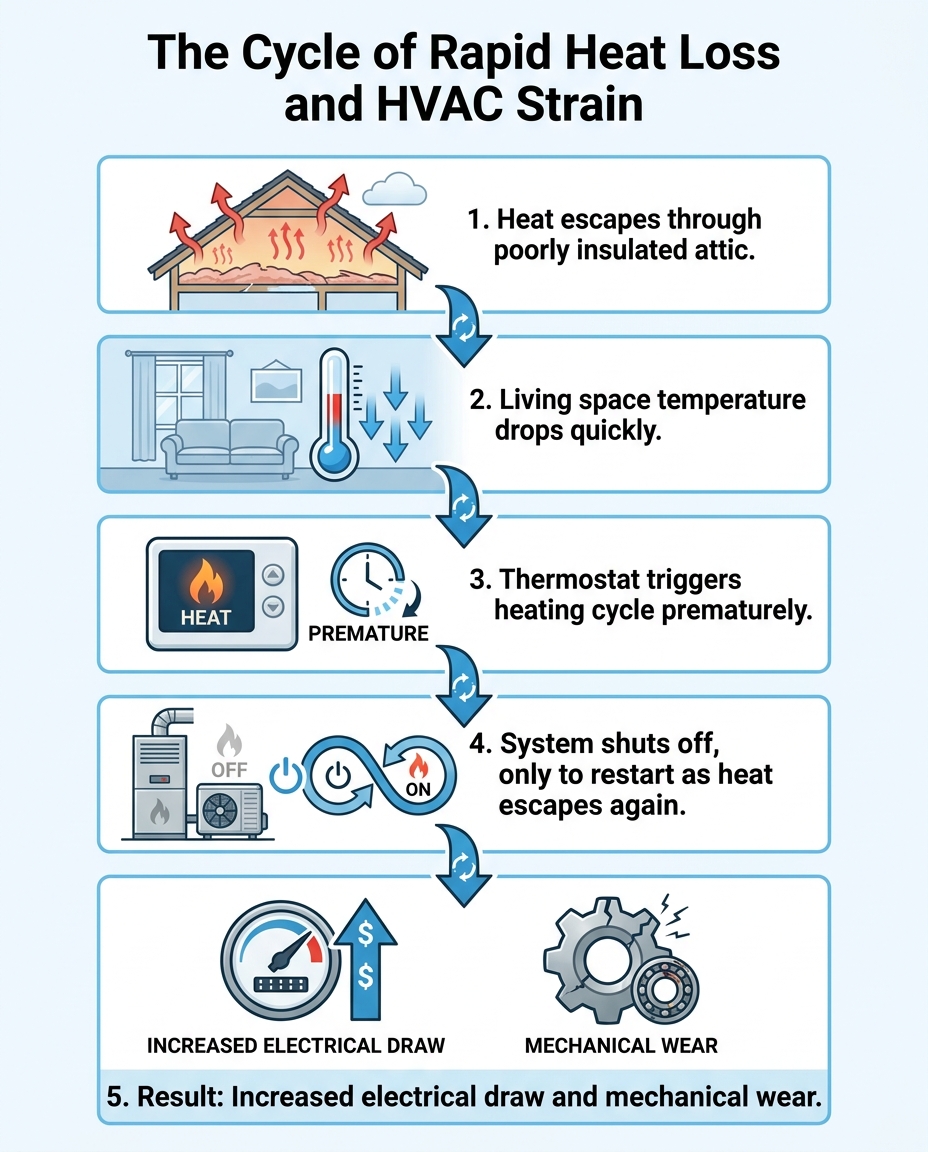
Here is exactly how a poor thermal boundary forces your system into a short-cycling loop:
1. The Initial Call for Heat: Your thermostat senses that the room has dropped below your set temperature. It sends a signal to the furnace or heat pump to turn on. The blower motor ramps up, the burners ignite (or the compressor engages), and warm air begins filling the room.
2. The Rapid Escape: Because the attic lacks proper insulation, the new heat does not stay in the living space. It immediately begins rising through the ceiling drywall and escaping into the cold attic.
3. The Premature Shutdown: The thermostat registers that the immediate area around it has reached the target temperature, so it shuts the heating system down. However, the overall thermal mass of the house hasn't actually warmed up.
4. The Immediate Restart: Within minutes, the heat that was temporarily hovering in the room finishes escaping through the roof. The room temperature plummets again. The thermostat senses the drop and immediately fires the heating system back up, starting the entire stressful process over.
This relentless on-and-off sequence places immense strain on every moving part inside your HVAC cabinet. A system designed to run in long, smooth, efficient cycles is instead forced into a stuttering rhythm that burns excess energy and accelerates mechanical wear.
Proving the Impact: Temperature Differential Readings
Many homeowners are familiar with generic "R-value" marketing claims, which rate how well a specific material resists heat flow. While R-value is an important metric, it doesn't tell the whole story of how your home actually performs. To truly prove the impact of a thermal upgrade, professionals rely on actual performance metrics—specifically, temperature differential readings.
A temperature differential is the measurable difference between the conditioned indoor living space and the unconditioned spaces (like the attic or the outdoors). On a cold fall evening, if your living room is set to 70°F and your attic is 45°F, there is a 25-degree differential. In a poorly insulated home, the ceiling drywall will register much closer to the attic temperature than the room temperature. This means the cold is bleeding right through the structure.
Properly installed blown-in insulation stabilizes these readings. By creating a thick, seamless blanket over the ceiling joists, the material proves that the thermal boundary is intact. When our Reliabee technicians measure the ceiling temperature after an upgrade, it closely matches the ambient room temperature, regardless of how cold the attic gets.
• Ceiling Surface Temp — Poorly Insulated Attic: Noticeably colder than room air — Upgraded Blown-In Insulation: Matches ambient room temperature
• Heating Cycle Length — Poorly Insulated Attic: 5-8 minutes (Short-cycling) — Upgraded Blown-In Insulation: 15-20 minutes (Efficient operation)
• Temperature Swings — Poorly Insulated Attic: Rapid drops between cycles — Upgraded Blown-In Insulation: Stable, consistent comfort
• Thermostat Behavior — Poorly Insulated Attic: Constant clicking on and off — Upgraded Blown-In Insulation: Gradual, predictable adjustments
A stabilized differential directly correlates to longer, more efficient heating cycles. Because the heat stays trapped in the living space, the thermostat remains satisfied for much longer periods. The furnace is allowed to run its proper, steady course, dramatically reducing the chaotic short-cycling behavior.
The Hidden Electrical and Mechanical Toll on Your Equipment
The underlying problem: It is easy to view insulation purely as a comfort feature, but its absence causes severe hidden damage to your mechanical systems. The highest electrical draw for any HVAC system occurs during startup. It takes a massive surge of electricity to overcome inertia and get the heavy blower motors and compressors spinning.
The hidden cause: Frequent short-cycling multiplies this electrical demand exponentially. Instead of pulling that heavy startup current three times an hour, a short-cycling system might pull it ten times an hour. This constant spiking stresses critical electrical components like capacitors, contactors, and blower motors. Mechanically, the erratic on/off commands cause the heat exchanger to rapidly expand and contract without ever reaching a steady operating temperature, which can lead to metal fatigue and premature cracking. Ignitors and gas valves also suffer from the repetitive, unnecessary cycling.
The permanent solution: As a comprehensive HVAC and electrical provider, Reliabee views insulation not just as a way to keep your toes warm, but as a critical protective measure for your home's electrical load and mechanical equipment lifespan. By stabilizing the thermal boundary, you drastically reduce the number of startup sequences your system endures. This lowers your overall electrical draw, protects sensitive electronic components from constant voltage spikes, and ensures the mechanical parts of your furnace aren't beaten down by erratic operation. Upgrading the attic is essentially a life-extension protocol for your expensive heating equipment.
The Reality of Upgrading to Blown-In Insulation
Many homeowners hesitate to upgrade their thermal barriers because they envision a messy, disruptive construction project. The reality of modern blown-in insulation is entirely different. It is a clean, highly effective, and streamlined process that yields immediate results without turning your home into a chaotic job site.
Unlike traditional fiberglass batts, which have to be unrolled, cut, and stuffed between ceiling joists, blown-in materials (like loose-fill fiberglass or cellulose) are applied pneumatically through a large hose. This allows the material to create a seamless, customized blanket over the entire attic floor. It easily fills irregular gaps around cross-bracing, intricate ductwork, and electrical wiring—areas where rigid batts always leave vulnerable voids.
The installation process is incredibly neat. The blowing machine remains outside in our service truck, and only the hose is routed up into the attic access point. Our professional installers take extensive care to protect your floors and walls during the process. For example, our team recently helped a local homeowner schedule a planned replacement of their aging AC ducts alongside a thermal upgrade. We replaced all the ductwork and blew in 8 inches of fresh insulation. The result wasn't just a more comfortable home with stabilized temperatures—it was a neatly executed job with incredible cleanup that left the living space completely pristine.
Homeowners can rest assured that this upgrade is minimally invasive. You don't have to move out of the house, and in most cases, the entire process is completed in a single afternoon. The moment the installation is finished, that seamless blanket begins protecting your home's thermal boundary.
Preparing Your Entire System for the Core Heating Season
While upgrading your attic's thermal barrier is the foundational step for a comfortable home, the mechanical equipment still needs proactive attention. Insulation traps the heat, but your furnace or heat pump still has to generate it efficiently and distribute it properly throughout the rooms.
Once the house is properly sealed and insulated, your system's operating conditions change. It won't have to work as hard, which means inspecting ductwork and calibrating thermostats to match the newly insulated environment becomes crucial. A thermostat that was programmed to aggressively combat a drafty house may need its cycle rates adjusted to account for the new, highly efficient thermal boundary. Additionally, checking the air ducts for leaks ensures that the warm air actually makes it to your living room instead of venting directly into the newly insulated attic space.
Before the deep winter freezes arrive, it is highly recommended to schedule a comprehensive system check-up. Enrolling in a routine HVAC maintenance plan ensures that your blower motors, electrical components, and heat exchangers are fully prepared for the core heating season. Additionally, generic energy rebates or federal tax credits may apply to qualifying insulation or heat pump upgrades, so we always advise homeowners to verify current programs with their utility provider or a tax professional. By combining a strong thermal envelope with finely tuned mechanical equipment, you guarantee a warm, comfortable, and efficient home all winter long.
Frequently Asked Questions
How does poor insulation affect HVAC performance?
Poor insulation forces your HVAC system to work significantly harder to maintain the set temperature. Because heat escapes the living space rapidly, the system must run longer or cycle on more frequently to replace the lost air. This constant demand accelerates mechanical wear and tear, increases electrical draw, and often prevents the home from ever feeling truly comfortable.
Can lack of insulation cause a heater to short cycle?
Yes, a lack of thermal protection is a leading cause of heater short-cycling. When hot air immediately rises and escapes through an uninsulated ceiling, the room temperature drops rapidly, prompting the thermostat to turn the heater back on just minutes after it shut off. This creates a damaging loop of short, erratic heating cycles.
How do you measure temperature difference in an attic?
Professionals measure temperature differences using infrared thermometers and ambient air probes. They take a reading of the conditioned living space, the surface temperature of the ceiling drywall, and the ambient air inside the attic. A large discrepancy between the room air and the ceiling surface indicates that heat is bleeding through the structure.
Does attic insulation help with heating as well as cooling?
Absolutely. While many people associate insulation with keeping the summer heat out, it is equally critical for keeping winter heat in. A strong thermal boundary works in both directions, resisting the transfer of heat regardless of whether you are running the furnace or the air conditioner.
Will blown-in insulation reduce the electrical draw of my furnace?
Yes, it reduces the overall electrical draw by significantly lowering the number of times the furnace has to start up. The highest electrical demand occurs when the blower motor first turns on. By trapping heat and extending the time between cycles, blown-in insulation minimizes those heavy electrical startup spikes.
If you are tired of listening to your heater constantly turn on and off, it is time to address the root cause. Upgrading your thermal boundary protects your equipment and transforms your indoor comfort. Reach out to our Reliabee team today to schedule an evaluation, and we will help you achieve the steady, reliable warmth your home deserves.

Ready to Transform Your Home?