Deciding Between a Gas Furnace Repair or a Heat Pump Conversion
Is It Worth Fixing an Aging Heating System Before Winter?
When our technicians at Reliabee Air Electric Plumbing perform early fall maintenance checks across San Antonio, we often find homeowners facing a tough choice: deciding between a gas furnace repair or a heat pump conversion right now. Is your current equipment actually reliable enough to make it through another season, or are you about to throw good money at a deteriorating system? When a technician hands you an estimate for a major fix on an aging unit, it forces a critical evaluation. Do you pay for a costly patch on old equipment, or do you invest in a modern, highly efficient alternative?
If you are leaning toward an upgrade, exploring an electric heat pump conversion might be the smartest move you can make for your home's long-term comfort.
Our team consistently recommends making this decision during the September pre-heating season. It gives you the breathing room to weigh your options carefully without the intense pressure of a mid-winter breakdown. When temperatures drop, desperation often leads to rushed decisions. When our technicians perform a thorough inspection, they aren't just changing a filter; they are testing the structural integrity of your heat exchanger, checking for gas leaks, and measuring the electrical draw of aging blower motors. By evaluating your system's true condition now, you can objectively compare the traditional gas route with modern electric alternatives. A failing system will only become more unreliable as the weather shifts. Getting ahead of the curve means you control the timeline, the budget, and the ultimate comfort of your living space.
The 50% Rule: When to Walk Away from Your Current Unit
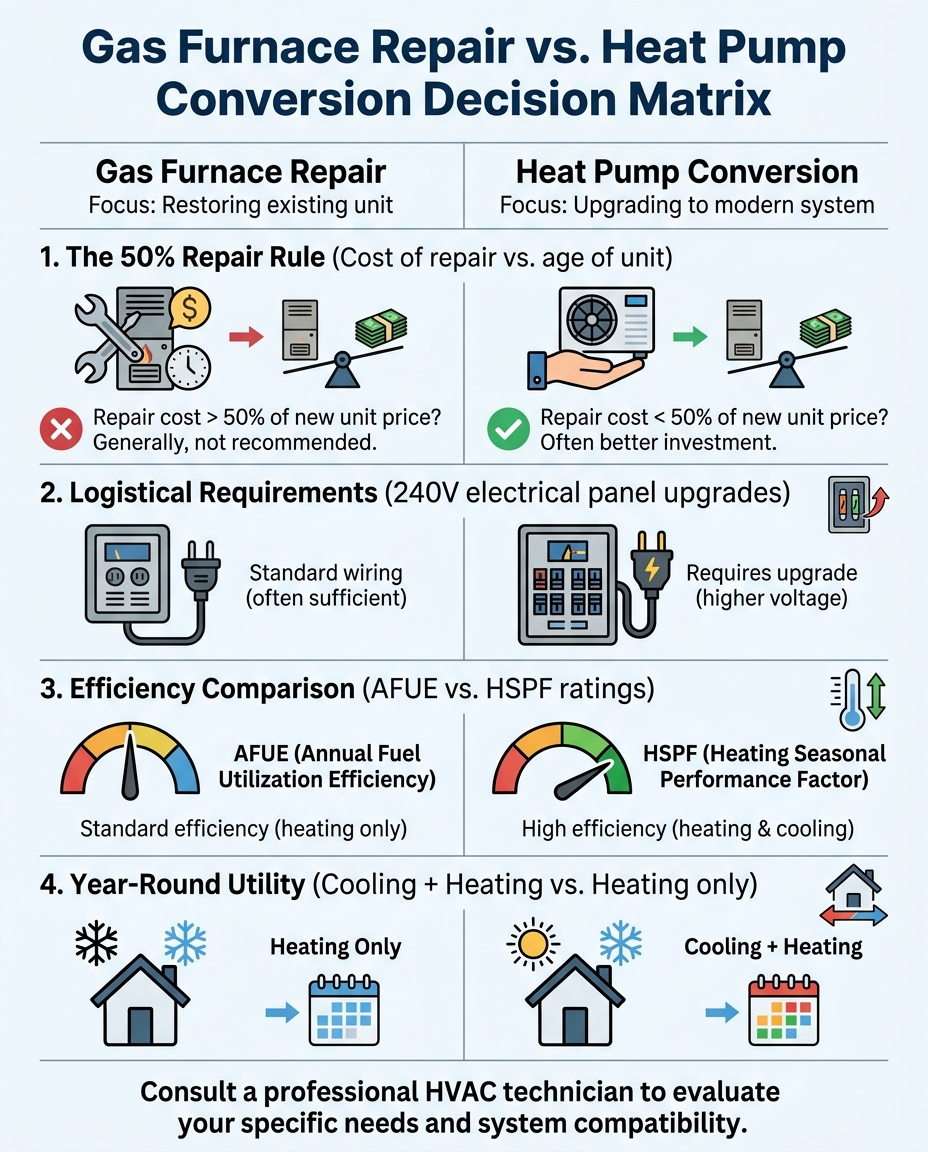
When you are staring down a major repair bill, you need a clear, objective metric to guide your choice. The industry-standard 50% rule is a highly effective tool we use with homeowners. Simply put, if the cost of fixing your system approaches half the value of a brand-new installation, replacement is generally the wiser path.
For example, our team recently helped a local San Antonio customer who called us during a previous winter when their heat stopped working completely. It was exceptionally cold, and they needed heat fast. Our technician was able to explain the problem clearly, fix the immediate issue, and keep the repair costs reasonable for them that time. However, not every aging system is so lucky. If your unit requires continuous, expensive interventions, you are likely reaching the point of diminishing returns.
If you need a gas furnace repair, it is crucial to evaluate the long-term viability of the equipment. Continuing to patch an old system often leads to compounding issues. A fix today might hold, but the stress on other aging components frequently causes a domino effect of failures.
1. Calculate the current repair: Look at the immediate estimate. Does it cross the 50% threshold of a new system?
2. Factor in recent fixes: Have you already paid for multiple service calls over the past two years?
3. Assess critical components: Are major parts like the heat exchanger or gas valve showing signs of imminent failure?
4. Evaluate peace of mind: Consider the value of knowing your system is fully reliable before the cold weather hits.
Assessing Age and Efficiency
Beyond the immediate repair cost, you must consider the age and declining efficiency of your unit. Traditional gas units have a typical lifespan, and as they approach the end of that window, their Annual Fuel Utilization Efficiency (AFUE) rating drops significantly. This means an older unit simply costs more to operate every single month. During your September pre-heating season tune-up, a thorough assessment of your unit's age and true operating efficiency will give you the complete picture of what that older system is actually costing you.
Why the Local Climate Makes Electric Conversions Ideal
In our years of serving San Antonio homes, we have found that understanding how modern HVAC technology interacts with our specific regional weather is crucial. Modern heat pumps do not generate heat by burning fossil fuels; instead, they transfer ambient heat from the outside air into your home. The magic of this technology lies in the refrigerant cycle. Even when it feels chilly outside, there is still an abundance of thermal energy in the air. The outdoor unit captures this energy, compresses the refrigerant to raise its temperature, and pumps that concentrated heat indoors. This heat transfer process makes them incredibly efficient, often delivering significantly more heat energy than the electrical energy they consume.
While older generations of heat pumps notoriously struggled in extreme northern freezes, today's modern units thrive in mild southern winters. This is where the local climate context becomes a major advantage. San Antonio's mild, relatively short winters provide the perfect environment for heat pumps to operate at absolute peak efficiency.
The Regional Advantage:
• Optimal temperature ranges: Local winter temperatures in San Antonio, TX, rarely dip below the threshold where these systems lose their operating efficiency.
• No secondary fuel needed: Because the climate is so accommodating, a secondary gas backup furnace is often entirely unnecessary in this region.
• Consistent, even heating: Heat pumps provide a steady, gentle flow of warm air, avoiding the harsh blasts of heat typical of traditional gas combustion.
By aligning your home's HVAC system with the realities of the local climate, you maximize both comfort and energy utilization. The technology has advanced to the point where relying on an electric conversion is not just a viable alternative to gas; in our specific weather conditions, we consider it the superior choice for consistent, efficient winter warmth.
The Hidden Logistics: Electrical Upgrades for Your New System
Moving away from a traditional gas setup to a fully electric system involves more than just swapping out the mechanical equipment. There is a hidden logistical hurdle that catches many homeowners off guard: the electrical infrastructure. A modern heat pump requires a dedicated 240V electrical circuit to power the new air handler and the outdoor condenser unit safely and effectively.
Older homes in San Antonio, TX, were often built with electrical panels designed for much lighter loads. When you transition from gas to electric heating, your home's electrical panel must have the capacity to handle that increased demand. If your current panel is outdated or full, an electrical upgrade is an unavoidable part of the conversion process.
The Traditional Frustration:
Typically, homeowners face a massive headache when trying to coordinate this upgrade. You hire an HVAC contractor to install the heat pump, but they tell you to go find a separate, licensed electrician to handle the 240V circuit and panel upgrades. You end up juggling multiple schedules, paying separate dispatch fees, and hoping the two distinct companies communicate effectively.
The Streamlined Solution:
This is where working with a unified team changes the experience entirely. As a comprehensive Air, Electric, and Plumbing company, Reliabee handles both the HVAC conversion and the necessary residential electrical services seamlessly in-house. Our licensed electricians work directly alongside our HVAC technicians. There is no need to hire a separate third-party contractor, no scheduling conflicts, and no miscommunication. Your panel upgrade and your new system installation are handled under one roof, ensuring a safe, code-compliant, and stress-free transition.
Year-Round Utility: Tackling Both Heating and Cooling
One of the most compelling reasons we advise moving away from a gas furnace is the dual-benefit nature of heat pump technology. A heat pump is essentially a high-performance air conditioner equipped with a reversing valve. During the summer, it pulls heat out of your home to cool it down. During the winter, it reverses that exact process, pulling ambient heat from the outside air indoors.
When you upgrade your heating system to a heat pump, you are simultaneously getting a brand-new, high-efficiency cooling system. This is a massive advantage in San Antonio, TX, where the system will also handle the intense summer cooling load typical of the region. The year-round utility of a single, highly efficient unit often heavily outweighs the benefits of traditional gas heating.
Consider a recent experience our technicians had with a local homeowner. This customer realized their aging setup was failing on multiple fronts, leaving their home uncomfortable year-round. We replaced both their heating and cooling systems at once. They were incredibly pleased with the professional installation and how our team took the time to explain the operation of their new, unified system.
If you choose to repair your failing gas unit, you are only solving half of your home's climate control equation. You are still left relying on an older, potentially failing air conditioner for the brutal summer months. Upgrading to a heat pump solves both problems simultaneously. If you find yourself replacing your gas furnace when changing out your air conditioner, a heat pump consolidates your equipment, simplifies your seasonal maintenance, and improves your overall home comfort every single month of the year.
Financial Considerations: Upfront Investment vs. Long-Term Returns
When evaluating your options during the September pre-heating season, the financial breakdown goes far beyond the initial estimate on a clipboard. It is vital to compare the immediate, sunk cost of patching a failing unit against the long-term investment of a completely new, highly efficient system.
Avoiding the Sunk Cost Fallacy:
A pattern we see often is homeowners feeling trapped into repairing an old system because they recently spent money on a minor fix. However, pouring more funds into a deteriorating gas furnace is often a sunk cost. The money spent on a major repair today does not add years to the lifespan of the rest of the aging components. Eventually, the cycle of repairs outpaces the cost of simply starting fresh.
Long-Term Operational Savings:
Conversely, converting to an electric heat pump represents an investment in long-term operational savings. High-efficiency electric heating insulates you from the often-fluctuating prices of natural gas. Because modern heat pumps transfer heat so efficiently, the month-to-month energy consumption is typically much lower, keeping your utility bills more predictable throughout the winter.
Incentives and Payment Flexibility:
Furthermore, the transition to high-efficiency electric systems is heavily encouraged at both the national and local levels. General federal tax credits and local utility incentive programs may apply to qualifying high-efficiency installations, helping to offset the initial conversion costs. Always consult with your tax professional or local utility provider to see what current incentives you qualify for.
Finally, do not let the upfront cost deter you from exploring your best options. We highly advise readers to look into flexible HVAC financing options. Breaking a comprehensive system upgrade into manageable monthly payments allows you to enjoy the comfort, safety, and efficiency of a new system immediately without straining your household budget.
Side-by-Side Comparison: Repairing Gas vs. Converting to Electric
Based on what our team typically sees in the field, making the best choice for your home in San Antonio, TX, requires seeing the facts laid out clearly. For homeowners at the bottom of the decision funnel, comparing the two paths side-by-side highlights exactly what you are getting for your money, your comfort, and your peace of mind.
When you look at the raw data, the contrast becomes sharp. Gas furnaces represent older, combustion-based technology that degrades over time. Heat pumps represent modern, clean-energy solutions that consolidate your home's climate control into a single, streamlined package. Repairing a gas furnace might seem like the path of least resistance, but it often comes with hidden long-term penalties in efficiency and reliability. Converting to an electric heat pump requires a larger initial logistical step, but it secures your home's comfort for the next decade or more.
Below is a clear breakdown of the primary decision-making factors:
• Upfront Investment — Repairing Aging Gas Furnace: Lower immediate cost, but highly susceptible to repeated breakdown expenses. — Converting to Electric Heat Pump: Higher initial investment, but offset by potential rebates and financing plans.
• Energy Efficiency — Repairing Aging Gas Furnace: Declining AFUE rating; costs more to operate as the system ages and wears down. — Converting to Electric Heat Pump: Operates at absolute peak efficiency; utilizes advanced heat transfer technology.
• Environmental & Safety Impact — Repairing Aging Gas Furnace: Involves combustion risks, potential carbon monoxide hazards, and fossil fuels. — Converting to Electric Heat Pump: Clean electric operation with zero on-site combustion or carbon monoxide risks.
• Longevity & Warranty — Repairing Aging Gas Furnace: Repairs carry very limited warranties; the rest of the aging unit remains unprotected. — Converting to Electric Heat Pump: Comes with comprehensive, long-term manufacturer warranties and full protection.
Secure Your Home's Comfort Before Winter Arrives
At Reliabee, we consistently advise our customers that the window to make a proactive decision is right now. Making a choice during the September pre-heating season prevents the stress and discomfort of an emergency breakdown during the first major cold snap. Whether you decide that a targeted repair is the right move for this year, or you are ready to make the leap to a high-efficiency electric conversion, taking action early puts you in control.
Remember, if you choose the conversion route, the logistics do not have to be overwhelming. Choosing a unified team that can handle both the advanced HVAC installation and the required electrical panel upgrades seamlessly under one roof makes all the difference. Do not wait for your aging system to force your hand on a freezing night. Schedule a professional evaluation with our team today to weigh your specific options and secure your home's comfort for the seasons ahead.
Frequently Asked Questions
Can I replace my gas furnace with a heat pump?
Yes, you can absolutely replace a gas furnace with an electric heat pump. The process involves removing the combustion equipment and installing a new electric air handler and outdoor condenser. You will likely need to upgrade your electrical panel to support the dedicated 240V circuit required by the new system.
Is a heat pump better than a gas furnace in Texas?
For most Texas homes, a heat pump is generally considered a superior option. The mild, relatively short winters are the exact environment where heat pumps operate at their absolute peak efficiency. Furthermore, because a heat pump also acts as an air conditioner, it effectively handles the intense, prolonged summer cooling demands of the region.
What electrical upgrades are needed for a heat pump conversion?
Converting from gas to electric heating requires significant electrical capacity. You will need a dedicated 240V circuit to power the new equipment safely. In many older homes, this requires a heavy-up or a complete electrical panel upgrade to ensure your home can handle the increased electrical load without tripping breakers.
Do I need a backup furnace with a heat pump?
In severe northern climates, a backup furnace is often required, but in milder southern regions, it is usually unnecessary. Modern heat pumps are highly capable of extracting heat from the air even when temperatures drop near freezing. Because local winter temperatures rarely stay below this threshold for long, a standalone heat pump is typically more than sufficient.
Is it cheaper to heat with gas or a heat pump in Texas?
Operating costs depend on the fluctuating prices of natural gas versus local electricity rates. However, because heat pumps transfer ambient heat rather than generating it from scratch, they are incredibly energy-efficient. This high efficiency often results in lower, more predictable monthly utility bills throughout the winter season.
How long does a gas-to-electric HVAC conversion take?
A standard conversion typically takes one to two full days to complete. The timeline depends heavily on the complexity of the required electrical upgrades and the accessibility of your existing ductwork. Hiring a contractor who handles both the HVAC and electrical work in-house can significantly streamline the schedule.

Ready to Transform Your Home?