The True Cost of Delaying a Leaky Water Heater Replacement
The Deceptive Danger of a "Minor" Water Heater Drip
You walk into your utility closet or garage and notice a small, seemingly harmless puddle forming near the base of your tank. Many homeowners assume this is just a minor quirk of an aging system, but the true cost of delaying a leaky water heater replacement is far greater than most realize. In the plumbing world, a drip coming from the tank itself is rarely a simple fix—it is a glaring warning sign of impending structural failure. The decision point is clear: you must choose between a controlled, scheduled replacement right now or waiting for an inevitable, catastrophic emergency.
If you are already seeing signs of failure, exploring professional water heater services is the safest way to protect your property.
The timing of the failure matters: As we enter the September pre-heating-season transition, the incoming water from the municipal supply begins to drop in temperature. Your water heater has to work considerably harder and cycle more frequently to bring that cooler water up to your desired temperature. This added thermal stress causes the metal tank to expand and contract more aggressively. If the structural integrity of your tank is already compromised enough to allow a minor drip, this seasonal shift in workload is often the exact trigger that pushes a weakened system past its breaking point. Addressing the vulnerability now ensures your home is protected before holiday guests arrive and the system faces its peak annual demand.
Anatomy of a Tank Failure: Why Leaks Can't Be Patched
The underlying problem: Standard tank water heaters have an average lifespan of 8 to 12 years. Throughout that decade of service, the appliance relies on a specific internal mechanism to protect itself from the highly corrosive nature of heated water. This protection comes in the form of a sacrificial anode rod—a long metal wand suspended inside the tank that is designed to attract corrosive elements and rust away so the steel walls of the tank do not.
The root cause of the leak: Once that anode rod is completely depleted, the water's corrosive properties have nowhere else to go but the inner steel lining of the tank itself. The tank begins rusting from the inside out. Because this deterioration happens entirely out of sight, homeowners in San Antonio area homes often have no idea their system is failing until the rust finally eats completely through the steel wall and the outer jacket. By the time water is visible on the outside, the internal structural integrity is already thoroughly compromised.
The reality of the solution: A pervasive myth in home maintenance is that a leaking water heater can simply be welded, sealed with epoxy, or patched from the outside. This is structurally impossible. Because standard tanks rust from the inside out, an exterior patch does nothing to restore the paper-thin, rusted steel holding back dozens of gallons of pressurized water. The only permanent, safe solution is a complete unit replacement.
• Small puddle at the tank base — Internal Root Cause: Inner steel lining has rusted completely through — Professional Solution: Immediate full tank replacement
• Rusty or discolored hot water — Internal Root Cause: Anode rod is depleted; severe interior tank corrosion — Professional Solution: System assessment; likely replacement
• Popping or rumbling noises — Internal Root Cause: Thick sediment buildup trapping boiling water at the bottom — Professional Solution: System flush or replacement if heavily calcified
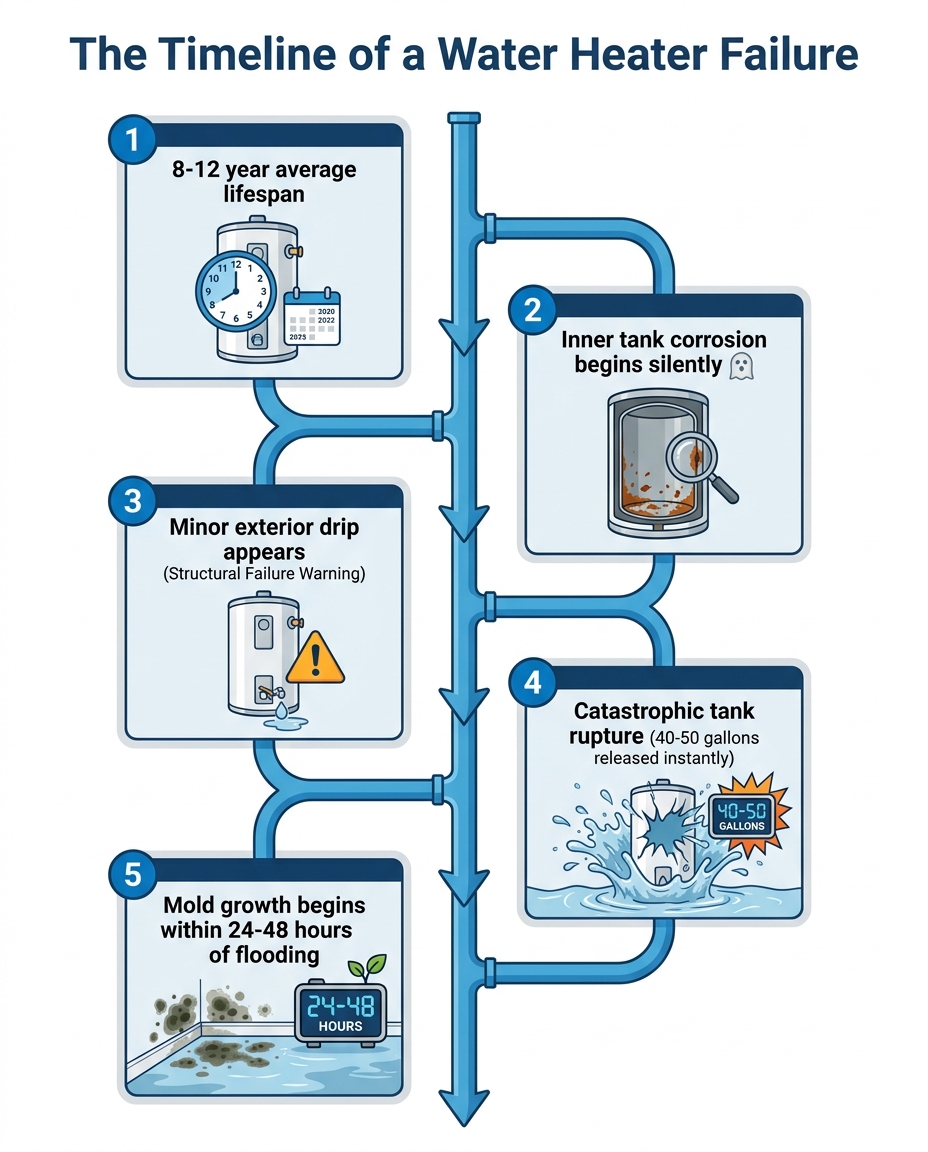
The Immediate Impact: When a Drip Becomes a Deluge
To truly understand the risks of delaying a replacement, it is vital to look at the physical reality of a tank rupture. When a structurally compromised tank finally gives way, the situation escalates from a minor annoyance to a chaotic event in seconds. A typical pattern we see in San Antonio area homes is a homeowner ignoring a small weep near the base of the tank, only to wake up to thousands of dollars in property destruction.
When a drip becomes a deluge, the timeline of destruction looks like this:
1. The initial rupture: The weakened steel gives way, instantly releasing 40 to 50 gallons of stored, scalding water into the surrounding utility closet, garage, or interior hallway.
2. The continuous pressurized flow: The flooding does not stop when the tank empties. Because the water heater is connected directly to your municipal water supply, the main line will continue to pump pressurized water into your home at full volume until someone locates and manually shuts off the main water valve.
3. The immediate structural saturation: Water quickly spreads across the floor, soaking into baseboards, seeping under expensive hardwood or laminate flooring, and saturating the bottom edge of your drywall.
4. The frantic mitigation: Homeowners are suddenly thrust into a high-stress scramble to stop the water, extract the flood, and find an available technician.
Contrast this chaotic, high-stress emergency event with the calm, predictable process of a proactive replacement. When you schedule a replacement before the tank bursts, the water is drained safely through a hose, the old unit is removed without spilling a drop, and the new system is installed on your schedule. If you find yourself facing the worst-case scenario, reaching out for emergency plumbing assistance immediately is critical to stopping the flow and minimizing the devastation.
Secondary Damage and the Rapid Onset of Mold
The immediate destruction of flooring and baseboards is only the first phase of the problem. The cascading effects of indoor water damage are severe, and they are heavily influenced by our regional climate. San Antonio's high ambient humidity leaves zero margin for error; indoor water damage combined with a warm, humid climate creates the perfect incubator for rapid, severe mold growth.
The timeline of indoor mold: According to environmental guidelines, mold spores can begin multiplying within 24 to 48 hours of water exposure. When 50 gallons of hot water flood an interior space, that water immediately begins evaporating into the indoor air, drastically spiking the humidity levels inside your home. Drywall acts like a sponge, wicking the standing water upward into the walls far beyond the visible water line on the floor.
The remediation reality: Once mold sets into the paper backing of your drywall and the wooden framing of your house, a straightforward plumbing issue instantly transforms into a major structural remediation project. You are no longer just paying to replace a water heater; you are dealing with industrial dehumidifiers, drywall removal, baseboard replacement, and specialized mold mitigation teams. Furthermore, this massive spike in indoor moisture can severely compromise your home's overall water quality and air quality for months.
The true return on investment for proactive replacement isn't just getting a new, energy-efficient appliance—it is entirely avoiding the massive secondary damages and health hazards associated with a flooded home.
Hidden Risks: The Electrical Dangers of Plumbing Floods
While water damage is the most obvious consequence of a failing tank, the intersection of water and electricity in utility closets presents a severe, immediate safety hazard. In many San Antonio area homes, the water heater shares a tight space with other critical mechanical systems, including the home's main electrical panel, nearby outlets, and the HVAC air handler.
The 240-Volt Threat
Electric water heaters require a dedicated 240-volt electrical circuit to operate the heavy-duty heating elements inside the tank. When a tank ruptures, water can easily spray across the side of the unit, completely saturating the electrical access panels, the thermostats, and the wiring connections. Standing in a puddle of water near a live 240-volt appliance is an incredibly dangerous situation that poses a severe shock or electrocution risk.
The Multi-Trade Advantage
Because of these electrical hazards, replacing a compromised unit safely requires more than just turning a wrench. The power supply must be safely verified as disconnected at the breaker, and the wiring must be carefully inspected for water damage before any plumbing extraction or replacement begins. This is where working with a comprehensive service provider becomes invaluable. As a company with comprehensive Air, Electric, and Plumbing capabilities, our technicians can safely handle the necessary electrical disconnects, assess the wiring for safety, and manage the plumbing replacement in a single, safe visit. You don't have to coordinate an electrician to make the area safe before the plumber is allowed to work—the entire hazard is neutralized and resolved under one roof.
How a Failing Water Heater Strains Your Broader System
A failing water heater does not operate in isolation; it is a vital organ in your home's overall plumbing anatomy. When the tank begins to deteriorate, the ripple effects can be felt at every faucet and fixture in the house, particularly as we move into the September pre-heating-season transition when household usage often increases.
The spread of sediment: As the interior of the tank rusts and breaks down, heavy flakes of rust, scale, and mineral sediment accumulate at the bottom of the tank. Over time, this abrasive debris can be pulled into your hot water supply lines. As it travels through your pipes, it causes several secondary issues:
• Clogged aerators: Small pieces of sediment get trapped in the fine mesh screens of your bathroom and kitchen sink faucets, drastically reducing water pressure.
• Damaged shower cartridges: The abrasive grit can score and ruin the delicate mixing valves in your showers, leading to leaks behind the wall or an inability to control water temperature.
• Appliance strain: Dishwashers and washing machines that rely on the hot water line can suffer premature wear as their inlet screens become choked with tank debris.
Furthermore, ignoring plumbing vulnerabilities places undue stress on the entire system. A compromised plumbing infrastructure can sometimes lead to unexpected issues in other areas of the home. For example, severe pressure imbalances or sediment issues can disrupt the proper function of your drainage and venting systems, which is a common culprit when homeowners start noticing strange odors and researching clogged plumbing vents. Taking a holistic approach to your home's maintenance means recognizing that a failing water heater is actively degrading the performance of your entire plumbing network.
Frequently Asked Questions About Leaking Water Heaters
For many homeowners in San Antonio area homes, discovering a leak raises immediate concerns about safety, timelines, and residential plumbing best practices. When you are standing over a puddle in your garage, you need fast, authoritative answers. Here are the most common questions we receive regarding failing tanks and what they mean for your home.
Is a leaking water heater considered an emergency?
Yes, if the leak is coming from the tank itself, it should be treated as an emergency. A leak on the outer jacket indicates imminent structural failure that can cause massive flooding at any moment. While a loose fitting at the top of the unit might just require a quick tightening, water pooling at the base means the steel has rusted through.
What happens if you ignore a leaking water heater?
If ignored, the tank will eventually rupture completely, releasing its entire capacity of scalding water instantly. This leads to uncontrolled flooding, potential electrical hazards if the water reaches nearby outlets or panels, and severe secondary property damage. The resulting moisture will also trigger rapid mold growth within the surrounding walls.
Can a leaking water heater be patched?
No. Standard tanks rust from the inside out due to the depletion of the internal anode rod. By the time water is visible on the exterior, the inner steel lining is thoroughly compromised. An exterior patch cannot restore the lost structural integrity of the steel, making replacement the only safe option.
How long can you wait to replace a leaking water heater?
You should not wait at all. A leaking tank is completely unpredictable; it could hold together for another week, or it could burst in the next ten minutes. To avoid catastrophic failure and thousands of dollars in water damage, you must schedule a professional replacement immediately upon discovering the leak.
Can a leaking water heater explode?
While a true explosion is rare, it is possible if the temperature and pressure relief (T&P) valve fails while the tank is structurally compromised, allowing pressure to build dangerously high. Much more commonly, the weakened tank will simply burst open along a rusted seam, violently flooding the immediate area with pressurized water.
Does a small puddle always mean the inner tank is failing?
Not always, but it is the most common cause. Sometimes, a small puddle can be traced to a leaky drain valve, a loose supply line connection, or a weeping T&P valve. However, because the risk of a full tank rupture is so high, any unexplained water near the base of the unit requires immediate professional assessment to rule out structural failure.
Protecting Your Home with Proactive Replacement
The central truth of home maintenance is that ignoring a warning sign never makes the problem cheaper to resolve. The true cost of delaying a leaky water heater replacement isn't just the eventual cost of the new unit—it is the massive secondary damages of a flood, the structural remediation of mold, and the deep stress of navigating an unexpected home emergency.
As we navigate the September pre-heating-season transition, now is the perfect time to upgrade your system before the cooler weather places higher demands on your hot water supply. If you have noticed a minor drip, strange noises, or rusty water, do not wait for the tank to make the decision for you. Seek a clear, expert assessment of your current unit today. By exploring your professional replacement options now, you ensure long-term peace of mind, protect your property from catastrophic water damage, and guarantee your family has safe, reliable hot water all season long.

Ready to Transform Your Home?