The Connection Between Fall Allergies and Dirty HVAC Blower Motors
The Hidden Source of September Sneezing: Your Blower Motor
If you are researching the connection between fall allergies and dirty HVAC blower motors, you might be shocked to learn that indoor air can be two to five times more polluted than outdoor air. This is a startling statistic that becomes painfully obvious during seasonal transitions. For many homeowners, the arrival of the September ragweed season brings a wave of severe indoor allergy symptoms—sneezing, coughing, and itchy eyes—that persist no matter how often the house is cleaned. You might vacuum daily, dust every surface, and swap out your air filter, yet the air inside your home still feels heavy and irritating.
To address this frustrating cycle, it helps to look deeper into the mechanics of your HVAC system. The root cause of these relentless indoor allergies is often hiding out of sight: a dust-caked blower motor wheel that is actively recirculating allergens throughout your living space. Recognizing that simply changing the air filter isn't enough is the critical first step. When the internal components of your heating and cooling equipment are contaminated, professional intervention is necessary to stop the cycle of poor indoor air quality and restore comfort to your home.
The Mechanics of the 'Squirrel Cage' Blower Wheel
The Problem: Your heating and cooling system relies on a specific component to move conditioned air through your ductwork. This part, often referred to as a "squirrel cage" blower wheel, consists of dozens of curved, tightly spaced blades designed to scoop air and push it forward. Over time, these blades can become heavily contaminated, transforming from a smooth aerodynamic surface into a thick, sticky mess of household debris.
The Cause: The accumulation process doesn't happen overnight. It is the result of months of extreme usage. In our years serving San Antonio, the team at Reliabee Air Electric Plumbing has seen exactly how heavy summer AC usage creates the perfect storm for this buildup. As your system runs continuously to battle the Texas heat, it naturally generates condensation. This moisture mixes with the microscopic dust particles that inevitably bypass standard fiberglass air filters. Over the course of a long, hot summer, this mixture fuses to the curved blades of the blower wheel, creating a sticky, cement-like layer of grime just in time for fall.
The Solution: Understanding how this sticky layer becomes a magnet for pollen is key to solving the problem. When fall arrives and outdoor allergens infiltrate the home, they are drawn into the return vents and stick directly to the dirty blower wheel. To resolve this, the blower assembly must be physically removed and deep-cleaned by a professional, stripping away the summer's accumulation before it can trap and distribute autumn pollen.
How Summer Cooling Sets the Stage for Fall Allergies
• Continuous AC cycling creates moisture: The constant operation required to cool a home during peak heat generates significant condensation within the air handler unit.
• Moisture mixed with household dust forms a cement-like buildup: As microscopic particles bypass the filter, they stick to the damp blades of the blower wheel, baking into a hard crust during off-cycles.
• The buildup hardens and prepares to catch newly introduced allergens: By the time September rolls around, this hardened, textured surface acts like a magnet, catching and holding onto newly introduced ragweed pollen before blowing it back into your rooms.
The Illusion of the Clean Air Filter
One of the most common misconceptions among homeowners is the belief that sliding a brand-new, high-efficiency filter into the return grille will instantly solve all indoor air quality issues. While a fresh filter is essential, it creates a false sense of security if the mechanical components downstream are already compromised. To understand why, you have to look at the physical path the air takes as it moves through your equipment.
Air is drawn from your home into the return ducts, passes through the air filter, and then hits the blower motor assembly before being pushed into the supply ducts. If the blower motor itself is caked in dust, it actively contaminates the air after it has already been filtered. Standard one-inch filters are primarily designed to protect the equipment from large debris—like pet hair and heavy dust—not necessarily to purify the air you breathe. When the blower wheel is dirty, it acts as an active allergen distribution system, bypassing the filter's efforts completely and keeping the September ragweed season alive and well inside your living room.
The Filter vs. The Blower Motor: A Quick Comparison
• Air Filter — Primary Function: Catches large particles on the intake side before they enter the equipment. — What Happens When It Fails: Restricts incoming airflow and allows dirt to reach the blower motor.
• Blower Motor Wheel — Primary Function: Scoops and pushes conditioned air into the supply ductwork. — What Happens When It Fails: Actively blows trapped dust and pollen directly into the living space.
If you want to understand more about how debris travels through your home, learning how clogged air ducts impact your HVAC system can shed light on the broader consequences of a contaminated air handler.
Why Fresh Filters Aren't Enough
Filters only catch particles on the intake side: A filter can only clean the air that passes through it. It has zero impact on the dirt that is already living inside the machine. Contaminants on the blower wheel are blown directly into the supply ducts: Every time the system kicks on, the force of the spinning wheel dislodges microscopic allergens and sends them straight into your bedrooms and living areas. The cycle of recirculation keeps airborne allergens suspended: Because the air is constantly moving, these irritants never truly settle, ensuring they are continuously inhaled by your family.
The Hidden Cost: CFM Drops and Prolonged Allergen Circulation
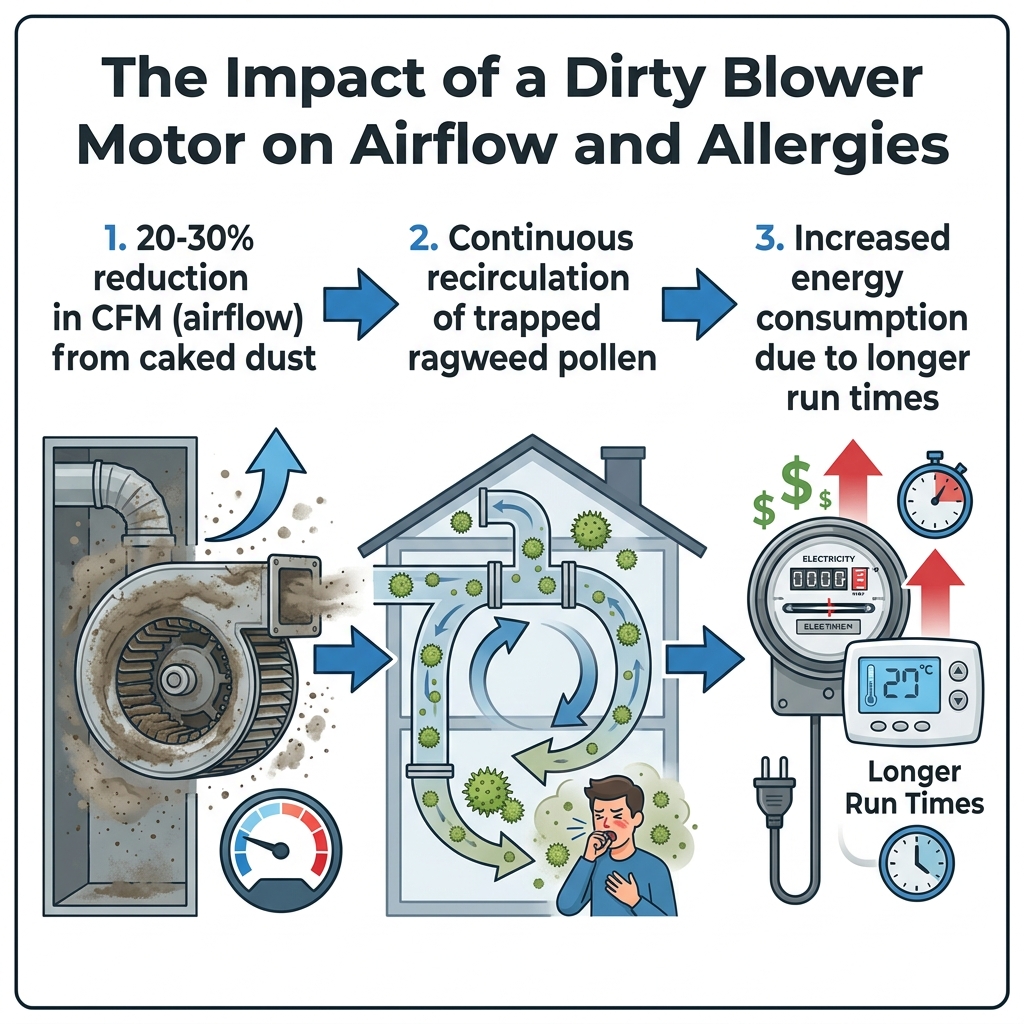
Beyond the immediate irritation of sneezing and coughing, a contaminated blower wheel carries a significant technical cost that impacts the overall health of your home's climate control system. In the heating and cooling industry, airflow is measured in CFM, or Cubic Feet per Minute. This measurement dictates how much conditioned air your system can successfully push into your living space. When the curved blades of a squirrel cage blower are filled with dirt, they lose their ability to scoop air effectively.
A severely dirty blower wheel can result in a reduced airflow / CFM drop from caked dust of up to 20 to 30 percent. This dramatic reduction means your system is pushing significantly less air than it was designed to. Because less cold or warm air is reaching the thermostat, the system is forced to run much longer to satisfy the temperature setting. These extended run times are terrible news for allergy sufferers. The longer the fan runs, the longer it circulates ragweed and other airborne irritants throughout the house.
The Ripple Effect of Restricted Airflow
• Cupped blades lose their aerodynamic efficiency: The specific curve of the blade is what moves the air; when that curve is filled with dirt, the wheel just spins without actually moving the proper volume of air.
• The motor works harder, increasing energy consumption: Because the system runs longer to reach the desired temperature, your monthly utility bills will inevitably rise.
• Stagnant air pockets allow allergens to settle: Weak airflow means the air doesn't circulate properly through the whole room, creating stagnant zones where dust and pollen settle heavily onto furniture and carpets.
Integrating Whole-Home Air Quality Strategies
Addressing a dirty blower motor is the critical first step to restoring baseline air quality, but it shouldn't be the last. Once the mechanical components of your system are clean and functioning at their proper CFM, you can implement supplementary strategies that work in tandem with your equipment to keep the air pristine year-round.
1. Start with a Deep Clean: Have a professional safely remove and clean the blower motor assembly. This establishes a clean slate for the rest of your home's air quality strategy.
2. Upgrade Your Filtration: Once the blower is clean, consider upgrading to a thicker media filter (like a 4-inch or 5-inch cabinet filter) that can capture smaller particles without restricting airflow.
3. Implement Active Purification: Consider adding dedicated air cleaners or UV light purifiers directly into the ductwork. These systems actively neutralize biological contaminants and neutralize pollen before it reaches the living space.
4. Address Temperature Inconsistencies: Proper airflow often reveals other system imbalances. Our technicians see this firsthand; for example, one San Antonio homeowner reached out to our team last spring because their home had major inconsistent temperatures between the upstairs and downstairs. Because the property required an entire system replacement, the solution involved installing a two-zone system alongside a dedicated air cleaner. The outcome was vastly improved temperature control and a foundation for superior indoor air quality, proving that addressing the entire system's performance ensures consistent temperatures and cleaner air.
5. Maintain the Standard: Schedule routine inspections to ensure that these upgrades remain effective, as they perform best when the foundational mechanical components are kept pristine.
Exploring comprehensive home performance solutions can help you tailor these strategies to the specific layout and needs of your property.
Comprehensive Maintenance vs. Basic Checks
Not all tune-ups are created equal, and understanding the difference is vital for allergy sufferers. Basic "blow-and-go" tune-ups often skip the difficult, time-consuming task of pulling and deep-cleaning the blower motor assembly. A technician might change the filter, check the refrigerant, and wipe down the outside of the cabinet, but leave the heavily contaminated squirrel cage completely untouched. This superficial approach does nothing to solve the problem of recirculated dust.
Properly accessing, removing, and safely cleaning a blower motor is a rigorous process that requires a licensed professional—this is never a DIY project. The assembly is wired directly into high-voltage components, and the wheel itself must be handled carefully to avoid throwing it out of balance. At Reliabee Air Electric Plumbing, our team provides comprehensive HVAC maintenance that goes beyond basic checks to ensure blower motors are thoroughly cleaned for optimal indoor air quality. By investing in a thorough cleaning, you eliminate the source of the recirculated dust, restore the system's CFM, and improve overall energy efficiency.
The value of expert diagnosis cannot be overstated. In another instance last spring, a local customer with a recently installed commercial 5-ton unit reached out to our technicians for service, assuming a major overhaul was needed due to poor performance. Rather than pushing for unnecessary work, our technician identified that only a precise adjustment to the outdoor unit was required. This saved the customer time and headaches, highlighting the long-term benefits of a structured, honest maintenance approach for anyone suffering from a reduced airflow / CFM drop from caked dust.
To keep your system running at peak performance year after year, consider enrolling in a professional HVAC maintenance plan.
What to Expect from a Professional Blower Cleaning
• Safe power disconnection and component removal: The technician will completely kill the power to the unit and carefully extract the heavy motor assembly from the cabinet.
• Specialized brushing and vacuuming of individual fan blades: Using specific tools, the technician will clean the cupped side of every single blade to remove the hardened summer grime.
• Rebalancing and testing to ensure restored airflow: Once reinstalled, the system is tested to ensure the wheel spins quietly, without vibration, and delivers the proper volume of air.
Frequently Asked Questions About HVAC Blower Motors and Allergies
Why is my house so dusty even with a new filter?
A new filter only catches dust on the intake side of your system. If your home remains dusty, it usually means the blower motor wheel or the ductwork itself is already contaminated. The spinning blower wheel acts as an active distribution system, blowing trapped dirt directly into your living space and bypassing the clean filter entirely.
Can a dirty HVAC blower motor cause allergies?
Yes, a dirty blower motor is a major contributor to indoor allergies. During seasonal transitions, pollen and outdoor irritants are drawn into the system and stick to the grime already present on the blower blades. Every time the system cycles on, it forcefully recirculates these allergens back into the air you breathe.
How do you know if your blower motor needs cleaning?
The most common signs include weak airflow coming from your vents, a sudden increase in indoor allergy symptoms, or a system that runs constantly without reaching the set temperature. You might also notice a thin layer of dust accumulating on your furniture just days after you have cleaned.
Does cleaning the HVAC blower increase airflow?
Absolutely. Cleaning a heavily caked blower wheel can restore up to 20 to 30 percent of your system's lost airflow. By removing the debris from the curved blades, the wheel regains its aerodynamic ability to scoop and push the proper volume of conditioned air through the ducts.
Can ragweed pollen bypass an HVAC air filter?
Yes, ragweed pollen is microscopic and can easily bypass standard one-inch fiberglass filters. Once it slips past the filter, it often sticks to the damp, dusty surfaces of the internal equipment, particularly during the September ragweed season, where it waits to be blown back into the home.
How often should an HVAC blower motor wheel be deep cleaned?
A blower motor wheel should typically be inspected annually during a comprehensive maintenance visit. Depending on your local climate, usage habits, and indoor air quality, a deep physical cleaning is usually required every three to five years to maintain optimal airflow and hygiene.
Breathe Easier This Fall with Professional HVAC Care
The transition into the cooler months shouldn't mean retreating indoors only to suffer from relentless sneezing and coughing. The reality is that a brand-new air filter is virtually useless if the blower motor sitting right behind it is covered in a thick layer of summer dust. That sticky buildup acts as a launchpad, ensuring that the September ragweed season dominates the air inside your living room.
Professional cleaning is the only way to safely remove this hardened grime. By extracting the assembly and cleaning the individual blades, a licensed technician restores vital airflow and stops the endless cycle of allergen recirculation. If you are tired of battling poor indoor air quality despite your best cleaning efforts, it is time to explore comprehensive maintenance options. A thorough, professional approach will protect your home's air quality, providing a clear, technical solution that finally allows you and your family to breathe easier.

Ready to Transform Your Home?