HVAC Maintenance: Decoding Burning Smells and Cold Air During the First Fall Startup
The First Cold Snap Surprise: Is Your Heater Safe to Run?
You switch the thermostat to 'heat' for the first time this season, expecting cozy warmth to quickly fill your home. Instead, you get a harsh blast of cold air and an alarming odor that smells like toasted dust—or worse, burning plastic. At Reliabee Air Electric Plumbing, we know this is a critical moment. When you rely on our local service expertise and area tips to keep your household running smoothly, you can navigate that sudden, jarring experience during the November first cold snap with confidence, rather than wondering if you are dealing with a normal seasonal transition or a dangerous mechanical failure.
Addressing these unsettling symptoms promptly prevents minor issues from escalating into costly, mid-winter breakdowns. It also ensures your family's safety before the freezing temperatures set in permanently. If you want to avoid the stress of dramatic temperature shifts and sudden equipment malfunctions, an HVAC maintenance plan is the most reliable way to catch underlying problems before you ever touch the thermostat.
Why the Eight-Month Heating Hiatus Causes Dramatic Startups
Our technicians at Reliabee see firsthand how heating systems in the San Antonio metro area operate under a unique set of seasonal pressures. Unlike northern climates where heaters run for half the year, South Texas systems experience incredibly long cooling seasons. From March through October, your system runs almost exclusively in air conditioning mode. This leaves the internal heating components completely dormant for eight months or more.
During this extended idle period, the air handler continues to pull air through the system to cool your home. While the air conditioning coil is working hard, the gas heat exchanger or electric heat strips sit perfectly still in the dark, damp environment of your indoor unit. Over those eight months, dust, pet dander, and microscopic airborne debris inevitably settle on these heating elements. When the system finally fires up for the first time in late fall, the intense heat instantly incinerates that accumulated layer of debris.
The result: A dramatic, often smelly startup that is much more pronounced than what homeowners experience in colder regions. Understanding the difference between surface dust ignition and internal mechanical friction is the first step in diagnosing your system's health.
The Anatomy of Dust Accumulation
You might wonder how dust reaches these internal components if you are diligent about changing your filters. The reality is that standard residential air filters are designed to protect the blower motor from large particles, but they do not catch 100% of microscopic dust—especially over an eight-month span.
• Filter bypass: Small amounts of air can pull around the edges of a standard filter, carrying fine particles into the system.
• Ductwork micro-leaks: Systems located in dusty attics can pull in unconditioned air through tiny gaps in the return plenum.
• Static attraction: Electric heat strips carry a slight static charge even when off, which naturally attracts fine household dust over time.
When the heater finally turns on, temperatures on the heat exchanger or electric strips can reach several hundred degrees within seconds, instantly vaporizing the dust blanket and sending that distinct toasted smell through your vents.
Decoding the Burning Smell: Normal Dust Burn-Off vs. Electrical Hazards
In our years of diagnosing HVAC systems across San Antonio, we've found that knowing how to interpret what you are smelling when the November first cold snap arrives can save your home from a serious hazard. A harmless dust burn-off and a critical electrical failure require completely different responses.
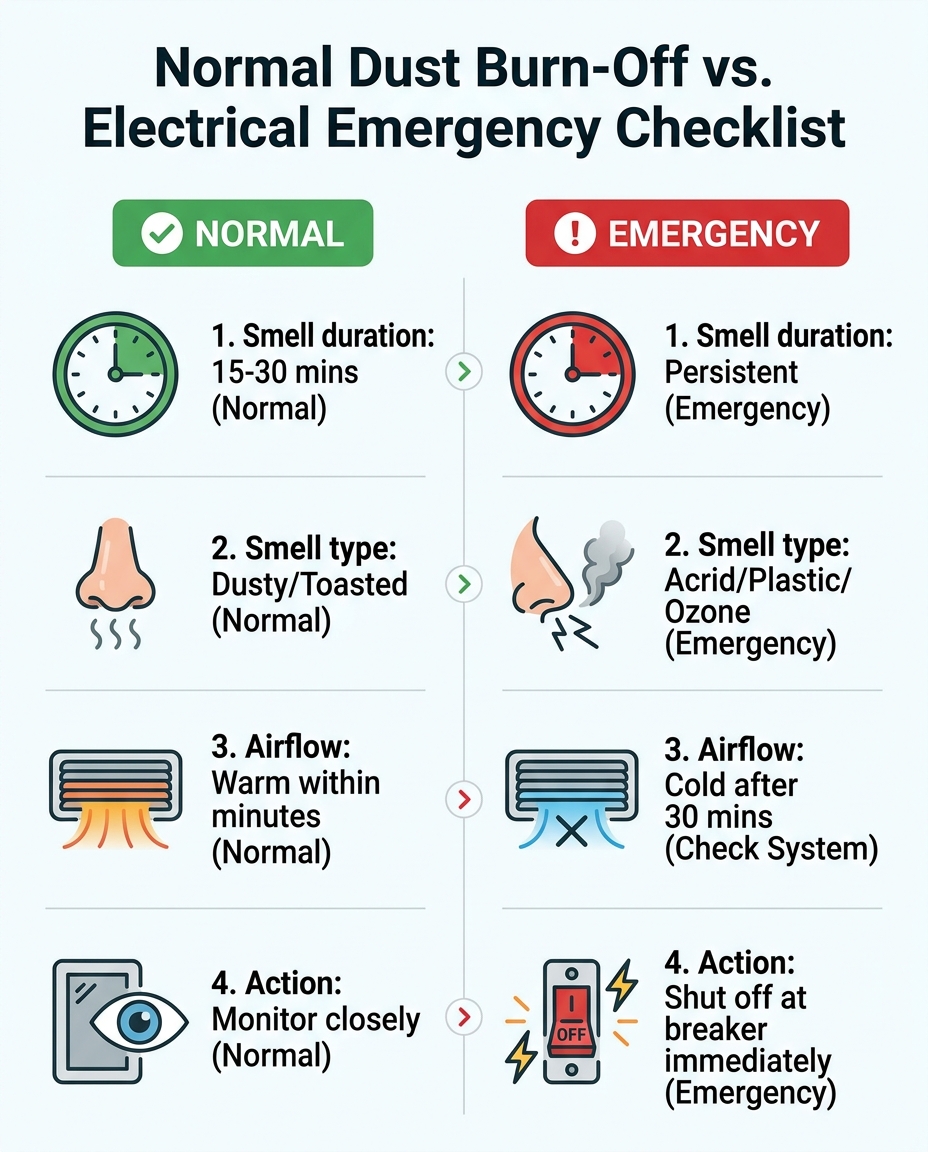
Normal dust burn-off has a very specific scent—it smells like toasted lint or warm earth. Most importantly, it is temporary. The smell should peak within the first five minutes of operation and completely dissipate within 15 to 30 minutes as the system clears the vaporized particles out of the ductwork. If the smell changes to an acrid, chemical odor resembling burning plastic, melting wire casing, or ozone, you are likely facing a failing electric heat strip, a seized blower motor, or compromised high-voltage wiring.
This is where professional heating maintenance becomes critical. Comprehensive inspections coordinate electrical and AC diagnostics in a single visit, ensuring that complex electrical faults masking as simple heating issues are accurately identified before they cause cascading system failures.
When to Wait and When to Worry
To help you navigate that stressful first startup, use this diagnostic breakdown to determine your next steps:
• Smell Characteristics — Normal Dust Burn-Off: Toasted dust, warm lint, slightly earthy. — Electrical / Mechanical Hazard: Acrid, burning plastic, fishy electrical odor, or sharp ozone.
• Duration — Normal Dust Burn-Off: Fades entirely within 15 to 30 minutes. — Electrical / Mechanical Hazard: Persists, intensifies, or returns every time the system cycles on.
• Airflow Temperature — Normal Dust Burn-Off: Gradually warms up within 5 to 10 minutes. — Electrical / Mechanical Hazard: Remains stubbornly cold, or airflow is extremely weak.
• System Sounds — Normal Dust Burn-Off: Standard blower hum and steady air movement. — Electrical / Mechanical Hazard: Loud buzzing, grinding, clicking, or immediate breaker tripping.
• Required Action — Normal Dust Burn-Off: Monitor closely for the first 15 minutes. Open a window if needed. — Electrical / Mechanical Hazard: Shut off the system at the thermostat and the main breaker immediately.
Why Your Heat Pump Might Blow Cold Air Initially
If your home relies on a heat pump rather than a traditional gas furnace, the initial startup sequence behaves very differently. Heat pumps do not generate heat by burning fuel; instead, they extract ambient heat from the outdoor air and move it inside. When outside temperatures plummet rapidly in the San Antonio metro area, your heat pump has to work harder to extract that thermal energy.
On our late fall service calls, we frequently reassure homeowners that it is incredibly common for a heat pump to blow cool or lukewarm air for the first few minutes of operation. However, if the air remains cold after 15 minutes, you may be dealing with a stuck reversing valve or a failed auxiliary heat strip, which requires professional heat pump service to resolve.
Understanding the Defrost Cycle
One of the most misunderstood features of a heat pump is its defrost cycle. When the outdoor temperature drops near freezing, moisture in the air can freeze on the outdoor condenser coil. To protect the compressor from ice damage, the system temporarily reverses itself.
1. The sensor triggers: The outdoor unit detects frost building up on the exterior coil.
2. The reversing valve shifts: The system temporarily switches back into air conditioning mode, sending hot refrigerant outside to melt the ice.
3. The indoor fan continues: While the outdoor coil is melting, the indoor unit may blow cool air into your home for a few minutes.
4. Auxiliary heat engages: To counteract the cold air, the system should automatically engage the electric auxiliary heat strips. If these strips are dusty (or failing), you will experience a blast of cold air followed by a burning smell.
Once the outdoor coil is clear of frost, the reversing valve shifts back, and warm air returns to your vents. This cycle is perfectly normal, but if your system gets stuck in defrost mode, professional intervention is necessary.
The Impact of Older R22 Refrigerant Systems on Winter Performance
For homeowners still operating older HVAC systems, winter performance can be particularly problematic. Systems manufactured before 2010 often use R22 refrigerant, which has been entirely phased out of production due to environmental regulations. As these aging systems develop micro-leaks, their refrigerant levels slowly drop.
While a system with slightly low refrigerant might limp through a mild summer day, it will fail dramatically when forced to heat your home during a cold snap. The relationship between the refrigeration cycle and effective winter heating is absolute. A heat pump relies on optimal refrigerant pressure to absorb and compress thermal energy. If you want to understand the exact physics behind this process, learning how an air conditioner works will show you why low pressure ruins efficiency.
The bottom line: Older R22 systems with low refrigerant cannot generate enough pressure to extract heat from near-freezing air. This causes the system to run constantly, blow cold air, and rely entirely on expensive emergency heat strips, driving up your energy consumption while leaving your house chilly.
Safe Steps for Testing AC and Heating Equipment Before Freezing Temps
The best way to handle the November first cold snap is to avoid being surprised by it altogether. Testing your AC and heating functions on a mild afternoon before the actual freezing temperatures arrive gives you a safe window to identify problems. Routine check-ups prolong unit life, save energy over the long term, and keep you off the emergency service schedule.
Just last season, a San Antonio homeowner reached out to our Reliabee team during a freezing winter stretch when their heat stopped working properly right when it was needed most. One of our technicians was able to explain the underlying problem clearly, perform outstanding repair work, and get the system running properly again. Proactive testing helps prevent these high-stress winter breakdowns.
What Homeowners Can Safely Check
Before calling us for professional air conditioning services or heating diagnostics, run through this safe, homeowner-level checklist:
• Verify thermostat settings: Ensure the system is actually set to "Heat" and the fan is set to "Auto." A fan set to "On" will blow cold air between heating cycles.
• Replace the thermostat batteries: Weak batteries can cause erratic system behavior, rapid cycling, or a failure to trigger the auxiliary heat.
• Inspect and replace air filters: A clogged filter severely restricts airflow, causing the heat exchanger to overheat and potentially triggering a safety shutdown.
• Check vent clearances: Walk through your home and ensure no rugs, furniture, or heavy curtains are blocking the supply or return vents.
• Run a 15-minute test cycle: Turn the heat up three degrees above room temperature and let it run. Monitor the smell, listen for unusual noises, and feel the vents for consistent warmth.
The Safety-First Shutdown: When to Call for Professional Diagnostics
While basic troubleshooting is helpful, there is a hard line between homeowner maintenance and dangerous electrical work. Modern heating systems operate on high-voltage electricity and contain sensitive, highly pressurized refrigerant lines. You should never attempt to open the air handler cabinet, bypass safety switches, or test high-voltage electrical components yourself.
If you notice definitive signs of mechanical failure—such as a burning plastic smell that persists past 30 minutes, a system that rapidly turns on and off every few minutes (short-cycling), or a breaker that trips immediately when the heat engages—you must power the system down at the main electrical panel.
What to expect from a pro: During a professional diagnostic visit in the San Antonio metro area, a licensed Reliabee technician will safely test the electrical amp draws, inspect the heat strip sequencers, check the blower motor capacitor, and verify that the reversing valve is shifting correctly. This ensures your system is not just running, but running safely.
Frequently Asked Questions About Fall Heater Startups
How long does the burning dust smell last when turning on the heater?
The burning dust smell typically lasts between 15 and 30 minutes during the first startup of the season. This occurs because dust accumulates on the heating elements over the summer and vaporizes when the system gets hot. If the smell persists longer than an hour or returns every time the system runs, you should shut it down and request an inspection.
Why does my heat pump blow cold air when I first turn it on?
A heat pump often blows cold air initially because it takes a few minutes for the system to extract ambient heat and build up pressure. Additionally, if the outdoor unit is covered in frost, the system may enter a defrost cycle, which temporarily blows cool air indoors while melting the outdoor ice. Warm air should return within 10 to 15 minutes.
Is it safe to leave the heater on if it smells?
It is generally safe to leave the heater on if the odor is strictly a toasted dust smell that begins fading within the first 15 minutes. However, if the odor smells like burning plastic, melting rubber, or sharp ozone, it is not safe. You must turn the system off at the thermostat and the breaker immediately to prevent electrical damage or fire risks.
Why do heaters smell worse on the first startup compared to other regions?
Heaters in long-cooling climates sit entirely dormant for eight months or more, allowing a much thicker layer of dust to settle on the internal components. Because the system is unused from March through October, the initial burn-off in late fall is significantly more dramatic and noticeable than in northern climates where heaters are only idle for a few months.
Can an electrical issue cause a burning smell in my HVAC system?
Yes, a failing component like a seized blower motor, a stuck heat strip sequencer, or melting wire insulation will produce a strong, acrid burning smell. Unlike normal dust burn-off, an electrical burning smell will not fade over time and is often accompanied by buzzing sounds or tripping circuit breakers, requiring immediate professional diagnostics.
Secure Your Comfort with Preventive Care This Season
The transition from a long, grueling summer to the sudden chill of late fall puts immense stress on your HVAC equipment. Understanding the difference between a normal, temporary dust burn-off and a persistent electrical hazard is the key to protecting your home. By knowing exactly how your system is supposed to perform during the first cold snap, you can avoid panic and make informed decisions about your family's comfort.
True peace of mind comes from knowing your equipment is clean, calibrated, and mechanically sound before the freezing temperatures arrive. We encourage you to explore professional maintenance options—and keep in mind that generic federal tax credits or local utility incentives may apply to qualifying high-efficiency heat pump installations—to ensure your heating system operates safely and efficiently throughout the entire winter season. A proactive approach guarantees that when you need warmth the most, your system will deliver safely and reliably.

Ready to Transform Your Home?