The Impact of Clogged Plumbing Vents on Indoor Air Quality
When Foul Odors Invade: The Hidden Link Between Your Plumbing and AC
Your air conditioner is running nonstop to beat the late-summer heat, but instead of fresh, cool air, your house suddenly smells like raw sewage. Our team at Reliabee fields frantic calls every August from homeowners dealing with this exact nightmare. Understanding the impact of clogged plumbing vents on indoor air quality is the first step to solving this alarming problem. When a foul, sulfur-like odor blasts through your air vents, your immediate reaction is likely panic. You might wonder if an animal has gotten into your ductwork, if your cooling equipment is failing, or if a sewer pipe has burst under your foundation.
This puts you at a frustrating decision point: do you need an HVAC technician to clean your air ducts, an AC specialist to service your indoor coils, or a plumber to clear a blockage? The truth is, the root cause often involves a hidden cross-system interaction. A failure in your plumbing system is actually being distributed throughout your home by your HVAC system. Solving this mystery requires looking beyond just the air vents or just the drains to see how these two separate networks interact.
If you need expert help navigating this exact issue, explore our residential plumbing services to get to the root of the problem.
The Mechanics of a Clogged Plumbing Roof Vent
To understand why your living room smells like a sewer, we first have to look at the roof. Every plumbing system has a network of vent pipes that run vertically through your walls and exit through the roof of your home. These plumbing roof vents serve two critical purposes: they safely exhaust harmful sewer gases outdoors, and they introduce atmospheric air into the drain pipes to equalize pressure, allowing water to flow smoothly.
When these vents become compromised, the entire drainage system suffers. Common culprits for roof vent blockages include accumulated tree leaves, bird nests, small rodents, or debris blown around during heavy storms. In our years of experience serving the San Antonio TX area, our plumbers frequently find that late-summer weather patterns, sudden squalls, and accumulated debris from surrounding trees easily contribute to hidden roof vent blockages that homeowners never see.
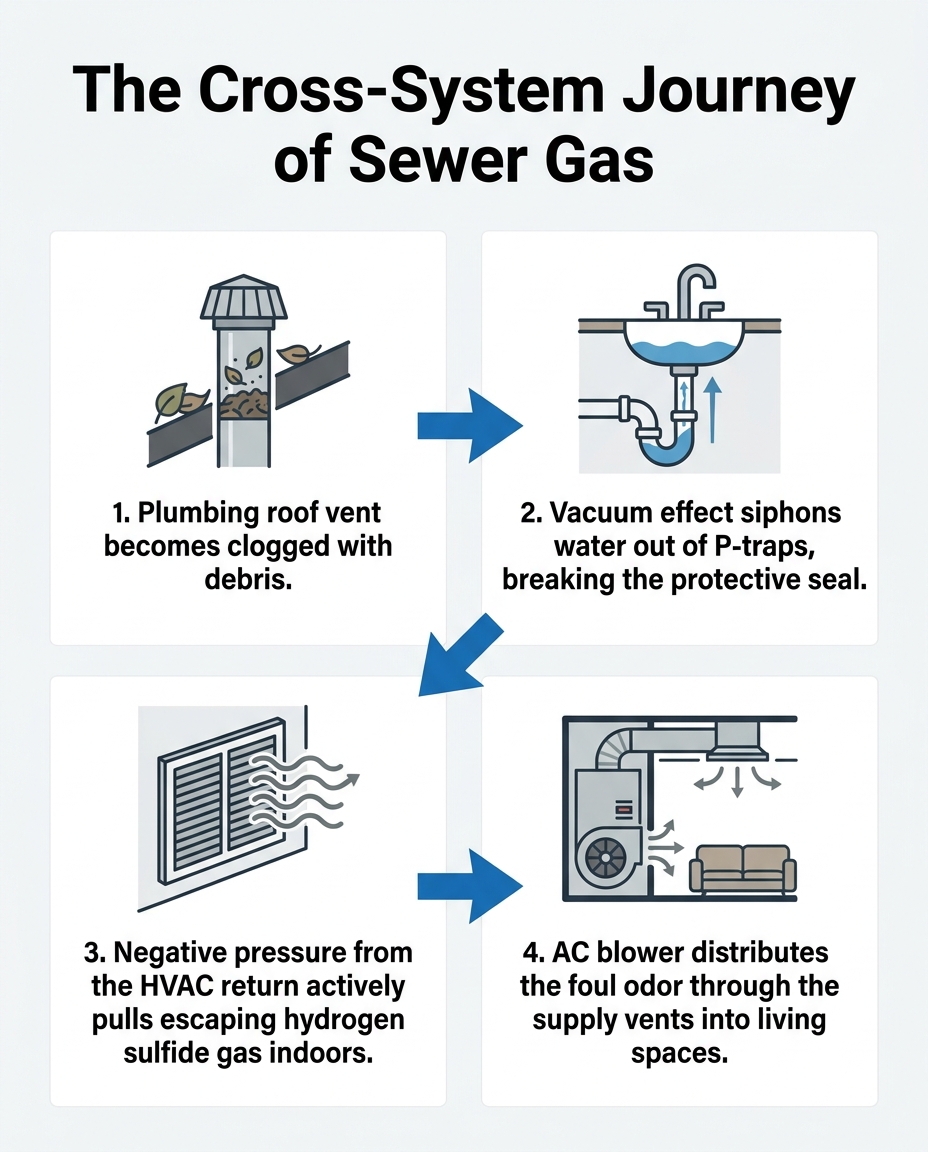
When the vent is blocked, the plumbing system can no longer "breathe." As water rushes down the drain from a flushing toilet or an emptying bathtub, it pushes air ahead of it and creates a vacuum behind it. Without the roof vent to let air in, that vacuum has to pull air from somewhere else. It ends up pulling air from the weakest points in your plumbing system: the drains inside your home.
How P-Traps Fail When Vents Clog
We always remind our customers that underneath every sink, shower, and bathtub in your home is a curved section of pipe called a P-trap. This curve is designed to hold a small amount of water at all times. That simple water plug acts as an airtight seal, forming the only physical barrier between the interior of your home and the municipal sewer lines.
• The physics of the seal: As long as water rests in the curve of the pipe, sewer gas cannot rise up through the drain into your bathroom or kitchen.
• The vacuum effect: When a clogged roof vent creates a vacuum in the pipes, the suction physically siphons the water right out of the P-trap and down the drain.
• The early warning signs: Before the smell ever appears, you will usually notice gurgling toilets, bubbling sounds from the bathtub when the sink drains, or generally slow-emptying basins.
Once that water seal is siphoned away, the pipe is completely open. Raw sewer gas, including hydrogen sulfide, is now free to drift up through the drain and into your living spaces.
How Negative Air Pressure Turns Your HVAC Into a Delivery System
Having an open drain is bad enough, but it does not fully explain why the foul odor is blasting out of your air conditioning vents. To understand that, we have to look at how your HVAC system moves air throughout your home. Our HVAC technicians often explain that your air conditioner does not just push cold air out; it actively pulls warm air in through the return vents to be cooled and recirculated.
During August and late-summer continuous cooling cycles, your air conditioner runs for hours at a time. This constant operation creates sustained zones of negative air pressure inside your tightly sealed home. The HVAC return vents act like a giant vacuum cleaner, actively pulling air from the surrounding indoor environment.
When a P-trap dries out because of a clogged plumbing vent, the negative pressure from the AC system takes over. It actively pulls the escaping hydrogen sulfide gas out of the open drain, across the room, and directly into the return ductwork. From there, the blower motor pushes the contaminated air over the cooling coils and distributes it at high speed into every single room of your house.
Your cooling equipment is not creating the smell. It is simply acting as a highly efficient, high-speed distribution network for a plumbing failure. Proper air conditioning systems are designed to circulate air thoroughly, which is normally a benefit, but in this specific scenario, it rapidly accelerates the spread of trapped sewer gases.
Recognizing the Symptoms: Is It an AC Problem or a Plumbing Issue?
Because the foul odor comes out of the air vents, misdiagnosis is incredibly common. Homeowners frequently assume the air conditioner itself is broken or contaminated. Accurately identifying the root cause requires knowing the difference between standard HVAC odors and plumbing-related sewer gas.
During a recent late-summer service call, our Reliabee technicians met a homeowner who noticed their 2-year-old system wasn't performing properly and suspected an internal AC failure. Our team used advanced gauges to test the system and provided pre- and post-service reports to explain the work. By systematically ruling out mechanical failures and verifying the coils were clean, we could confidently determine the AC was functioning perfectly—pointing the investigation toward cross-system environmental factors instead.
One of the most distinct differences is the actual scent. "Dirty Sock Syndrome" is a well-known HVAC issue caused by bacterial growth or mildew on damp evaporator coils. It smells exactly like a locker room or wet, musty laundry. Sewer gas, on the other hand, is rich in hydrogen sulfide. This gas has a sharp, unmistakable sulfur or rotten egg smell. The human nose is incredibly sensitive to hydrogen sulfide, capable of detecting it at concentrations as low as 0.00047 parts per million.
Odors Originating from the HVAC
If our team isolates the problem to the cooling equipment, you will typically notice:
• Musty, damp, or moldy smells: Similar to a damp basement or wet dog.
• Moisture issues: Usually caused by clogged condensate drain lines or dirty indoor evaporator coils.
• Timing: The smell is most noticeable the very second the system kicks on, then fades slightly as it runs.
Odors Originating from Plumbing
If the problem stems from a blocked roof vent and dried-out P-traps, you will notice:
• Sharp sulfur or methane smells: A distinct raw sewage or rotten egg odor.
• Plumbing symptoms: Accompanied by gurgling toilets, slow drains, or bubbling sounds in the pipes.
• Location dynamics: The smell may be strongest near bathrooms or laundry rooms when the AC is off, but spreads rapidly to the whole house when the blower engages.
• Primary Odor Profile — Typical HVAC Issue: Musty, damp, "dirty socks" — Plumbing Vent Issue: Sulfur, rotten eggs, raw sewage
• Accompanying Noises — Typical HVAC Issue: Rattling vents, whistling filters — Plumbing Vent Issue: Gurgling drains, bubbling toilets
• Odor Concentration — Typical HVAC Issue: Equal across all supply vents — Plumbing Vent Issue: Strongest near drains, pulled into returns
• Root Cause — Typical HVAC Issue: Dirty coils, clogged condensate line — Plumbing Vent Issue: Blocked roof vent, empty P-traps
The Dangers of Circulating Sewer Gas in Your Home
Ignoring a sulfur smell is not just unpleasant; it poses genuine risks to your indoor air quality and overall well-being. Sewer gas is a complex mixture of toxic and non-toxic gases, primarily consisting of hydrogen sulfide, ammonia, methane, and carbon dioxide.
According to OSHA and EPA guidelines regarding indoor air quality, hydrogen sulfide is a significant respiratory irritant. Prolonged exposure to low levels of this gas can cause a range of health risks. Homeowners often report experiencing persistent headaches, nausea, dizziness, and irritation of the eyes, nose, and throat. For individuals with pre-existing respiratory conditions like asthma, circulating sewer gas can trigger severe flare-ups.
The problem is heavily magnified by modern building practices. Today's homes are constructed to be incredibly airtight to maximize energy efficiency. While tightly sealed homes are great for keeping utility bills low, they are terrible at naturally venting out indoor pollutants. When sewer gas enters the home, it becomes trapped inside the building envelope. The continuous cycling of the air conditioner just mixes the gas more thoroughly into the breathable air.
We frequently see homeowners try to solve the problem by lighting candles, using plug-in air fresheners, or spraying deodorizers into the return vents. Masking the odor does absolutely nothing to resolve the underlying toxicity or the plumbing failure. To truly protect your family, you need professional home performance solutions that address ventilation, air purification, and the root mechanical failures driving the contamination.
Why a Multi-Trade Approach is Essential for Proper Diagnosis
One of the most frustrating experiences for a homeowner is getting caught in a loop between different specialized contractors. A typical scenario involves calling an HVAC company because the smell comes from the vents. The technician inspects the ductwork, finds the coils are clean, and tells the homeowner to call a plumber. The plumber arrives, checks for visible leaks under the sinks, finds none, and suggests calling the HVAC company back. You end up paying multiple dispatch fees without ever solving the root cause.
This happens because single-trade contractors often lack visibility into how different home systems interact. A holistic, cross-trade diagnostic approach is absolutely necessary. The technician needs to understand both the airflow dynamics of negative pressure and the ventilation requirements of a modern plumbing system.
This pattern of misdiagnosis is exactly why our team at Reliabee operates as a comprehensive Air, Electric, and Plumbing provider. We are uniquely equipped to diagnose and resolve these exact cross-system issues without you having to make multiple calls. A unified diagnostic process saves time, reduces frustration, and eliminates the guesswork. Whether the solution requires adjusting blower speeds to manage negative pressure or utilizing advanced drain and sewer services to clear the main stack, having all trades under one roof ensures the problem is fixed correctly the first time.
Safe and Effective Solutions to Restore Your Indoor Air Quality
Fixing a clogged plumbing roof vent is not a simple weekend project. It requires specific procedures to ensure the blockage is removed completely and the home's air quality is safely restored. Due to the severe fall hazards associated with steep roof pitches and the specialized tools required, we strongly advise that you never attempt DIY roof vent clearing.
When a Reliabee professional arrives to remediate the issue, our team follows a strict, multi-step process:
1. Roof-Level Inspection and Clearing: A licensed plumber safely accesses the roof to inspect the main vent stack. Using specialized augers or high-resolution inspection cameras, they locate the blockage—whether it is a bird's nest, packed leaves, or a collapsed pipe—and carefully extract it to restore airflow.
2. System Verification: Once the vent is clear, our technician runs water through the highest fixtures in the home to verify that the drain lines are flowing smoothly and no vacuum effect remains.
3. Repriming the P-Traps: The technician will systematically run water into every sink, shower, bathtub, and floor drain in the house. This simple action refills the dried-out P-traps, re-establishing the vital water seal that blocks sewer gases from entering.
4. HVAC Assessment: Finally, a cross-trade evaluation ensures the heating and cooling system is clear. The technician will check the return vents and filters to ensure no residual odors or contaminants are lingering in the system. They may also review how clogged air ducts impact your HVAC system to confirm no secondary cleaning is required.
By following this comprehensive process, our professionals ensure the plumbing breathes correctly and the HVAC system returns to delivering fresh, clean air.
Protect Your Home's Air Quality with Comprehensive Diagnostics
A foul smell blasting out of your air vents is a highly noticeable symptom, but the actual cure often lies high up on your roof. The interaction between a blocked plumbing vent and the negative pressure of your HVAC return is a perfect example of how interconnected your home's systems truly are.
Especially during periods of August and late-summer continuous cooling, do not ignore the warning signs of cross-system contamination. Gurgling drains and sulfur odors are your home's way of telling you that the protective barriers have failed. If your air conditioner smells like a sewer, skip the guesswork and the multiple dispatch fees. Reach out to our qualified, multi-trade local experts at Reliabee to schedule a comprehensive diagnostic and restore the safety and comfort of your home's air.
Frequently Asked Questions
Why does my AC smell like sewage?
Your AC smells like sewage because the return vents are pulling in actual sewer gas from an open drain inside your home. This typically happens when a plumbing P-trap dries out, allowing hydrogen sulfide to escape into the room. The air conditioner's blower motor then sucks up this foul air and distributes it rapidly through the ductwork. As our technicians often explain, the AC itself is rarely the source of a raw sewage smell.
Can a clogged plumbing vent affect indoor air quality?
Yes, a clogged plumbing vent has a massive impact on indoor air quality. When the roof vent is blocked, the plumbing system creates a vacuum that siphons water out of your drain traps. Without that water seal, toxic and foul-smelling sewer gases drift freely into your living spaces. In tightly sealed homes, these gases accumulate quickly and degrade the breathable air.
How do plumbing and HVAC systems interact to cause odors?
Plumbing and HVAC systems interact through air pressure dynamics. When a plumbing failure allows sewer gas to enter a bathroom or kitchen, the HVAC system's return vents actively pull that contaminated air into the ductwork. The continuous cycling of the air conditioner creates negative pressure zones that draw the gas out of the drains faster, turning the AC into a high-speed delivery system for plumbing odors.
How do you know if your plumbing vent is clogged?
The earliest signs of a clogged plumbing vent appear before you ever smell sewer gas. You will likely notice toilets that gurgle or bubble when flushed, sinks that drain very slowly, or water backing up slightly in the bathtub when another fixture is used. Eventually, you will notice a strong sulfur or rotten egg smell near your drains as the water seals fail.
Is sewer gas from a clogged vent dangerous to breathe?
Yes, breathing sewer gas can be dangerous, especially over long periods. Sewer gas contains hydrogen sulfide, which is a known respiratory irritant. Prolonged exposure can lead to headaches, nausea, dizziness, and irritation of the throat and eyes. For vulnerable individuals, such as those with asthma, it can trigger severe respiratory symptoms and requires prompt professional remediation.
Will cleaning my air ducts get rid of a sulfur smell?
No, cleaning your air ducts will not get rid of a sulfur smell if the root cause is a plumbing failure. While duct cleaning removes dust and standard debris, it does nothing to stop sewer gas from continuously entering your home through a dried-out P-trap. You must clear the blocked plumbing roof vent and re-prime the drains to permanently eliminate the odor.

Ready to Transform Your Home?