HVAC Maintenance and Heating Options: A Comparison for Homeowners
The October Heating Dilemma: Choosing the Right System Before Winter
If your aging heating equipment is showing signs of failure, finding objective options comparisons for homeowners is the most critical step you can take before winter weather arrives. At Reliabee Air Electric Plumbing, we find that October is the ideal window for evaluating your San Antonio home's heating infrastructure. While the fall weather outside might feel perfectly comfortable right now, waiting for the first major temperature drop to make a decision often leads to rushed installations and limited equipment choices. You are facing a key decision point right now: whether the year-round efficiency of modern electric heating outweighs the traditional familiarity and cold-snap reliability of a combustible fuel system.
To navigate this choice effectively, our team always recommends starting by securing a comprehensive HVAC maintenance plan to keep your current or future system operating at peak performance. Proactive evaluation prevents catastrophic seasonal breakdowns during periods of high demand. When a heating system fails in the middle of a freeze, emergency replacement options are often dictated by what is currently sitting in a local warehouse rather than what is actually best for your home's long-term energy profile.
Evaluating your heating infrastructure now means you have the time to properly assess your home's thermal envelope, review your electrical capacity, and make an objective, data-driven choice. Navigating mild Texas winters with occasional unexpected freezes requires a system that can handle long stretches of moderate weather without short-cycling, while still possessing the capacity to keep your family safe when the thermometer plummets.
Understanding Air-Source Heat Pumps in Mild Climates
When comparing an air-source heat pump vs. traditional gas furnace, the most fundamental difference lies in how the equipment sources its warmth. Heat pumps do not generate heat by burning fuel or using high-resistance electrical coils. Instead, they transfer ambient heat from the outside air and move it indoors. Even when the outside temperature feels chilly to the human body, there is still ample thermal energy in the air for a modern heat pump to extract, compress, and deliver into your living space.
This technology operates by simply reversing the standard cooling process. If you understand how your air conditioner's refrigeration cycle works, you already understand a heat pump. A specialized component called a reversing valve changes the direction of the refrigerant flow, allowing the system to absorb heat from the outdoor coil and release it through the indoor coil.
The efficiency advantage:
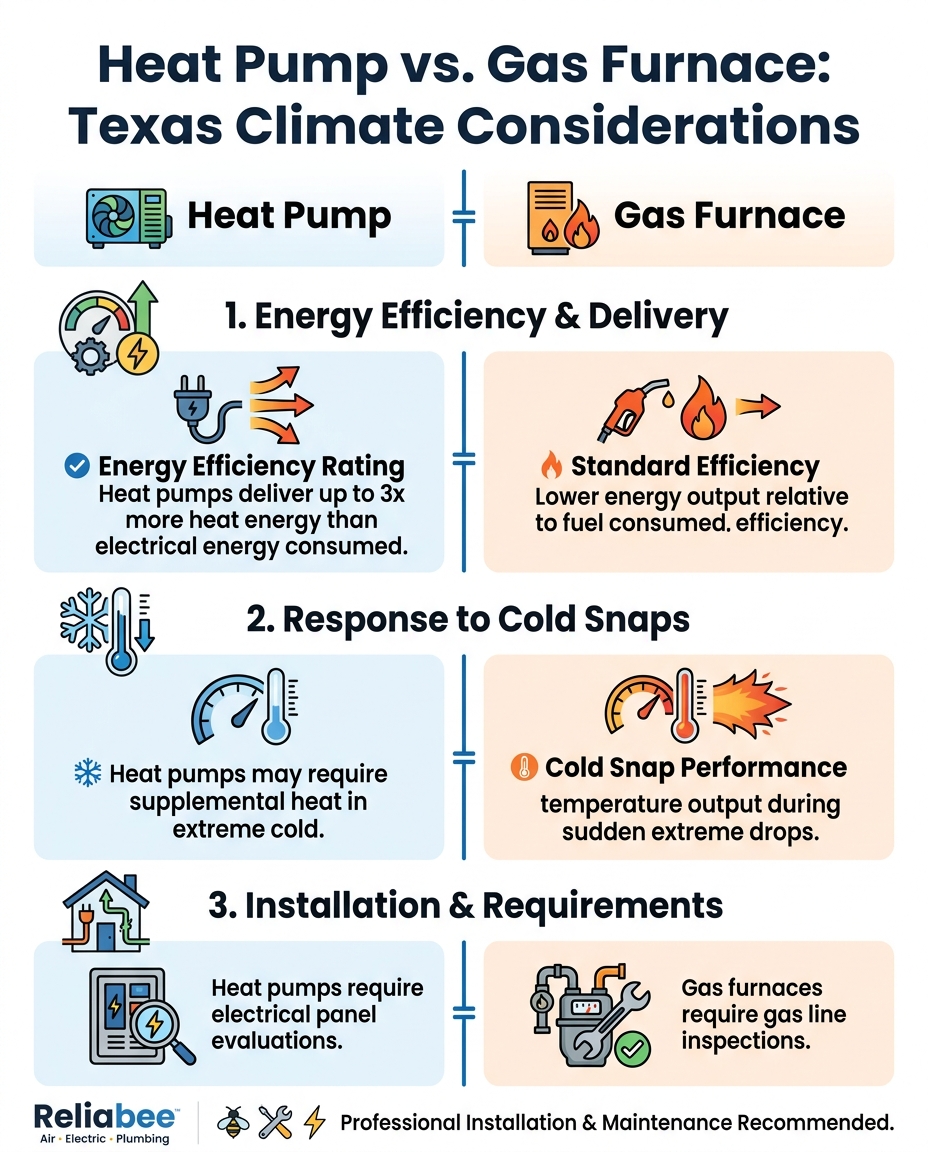
• Energy transfer over generation: Because they move heat rather than create it, heat pumps can deliver up to three times more heat energy to a home than the electrical energy they consume.
• Moderate weather optimization: They are highly efficient for the majority of the season when average San Antonio lows sit comfortably in the 40s.
• Consistent comfort: Heat pumps typically provide a lower, steadier stream of warm air, which helps maintain an even temperature throughout the house without the dramatic temperature swings associated with older systems.
In our experience, these systems are perfectly suited for the prolonged mild periods of a southern winter. However, it is important to note that their efficiency curves do change during sudden deep freezes. When temperatures drop near freezing, the system must rely on auxiliary electric heat strips to make up the difference, which uses significantly more electricity.
The Traditional Gas Furnace Advantage During Cold Snaps
While electric transfer technology has advanced rapidly, many of the San Antonio homeowners we serve still prefer the established reliability of combustion heating. In the debate of an air-source heat pump vs. traditional gas furnace, the furnace holds a distinct advantage when temperatures drop rapidly and severely.
Gas furnaces generate heat by combusting fuel—typically natural gas or liquid propane—inside a sealed heat exchanger. The system's blower motor then passes indoor air over the exterior of this hot metal exchanger, warming the air before distributing it through your ductwork. This combustion process provides a significantly higher and faster temperature output than a heat pump can achieve.
Key benefits of gas furnaces:
• Rapid recovery: If you turn your thermostat down while away at work, a furnace can raise the indoor temperature quickly upon your return.
• Extreme weather reliability: Furnaces offer unwavering performance during sudden, extreme temperature drops when heat pumps might struggle to extract enough ambient heat from the freezing outdoor air.
• Warmer air delivery: The air coming out of a furnace supply register is typically much hotter to the touch (often between 120°F and 140°F) compared to the milder air produced by a heat pump.
Because these systems rely on combustion, familiarity and established infrastructure make them a common choice for older homes that already have gas lines installed. However, proper ventilation and safety checks are non-negotiable requirements. The combustion process produces byproducts, including carbon monoxide, which must be safely vented out of the home through an intact flue pipe. A cracked heat exchanger or a compromised vent poses a serious safety hazard, making professional evaluation by certified technicians absolutely mandatory.
Infrastructure Requirements: Electrical Loads vs. Gas Lines
One of the most frequently overlooked aspects of comparing an air-source heat pump vs. traditional gas furnace is the hidden infrastructure required to support the equipment. Switching from one heating technology to another is rarely a simple "plug-and-play" swap. It requires a comprehensive evaluation of the systems hiding behind your walls and in your utility closets.
Switching to a heat pump often requires a deep evaluation of the home's electrical panel capacity. Because heat pumps rely on high-amperage auxiliary heat strips during extreme cold snaps, older homes with 100-amp or 150-amp electrical panels may not have the capacity to support the new system safely. Upgrading to a heat pump might necessitate a heavy-up or a full electrical panel replacement to handle the increased load without tripping breakers or causing fire hazards.
Conversely, installing or maintaining a gas furnace necessitates strict inspections of gas line integrity and plumbing connections. Black iron gas pipes can degrade over decades, and the valves and unions must be tested for microscopic leaks. Proper drafting and flue clearance must also be verified to ensure exhaust gases safely exit the roofline.
This is where a holistic evaluation prevents unexpected installation delays or safety hazards. Single-trade assessments often miss these interconnected infrastructural needs. As a comprehensive provider at Reliabee Air Electric Plumbing, our integrated approach across air, electric, and plumbing disciplines ensures that every aspect of the installation is handled seamlessly. Our multi-trade team can assess electrical panels for heat pumps or inspect gas lines for furnaces without needing to sub-contract outside tradesmen. To ensure your home's infrastructure is ready for either system, it is highly recommended to consult with professional HVAC services for a full load and safety calculation.
How Routine Care Differs Between Heating Technologies
The operational differences between these two systems dictate entirely different maintenance schedules and priorities. Understanding these requirements is a major factor in choosing the right system for mild Texas winters with occasional unexpected freezes.
Heat pumps run year-round. They serve as your air conditioner all summer, and then the reversing valve switches their function to heat your home all winter. This means the compressor, blower motor, and outdoor fan endure an extreme workload. Because they never truly get an off-season, heat pumps require strict bi-annual performance checks. The refrigerant charge must be precise; even a slight undercharge will drastically reduce the system's ability to heat your home efficiently in January. This makes routine air conditioning maintenance indistinguishable from heating maintenance, as the core components are exactly the same.
Gas furnaces, on the other hand, sit completely idle for months at a time. From early spring through late fall, the burners, gas valve, and ignitor are dormant. This long period of inactivity makes pre-winter safety and ignition inspections critical. Dust and debris can settle on the burners, causing them to ignite improperly. Flame sensors can oxidize, causing the furnace to shut down prematurely. Most importantly, the heat exchanger must be visually inspected for microscopic stress cracks that could allow carbon monoxide to mix with your indoor air.
During a routine fall heating start-up visit last year, our Reliabee technicians helped a local homeowner who needed maintenance and guidance on prolonging their unit's lifespan. Our team provided useful energy-saving and maintenance tips, resulting in a pleasant and stress-free pre-winter experience. This level of proactive care extends equipment lifespan and maximizes energy savings, regardless of which technology you choose. Both systems ultimately rely on clean filters, clear condensate lines, and unhindered airflow to operate efficiently.
Comparing Efficiency, Lifespan, and Incentive Opportunities
To make an informed decision between an air-source heat pump vs. traditional gas furnace, you need an objective, side-by-side evaluation of how they perform over their total operational life. Energy efficiency ratings, longevity, and upfront incentives all play a role in the total cost of ownership.
• Efficiency Rating — Air-Source Heat Pump: Measured in SEER2 (cooling) and HSPF2 (heating). Highly efficient in moderate weather. — Traditional Gas Furnace: Measured in AFUE (Annual Fuel Utilization Efficiency). High-efficiency models reach up to 98% AFUE.
• Lifespan Expectancy — Air-Source Heat Pump: Typically 10 to 15 years, as the system operates continuously year-round. — Traditional Gas Furnace: Typically 15 to 20 years, as the heating components rest during the long summer months.
• Environmental Impact — Air-Source Heat Pump: Lower direct carbon footprint. Runs entirely on electricity. — Traditional Gas Furnace: Combusts fossil fuels on-site, producing exhaust gases that must be vented.
• Incentive Opportunities — Air-Source Heat Pump: Generic federal tax credits may apply to qualifying high-efficiency installations (verify with a tax professional). — Traditional Gas Furnace: Local utility rebates sometimes apply for upgrading from older, low-AFUE models to modern condensing furnaces.
Long-Term Value Considerations
When weighing the initial infrastructure updates against long-term utility usage, our team finds it is vital to match the system to the home's specific thermal envelope. A heat pump might offer incredible energy savings on paper, but if your home is poorly insulated and lacks weatherstripping, the system will run constantly and rely too heavily on expensive auxiliary heat strips. Conversely, a high-efficiency gas furnace might cost less to operate during a freeze, but requires paying a separate monthly gas utility base charge even during the summer when the furnace is off. An accurate load calculation helps balance these long-term value considerations.
Preparing Your Ductwork and Home for a New System
Whether you choose an air-source heat pump vs. traditional gas furnace, the equipment itself is only half of the equation. The other half is your home's air delivery system. Even the highest-efficiency unit on the market will severely underperform if it is attached to compromised, leaky, or undersized ductwork.
Inspecting attic flexible ducts and plenum boxes is a crucial step before any new installation. Over time, the outer vapor barrier of flexible ductwork can degrade in the extreme heat of an attic. The fiberglass insulation can compress, losing its R-value, and the inner liner can tear, spilling conditioned air directly into your attic space. When this happens, your new heating system has to work twice as hard to reach the temperature set on the thermostat.
Proper sizing and airflow calculations ensure the new system operates at peak capacity. A system that pushes too much air through undersized ducts will create loud whistling noises and burn out the blower motor prematurely. A system attached to oversized ducts will suffer from low air velocity, leading to hot and cold spots throughout the house.
Last fall, our Reliabee team responded to a customer experiencing severe airflow issues who needed duct and plenum box repairs. Our technicians replaced the compromised flexible duct and the failing plenum box. The improvement in airflow and comfort was so immediate that the customer booked an upcoming early summer system inspection on the spot. Addressing duct issues early prevents uneven heating and wasted energy. Before finalizing your equipment choice, always schedule a comprehensive heating system inspection with our crew to ensure your ductwork is prepared to handle the new load.
Frequently Asked Questions About Home Heating Options
Which is better for Texas winters: a heat pump or a gas furnace?
The answer depends entirely on your home's existing infrastructure and your comfort preferences. Heat pumps are exceptionally efficient for mild Texas winters with occasional unexpected freezes, handling days in the 40s and 50s with ease. However, gas furnaces provide faster, hotter air during sudden, extreme cold snaps. A professional evaluation of your electrical panel, gas lines, and insulation by our team will determine which system offers the best long-term value for your specific property.
How does a heat pump work in mild climates?
A heat pump works by transferring heat rather than generating it from scratch. It uses a reversing valve to absorb ambient thermal energy from the outdoor air, compress it to raise its temperature, and release that warmth inside your home. Because there is still plenty of heat energy in the air even when it feels chilly outside, this transfer process uses significantly less electricity than traditional heating methods.
What infrastructure is needed to switch from a gas furnace to a heat pump?
Switching to a heat pump primarily requires a robust electrical infrastructure. Because heat pumps use high-amperage electric resistance strips as a backup heat source during deep freezes, your home's electrical panel must have the capacity to handle that significant load. Additionally, the existing ductwork must be evaluated to ensure it can handle the specific airflow requirements of a heat pump, which often differs from a gas furnace.
Does switching to a heat pump require a new electrical panel?
It often does, especially in older homes. If your home currently operates on a 100-amp or 125-amp service panel, adding a heat pump with auxiliary heat strips will likely overload the system. An electrician must perform a load calculation to determine if a panel upgrade or a heavy-up is necessary to safely support the new equipment without tripping breakers.
Why is year-round HVAC maintenance essential for heat pumps?
Unlike a gas furnace that sits dormant all summer, a heat pump operates 365 days a year. It cools your home in the summer and heats it in the winter, meaning the compressor, motors, and coils endure double the wear and tear. Bi-annual maintenance is required to keep the refrigerant charge precise, clean the coils, and ensure the system doesn't lose efficiency due to continuous mechanical strain.
Explore Your Home Heating Options with a Local Expert
Choosing the right heating system requires a personalized assessment of your home's unique infrastructure. What works perfectly for a neighbor's newly built property might not be the right fit for an older home with different electrical and plumbing realities. A clear, unbiased technical evaluation from our team at Reliabee Air Electric Plumbing provides the exact options comparisons for homeowners needed to make a confident decision. Take the time to explore professional options with us today to ensure your San Antonio home, your ductwork, and your family are fully prepared for whatever the winter season brings.

Ready to Transform Your Home?