Replacing Blown Capacitors After Months of Continuous Running
The Late-Summer Breaking Point for Hard-Working Condensers
Here at Reliabee Air Electric Plumbing, we know firsthand that August in San Antonio brings a relentless, unforgiving heat that pushes mechanical equipment to its absolute limits, making replacing blown capacitors after months of continuous running a critical priority for local homeowners. After operating almost non-stop since late spring, your air conditioning system is exhausted right as the back-to-school transition begins. You might notice the air flowing from your vents isn't quite as cold as it was in June, or perhaps the outdoor unit is making a strange, aggressive humming noise while the fan blades remain completely still. In our experience, this scenario is the classic setup for a major, late-season breakdown.
By the time late summer arrives, the cumulative thermal and electrical stress on your cooling equipment reaches its absolute peak. Our technicians typically see the capacitor as the first component to surrender to this seasonal exhaustion. Acting as the electrical heart of the condensing unit, this small but mighty part provides the massive jolt of stored energy required to jumpstart the compressor and fan motors. When it fails, the entire cooling process grinds to a sudden halt. Catching this specific component failure early is the crucial difference between a simple, routine part swap and a catastrophic, system-ending compressor failure. If your system is showing signs of late-summer fatigue, securing professional air conditioning services immediately can save your equipment from permanent, irreversible damage.
Understanding the Cumulative Thermal Toll on HVAC Components
To understand why our dispatch board lights up with air conditioning breakdowns in August, you have to look at the immense physical and electrical loads placed on the system over time. HVAC capacitors are designed to store high voltage—typically ranging from 370v to 440v—to deliver the necessary torque to start heavy mechanical motors. However, these components have strict physical limitations. Standard motor run capacitors are typically rated for maximum internal operating temperatures around 158 degrees Fahrenheit.
When you place a metal condenser cabinet in the direct Texas sun, the ambient temperature inside that metal box skyrockets. Combine that environmental heat with the internal heat generated by the electrical current flowing through the capacitor itself, and the component is constantly operating on the razor's edge of its thermal limits. This is exactly why the late-summer breakdowns we service are fundamentally different from early-season failures.
• Electrical Surge — Typical Season: Spring / Early Summer — Primary Cause: Lightning strikes, grid fluctuations, or initial startup after winter dormancy. — Impact on Capacitor: Instantaneous voltage overload causing immediate, sudden failure.
• Thermal Fatigue — Typical Season: Late Summer (August) — Primary Cause: Months of continuous running, high ambient heat, and lack of cooling downtime. — Impact on Capacitor: Cumulative breakdown of internal dielectric fluid, leading to swelling and eventual rupture.
Why Nighttime Cooling Deficits Matter
Here in San Antonio, the climate context our technicians navigate daily is critical. Prolonged summer heat waves often come with minimal nighttime cooling. In a milder climate, an air conditioner might run hard during the day but cycle off frequently at night, allowing the internal components to shed their thermal loads and return to a safe baseline temperature. When nighttime temperatures remain stubbornly high, your system's duty cycle stays near 100 percent. The condenser unit rarely gets a chance to rest, meaning the capacitor never fully cools down. Over weeks and months, this sustained heat degrades the chemical composition inside the capacitor, accelerating wear and virtually guaranteeing a failure if the part is already aging.
Visual and Auditory Red Flags: Spotting a Failing Capacitor
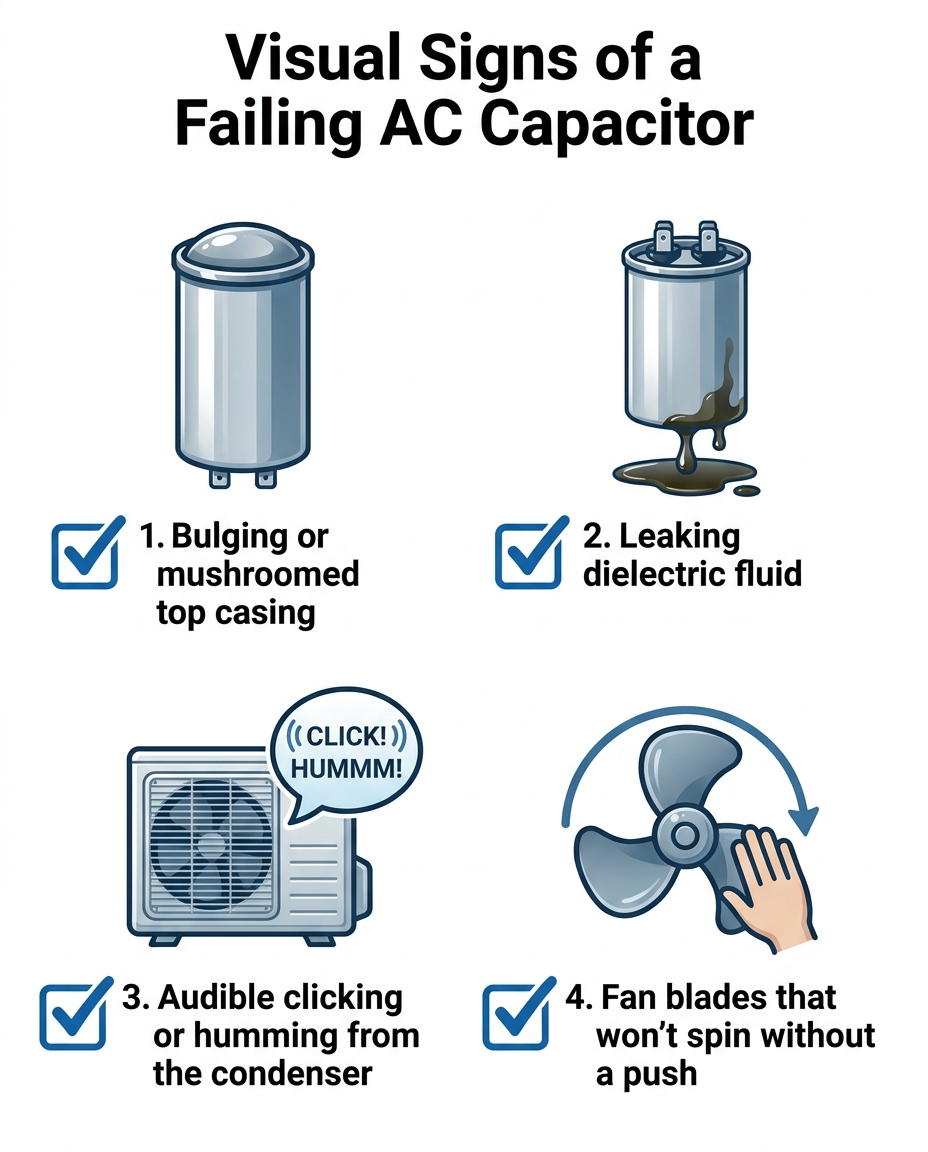
Because a blown capacitor is such a common late-summer issue, our team always tells homeowners that knowing how to identify the warning signs can save you from a much larger headache. When this component begins to fail, it rarely does so quietly. Your outdoor condenser unit will usually provide clear visual and auditory signals that it is struggling to operate.
• The humming or clicking condenser: This is the most common auditory red flag we encounter. You will hear a distinct, loud humming or buzzing sound coming from the outdoor unit, but the fan blades will refuse to spin. This sound is the motor trying to pull power to start, but failing because the capacitor cannot deliver the necessary voltage boost.
• A swollen or bulging capacitor casing: If you look inside the vents of the outdoor unit (without touching anything), you might see a silver, cylindrical component that looks physically deformed. A healthy capacitor has a completely flat top. A failing one will have a swollen or bulging capacitor casing, often described as looking "mushroomed" or like a soda can that was left in the freezer.
• Warm air from the vents: If your thermostat is set to 72 degrees but the air blowing from your indoor vents feels lukewarm, the indoor blower is working, but the outdoor compressor (which actually cools the refrigerant) is not running due to the failed capacitor.
• Random system shut-offs: A weak capacitor may occasionally provide enough power to start the system, but it will cause the motor to draw too much amperage, tripping the internal thermal overload switch or your home's circuit breaker.
The immediate action plan: If you notice any of these signs, you must turn the system off immediately at the thermostat. Forcing the system to keep trying to start without a functioning capacitor will cause severe secondary damage.
The Domino Effect: How a Small Part Threatens the Compressor
Many homeowners make the mistake of ignoring a humming air conditioner, hoping the problem will resolve itself or waiting a few days to call for help. Over our years serving San Antonio, we've seen this dangerous gamble play out too many times. While a capacitor is a relatively small and simple component, its failure creates a massive ripple effect throughout the entire condensing unit. The most significant threat is to the compressor, which is the heavy-duty engine of your entire cooling system.
When the compressor tries to start without the capacitor's high-voltage boost, it experiences what the industry calls a "hard start." The motor physically struggles to overcome inertia. To compensate for the lack of starting torque, the compressor begins pulling significantly higher amperage from your home's electrical grid. This massive electrical draw generates extreme heat inside the hermetically sealed compressor shell.
The Hard Start Struggle
If the system is left running in this state, the compressor will quickly overheat and trip its internal thermal overload protector, shutting down to save itself. However, once it cools off, it will try to start again, fail again, and overheat again. This continuous cycle bakes the internal windings of the compressor motor. What begins as a minor electrical issue quickly evolves into cascading AC failures. As we often remind our customers, the difference in scale here is vast: a capacitor swap is a fast, straightforward diagnostic visit. A compressor burnout is a catastrophic failure that often necessitates replacing the entire outdoor unit. During the hottest weeks of the year, ignoring the warning signs is the fastest way to shorten the lifespan of your entire HVAC system.
Navigating Late-Summer Breakdowns and Holiday Weekends
Air conditioning breakdowns rarely happen on a mild Tuesday morning. In our experience, because these failures are driven by cumulative thermal stress, they almost always occur when the system is working its hardest—which usually means late Friday afternoons, right in the middle of a brutal August heatwave, or just as a long Labor Day weekend is beginning. When indoor temperatures spike dangerously high, restoring cooling isn't just about comfort; it becomes a matter of safety for your family and pets.
Having a reliable team that can provide prompt, accurate diagnostics is essential when time is of the essence. Just this past late-summer season, as families were transitioning back to school routines, the Reliabee team responded to a call regarding a surprisingly new, two-year-old system that was suddenly failing to cool the home properly. Our technician arrived promptly, hooked up advanced diagnostic gauges, and quickly identified the root of the electrical strain. By providing detailed pre- and post-service performance reports, we were able to explain exactly how the repair increased the system's performance back to the necessary level, giving the family total confidence in the fix.
When a capacitor blows and the house is rapidly heating up, you need a team committed to restoring your comfort without unnecessary delays. Fast, accurate emergency AC repair is the only way to prevent a stressful situation from turning into a miserable weekend.
The Hidden High-Voltage Hazards of Condenser Cabinets
Because a capacitor is a relatively small part, many homeowners are tempted to look up an internet tutorial and attempt a DIY replacement. As licensed professionals, we cannot state this strongly enough: opening a condenser cabinet and handling electrical components without proper training is incredibly dangerous. The hazards inside that metal box go far beyond standard household wiring.
Capacitors are designed to store massive amounts of electrical energy. Even after you have completely disconnected the power to the air conditioning unit at the circuit breaker and pulled the outdoor disconnect whip, the capacitor itself remains fully charged. It can hold a lethal amount of energy—upwards of 440 volts—for days. If you touch the terminals without properly safely discharging the stored energy, your body becomes the ground, resulting in a severe or potentially fatal electrical shock.
The Microfarad Matching Requirement
Beyond the immediate physical danger, there is the technical complexity of matching the replacement part. Capacitors are rated in microfarads (µF), which measures their capacity to store an electrical charge. If you install a capacitor with a microfarad rating that is even slightly too high or too low for your specific fan motor or compressor, the motor will run inefficiently, overheat, and eventually burn out prematurely.
This is where our unique position at Reliabee Air Electric Plumbing as a combined HVAC and electrical service provider becomes a distinct advantage. Because we deliver professional electrical services alongside our cooling expertise, our technicians are uniquely qualified to safely handle, discharge, and diagnose high-voltage components. We carry the precise diagnostic multimeters required to test capacitance under load, ensuring the replacement part matches your system's exact engineering specifications perfectly.
Extending System Lifespan Through the End of the Season
Once your capacitor has been replaced by our team and your system is blowing cold air again, your goal should be to protect the equipment and reduce unnecessary stress for the remainder of the hot season. Implementing a few strategic habits can significantly extend the lifespan of your newly repaired system.
1. Maintain optimal airflow around the condenser: The outdoor unit needs to breathe to dissipate heat. Keep bushes, tall grass, and debris trimmed at least two feet away from the cabinet on all sides. If the metal fins are clogged with dirt or pollen, the system has to work harder to reject heat, increasing the thermal load on the internal electronics.
2. Implement strategic thermostat management: Give your system a break during the absolute hottest part of the afternoon. Raising your thermostat just two or three degrees between 3:00 PM and 7:00 PM reduces the duration of the cooling cycles, giving the capacitor and compressor a chance to cool down slightly before the evening.
3. Change indoor air filters proactively: A clogged indoor air filter restricts airflow over the evaporator coil. This forces the outdoor compressor to run longer cycles to achieve the desired indoor temperature. In August, you should be checking your filter every two weeks.
4. Schedule a comprehensive system check: If one electrical component has failed due to cumulative wear, others (like the contactor or the fan motor bearings) may be close behind. Investing in routine AC maintenance allows a technician to check the electrical draw of all moving parts, spotting failing components before they pop and leave you stranded in the heat.
Frequently Asked Questions
What happens when an AC capacitor blows?
When an AC capacitor blows, the outdoor condensing unit loses the stored electrical energy required to start its heavy motors. You will typically hear a loud humming or buzzing sound from the outdoor unit, but the fan blades will not spin, and the compressor will fail to engage. Because the refrigerant is no longer being circulated and cooled, the indoor vents will begin blowing warm or room-temperature air.
Can a bad capacitor ruin my compressor?
Yes, a bad capacitor can absolutely ruin your compressor if the system is left running. Without the capacitor's voltage boost, the compressor experiences a "hard start," pulling excessive amperage and generating extreme heat. Over time, this repeated overheating will melt the internal wire insulation and cause a catastrophic, permanent compressor burnout.
Why do AC capacitors keep blowing in the extreme summer heat?
AC capacitors keep blowing in the extreme summer heat due to cumulative thermal fatigue. These components are rated for specific maximum temperatures, and when a metal condenser bakes in the direct sun while running continuously for months, the internal heat exceeds those limits. The lack of nighttime cooling prevents the system from shedding this heat, causing the internal dielectric fluid to break down and expand.
How long can an AC run with a bad capacitor?
An air conditioner should not be run at all with a bad capacitor. While a weakened capacitor might occasionally manage to start the system, it forces the motors to draw dangerous levels of electrical current. Continuing to run the system in this compromised state guarantees accelerated wear and drastically increases the risk of expensive secondary damage to the fan motor and compressor.
What does a swollen or bulging AC capacitor mean?
A swollen or bulging AC capacitor means the internal chemical components have boiled and expanded due to extreme thermal or electrical stress. A healthy capacitor has a completely flat top, so any visible "mushrooming" or doming of the casing indicates that the part has failed or is in the final stages of failing. It must be replaced immediately by a qualified professional before it ruptures completely.
Restoring Your Comfort When It Matters Most
Late summer doesn't have to mean the end of the road for your air conditioner. Understanding the signs of a swollen or bulging capacitor allows you to act quickly before minor electrical fatigue turns into a major mechanical disaster. If your system is humming, struggling to keep up, or blowing warm air, don't wait for a total breakdown. Reach out to the experts at Reliabee Air Electric Plumbing today to get your system safely diagnosed, professionally repaired, and properly prepared to handle whatever the rest of the Texas summer has in store. And if years of extreme wear have unfortunately led to a full system failure, we can also help you explore how generic federal tax credits or local utility incentive programs may apply to qualifying high-efficiency replacement installations.

Ready to Transform Your Home?