Diagnosing Cascading AC Failures During San Antonio's Peak Heat
The Hidden Danger of AC Breakdowns in Extreme Weather
San Antonio averages over 15 days of 100-plus degree temperatures in mid-summer, creating an environment where a minor mechanical hiccup can destroy an entire cooling system in hours. Here at Reliabee Air Electric Plumbing, we know that Diagnosing cascading AC failures during San Antonio's peak heat requires looking far beyond the obvious broken part. When your air conditioner suddenly stops blowing cold air, the culprit might look like a simple, inexpensive run capacitor failure. However, in our experience servicing extreme weather breakdowns, that single failed component often masks severe, underlying compressor strain.
The core problem: In our years of working in local homes, we've noticed homeowners are frequently faced with a critical decision point when a technician arrives. Do you authorize a quick part swap to get the cold air flowing immediately, or do you insist on a full system diagnostic to catch hidden secondary damage? Treating an air conditioning breakdown as an isolated event is a critical mistake in this specific climate. A quick fix might restore cooling for a few days, but leaving the underlying electrical strain unchecked almost guarantees a catastrophic breakdown right when you need the system most.
Need immediate help? San Antonio air conditioning services | emergency AC repair
Understanding the Mechanics of a Cascading AC Failure
A cascading failure in a residential HVAC system occurs when one degrading component forces larger, more expensive parts to overwork, eventually leading to a complete system breakdown. To understand why this happens, our team often walks customers through the physics of how your air conditioner operates during July peak heat.
How a Failing Capacitor Strains the Compressor
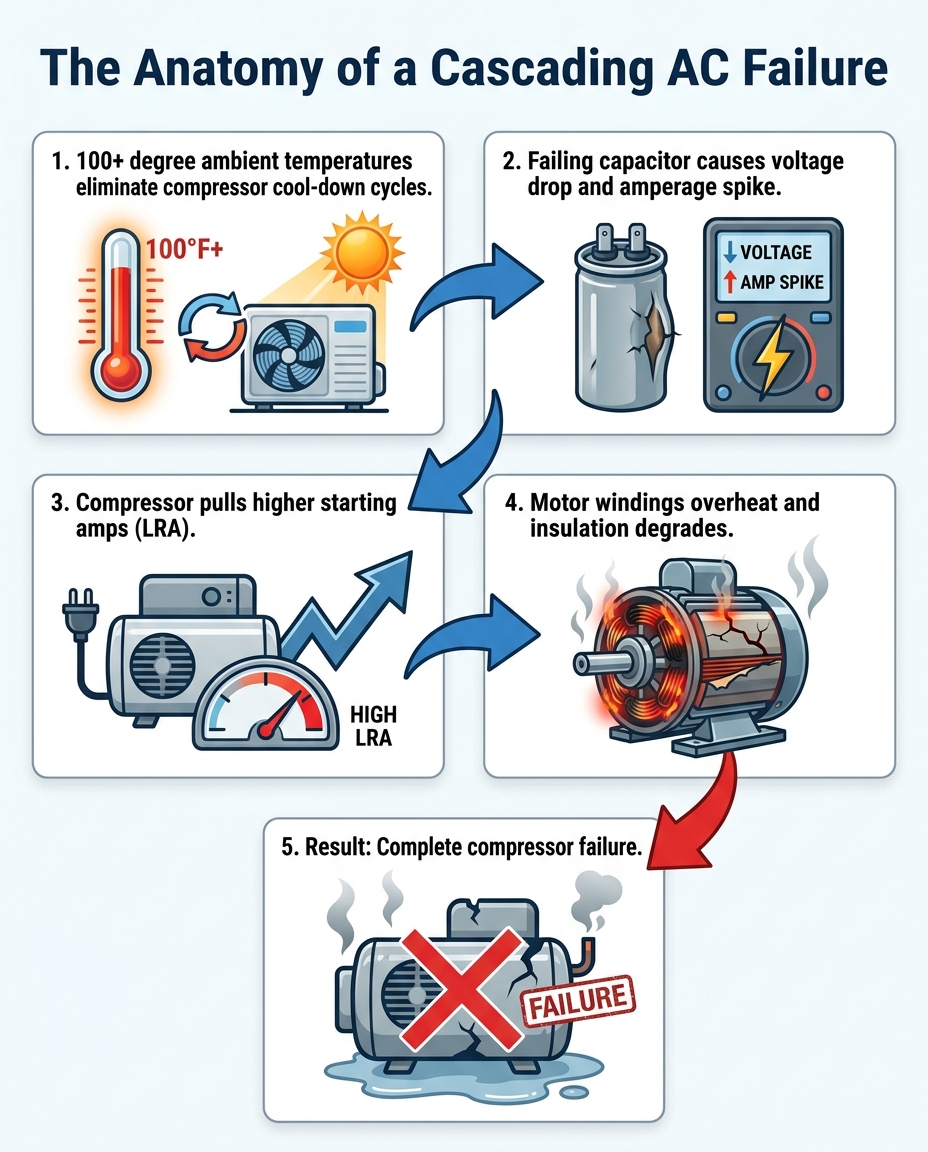
The run capacitor is essentially a high-voltage battery that provides the continuous electrical boost your compressor motor needs to run efficiently. When a capacitor begins to lose its charge capacity (measured in microfarads), the electrical relationship between the capacitor and the compressor breaks down. As the capacitor weakens, it causes a severe voltage drop. To compensate for this lack of voltage and maintain its required power output, the compressor is forced to pull dangerously high starting amperage.
The electrical domino effect:
• Voltage drops: The weakened capacitor fails to deliver the necessary electrical push.
• Amperage spikes: The compressor motor draws more current (amps) to overcome the voltage deficit.
• Heat generates: Higher electrical current creates immense friction and heat inside the motor.
• Insulation degrades: The protective coating on the motor windings begins to melt away.
The Impact of High Amp Draw on Motor Windings
According to ASHRAE standards on motor operating temperatures, electrical motors are only designed to handle specific heat thresholds. When a compressor pulls excessive amperage, the internal motor windings rapidly overheat. This intense electrical heat physically degrades the thin layer of insulation protecting the copper wires inside the motor. Because this damage happens entirely inside the sealed steel shell of the compressor, it is completely invisible to the naked eye. A technician cannot simply look at a compressor and know its internal windings are melting; it requires precise electrical measurement.
Why Continuous Operation Accelerates System Damage
Intense ambient temperatures push residential cooling systems to their absolute maximum design load. In standard weather conditions, an air conditioner cycles on and off, giving the internal components time to shed heat. With summer temperatures regularly exceeding 100°F in San Antonio, that recovery period disappears entirely.
Eliminating the Essential Cool-Down Cycle
During a severe heatwave, relentless mid-summer heat forces the system to run continuously just to maintain a basic indoor temperature. This continuous operation means the compressor motor never gets a cool-down cycle. Trapped heat inside the metal condenser cabinet compounds the internal motor heat generated by the electrical current. A minor component weakness that might take months to cause a failure in mild weather can destroy a compressor in a matter of days when the system is running for twelve to fourteen hours straight.
Heat Resistance and Electrical Wear
The physics of heat and electrical resistance play a massive role in cascading failures. As ambient temperatures rise, the electrical resistance within the system's wiring and components also increases. ERCOT grid demand peaks heavily in July and August specifically because millions of air conditioning units are fighting this exact resistance.
• Mild Weather (Cycling normally) — Electrical Resistance: Normal baseline — Compressor Impact: Standard wear and tear, ample cooling time.
• Extreme Heat (Continuous run) — Electrical Resistance: High resistance — Compressor Impact: Trapped cabinet heat, elevated internal motor temperatures.
• Extreme Heat + Weak Capacitor — Electrical Resistance: Maximum resistance — Compressor Impact: Severe amp spikes, melting winding insulation, rapid failure.
Sustained high temperatures increase resistance, forcing components to work harder to push the same amount of electricity. This dynamic turns minor friction or electrical inefficiency into a critical failure rapidly due to zero recovery time.
The Risks of Skipping a Complete System Diagnostic
A common, yet dangerous, industry practice we see all too often is the "band-aid" repair. A technician arrives, spots a visibly bulging capacitor, swaps it out, verifies the fan is spinning, and leaves. While this gets the cold air blowing quickly, it leaves the homeowner entirely vulnerable to a total compressor failure days later.
Leaving Hidden Compressor Strain Unchecked
There is a false sense of security that comes with hearing a system turn back on after a minor repair. If the air conditioner was running with a weak capacitor for two weeks during July peak heat, the compressor windings have already suffered immense strain. If that strain isn't identified and addressed, those weakened motor windings will eventually short out against the compressor casing. Once a compressor shorts to ground, the entire unit is dead, turning a minor repair into a massive replacement project.
Validating System Performance Under Load
To truly protect the equipment, our team emphasizes that it is critical to properly test your AC system's performance after any part is replaced. Secondary damage hides deep within the system, requiring specific tools to uncover. Testing ensures the newly replaced part is functioning harmoniously with the rest of the unit. A new capacitor might fix the immediate starting issue, but if the refrigerant charge is low or the contactor is pitted, the compressor will continue to pull dangerous amperage.
Professional Diagnostics: Going Beyond the Broken Part
A whole-system diagnostic protocol is the only way to catch hidden strain rather than just swapping the visibly broken part. At Reliabee Air Electric Plumbing, professional diagnostics treat the air conditioner as an interconnected ecosystem, where one failing part always impacts another.
Testing Compressor Amp Draw
A thorough evaluation involves measuring both Locked Rotor Amps (LRA) and Rated Load Amps (RLA). LRA measures the massive surge of electricity required to break the compressor's inertia and start it spinning. RLA measures the continuous current the motor draws while running. By using specialized multimeters to capture these readings, our technicians can see exactly how hard the motor is working. If the RLA is pulling higher than the manufacturer's rating, it is a clear indicator that the motor's internal condition is deteriorating, even if the system is currently blowing cold air.
Evaluating the Entire Refrigeration Cycle
Electrical issues can sometimes mask, or be caused by, refrigerant flow problems. Consider a recent scenario where our Reliabee Air Electric Plumbing team visited a San Antonio homeowner whose two-year-old system was suddenly failing to cool the house properly. Rather than making assumptions, our technician connected advanced digital gauges to read the entire refrigeration cycle alongside the electrical draw. By providing detailed pre- and post-service reports, our technician explained exactly what was causing the underlying strain. Once the root cause was addressed, the system's performance increased to the necessary level to handle the summer heat. This holistic view of the system prevents repeat breakdowns and frames a thorough diagnostic as an investment in the system's longevity.
Interrupting the Chain Reaction Before It Starts
The best way to handle a cascading failure is to stop the chain reaction before the first domino falls. Capacitors, contactors, and fan motors do not fail instantly; they degrade predictably over time, and that degradation can be measured long before the part actually breaks.
Catching Electrical Degradation Early
Routine evaluation prevents cascading failures. During a comprehensive check, our technicians always read the microfarads of the run capacitor. If a capacitor is rated for 45 microfarads but is currently reading at 41, it hasn't failed yet—but it is actively beginning to strain the compressor. Proactively replacing that weakened component during July peak heat is a minor investment compared to replacing a dead compressor later in the season.
Safeguarding Your Most Expensive Components
The compressor is the heart of your air conditioning system, and it is by far the most expensive component to replace. Small investments in electrical health protect this major asset. Beyond electrical testing, simply cleaning the outdoor condenser coils reduces the baseline strain on the compressor by allowing it to shed heat more efficiently. Enrolling in a preventative HVAC maintenance plan ensures these vital electrical anomalies are caught before they cause a breakdown, ultimately connecting proactive care to lower energy bills and extended equipment lifespan.
Navigating Severe Secondary Damage and System Recovery
Sometimes, despite your best efforts, a diagnostic reveals the worst-case scenario: the cascading failure has already caused irreversible damage, and the compressor windings are already shorted to ground. When this happens, homeowners face a significant choice regarding system recovery.
Assessing Total System Viability
When the outdoor unit fails catastrophically, our team meticulously evaluates the indoor coil and ductwork as well. You cannot simply attach a brand-new, high-efficiency outdoor condenser to a fifteen-year-old indoor evaporator coil. The components must match in terms of capacity and refrigerant type (such as R-410A) to function properly.
Factors we consider when facing a dead compressor:
• System Age: If the unit is over 10 years old, replacing the entire condensing unit is almost always more cost-effective than replacing just the compressor.
• Refrigerant Type: Older systems using phased-out refrigerants cannot be easily repaired and require full replacement.
• Overall Condition: If the indoor coil is rusting or leaking, investing in a new outdoor compressor is a waste of money.
Strategic Replacement Decisions
Modern equipment handles extreme ambient temperatures far better than older models, utilizing advanced scroll compressors and variable-speed technology to manage electrical draw efficiently. Upgrading a severely damaged system offers long-term efficiency benefits that offset the initial replacement cost. If a total replacement is necessary, there are flexible AC replacement financing options available to help manage the cost of major unexpected upgrades, ensuring your home doesn't stay dangerously hot for long.
Securing Your Comfort with Comprehensive Diagnostics
An air conditioning breakdown is rarely an isolated event, especially under the extreme thermal load of San Antonio's summer weather. A clear, logical understanding of how components rely on each other proves exactly why a full diagnostic is non-negotiable. A weakened capacitor isn't just a nuisance; it is an active threat to the heart of your cooling system.
We always advise homeowners to demand thorough testing rather than settling for a quick part swap that leaves the underlying compressor strain unchecked. If your system is struggling to keep up with July peak heat, or if it has already shut down completely, don't risk a cascading failure. Reach out for professional emergency AC repair from Reliabee Air Electric Plumbing to get a comprehensive evaluation of your system, ensuring your most expensive components are protected and your home remains comfortable all summer long.
Frequently Asked Questions
Can a bad capacitor damage my AC compressor?
Yes, a bad capacitor can absolutely damage your AC compressor. The capacitor provides the initial surge of power needed to start the compressor motor and helps maintain a steady voltage while it runs. When the capacitor weakens, the compressor is forced to pull excessive amperage to compensate for the missing power. Over time, this high electrical draw causes the internal motor windings to overheat, which can eventually lead to a total compressor failure.
Why is a full AC diagnostic necessary after a breakdown?
A full AC diagnostic is necessary because, as we frequently see in the field, air conditioning breakdowns are rarely caused by a single, isolated issue. When one part fails, it almost always puts abnormal stress on other connected components in the system. A complete diagnostic measures electrical draw, tests refrigerant pressures, and evaluates airflow to uncover hidden secondary damage. Skipping this step and only fixing the obvious broken part often leads to a second, more expensive breakdown shortly after.
What happens when an AC compressor overheats?
When an AC compressor overheats, the protective insulation coating the internal copper motor windings begins to break down and melt. As this insulation degrades, the electrical wires can touch each other or the metal casing of the compressor, causing an electrical short. Once the compressor shorts out—often referred to as being "shorted to ground"—the motor is permanently destroyed and the entire compressor must be replaced.
Why do AC capacitors fail in hot weather?
AC capacitors fail more frequently in hot weather because extreme ambient temperatures force the air conditioning system to run continuously without a cool-down cycle. Capacitors are sensitive to heat, and the combination of high outdoor temperatures and internal electrical friction degrades their internal components rapidly. Additionally, hot weather increases electrical resistance, forcing the capacitor to work harder to deliver the necessary voltage to the compressor.
How to tell if an AC compressor is damaged?
Signs of a damaged AC compressor include the system blowing warm air, loud grinding or screeching noises coming from the outdoor unit, or the system frequently tripping your home's circuit breaker. You might also notice the outdoor unit shaking violently when it tries to start. However, internal electrical damage is invisible to the naked eye, so a professional technician must use a multimeter to measure the motor's amperage draw to confirm the exact extent of the damage.
How does extreme ambient heat affect electrical resistance in HVAC systems?
Extreme ambient heat directly increases the electrical resistance within your HVAC system's wiring and components. As the physical temperature of the copper wiring and internal parts rises, it becomes harder for electrical current to flow through them efficiently. This increased resistance forces the system's motors to pull more amperage to achieve the same amount of work, which generates even more heat and rapidly accelerates wear and tear on the equipment.

Ready to Transform Your Home?