Why We Quote Multiple Repair Options for Aging HVAC Systems
Facing a Late-Summer AC Breakdown: Why a Single Quote Isn't Enough
When August in San Antonio brings a relentless, late-summer heat wave and your air conditioner starts struggling to keep up, you might wonder Why We Quote Multiple Repair Options for Aging HVAC Systems instead of just handing you a single fix. A complete system failure during peak temperatures, especially during the busy back-to-school transition, is a high-stress emergency that disrupts your entire household. The last thing you want is a technician handing you a single, take-it-or-leave-it mandate that ignores your budget and timeline. Understanding this tiered quoting approach is the first step toward getting your home back to a comfortable temperature without feeling backed into a corner. Every home requires a customized approach that aligns the mechanical reality of your equipment with your actual needs.
To learn more about our comprehensive HVAC services or to schedule an inspection for air conditioning repair and replacement, reach out to our team today.
When you are staring down a broken air conditioner during the August late-summer cooling season, panic often sets in. You might assume that the only path forward is a massive, unexpected expense. However, a professional diagnostic process should never feel like a trap. By providing tiered solutions, a skilled technician transforms a stressful breakdown into an educational discussion.
The core problem with a single quote:
• It ignores your future plans: A quick patch makes sense if you are moving next month, but it is a terrible investment if you plan to stay for a decade.
• It hides mechanical risks: Forcing a basic repair on a severely degraded system often sets off a chain reaction of future breakdowns.
• It removes your agency: You should always have the final say in how you invest in your home's comfort.
Providing multiple options aligns the mechanical reality of the system with your financial situation and timeline. It shifts the power back to you, ensuring that the repair strategy you choose actually serves your long-term goals.
The Unique Strain on Aging Systems in the Texas Heat
To understand why complex quoting is necessary, you have to look at the environment your equipment operates in. In our years of keeping San Antonio families cool at Reliabee, a pattern we see often is how our relentless heat puts maximum continuous load on aging units, making simple "band-aid" fixes much riskier here than they are in milder climates. When a system runs almost non-stop from May through early fall, the cumulative end-of-season wear-and-tear accelerates the degradation of every internal component.
Air conditioners in extreme southern climates simply do not last as long as the national average suggests. While homeowners in cooler regions might get two decades out of a unit, our team typically sees that San Antonio area homes demand a different set of expectations.
• Cooling Season Length — National Average: 3 to 4 months — San Antonio Area: 6 to 8+ months
• Continuous System Load — National Average: Moderate, intermittent cycling — San Antonio Area: Extreme, prolonged daily operation
• Expected AC Lifespan — National Average: 15 to 20 years — San Antonio Area: 10 to 12 years
Because of this intense operational strain, a simple breakdown is rarely an isolated event in an older unit. If a capacitor blows or a fan motor seizes after ten years of Texas heat, the surrounding components are likely just as worn out. Replacing one part without evaluating the health of the entire system is like putting a brand-new tire on a car with a failing transmission—it gets you moving today, but it does not solve the underlying problem.
This regional climate reality is exactly why we cannot ethically offer a single, basic repair quote for an aging system. We have to present the full picture, showing you what it takes to get the system running today versus what it takes to keep it running reliably through the rest of the summer.
Understanding the Good, Better, Best HVAC Proposal
When our technicians evaluate your failing system, they use a structured quoting framework. This tiered approach is a diagnostic tool, not a high-pressure sales tactic. Here is exactly what those tiers represent:
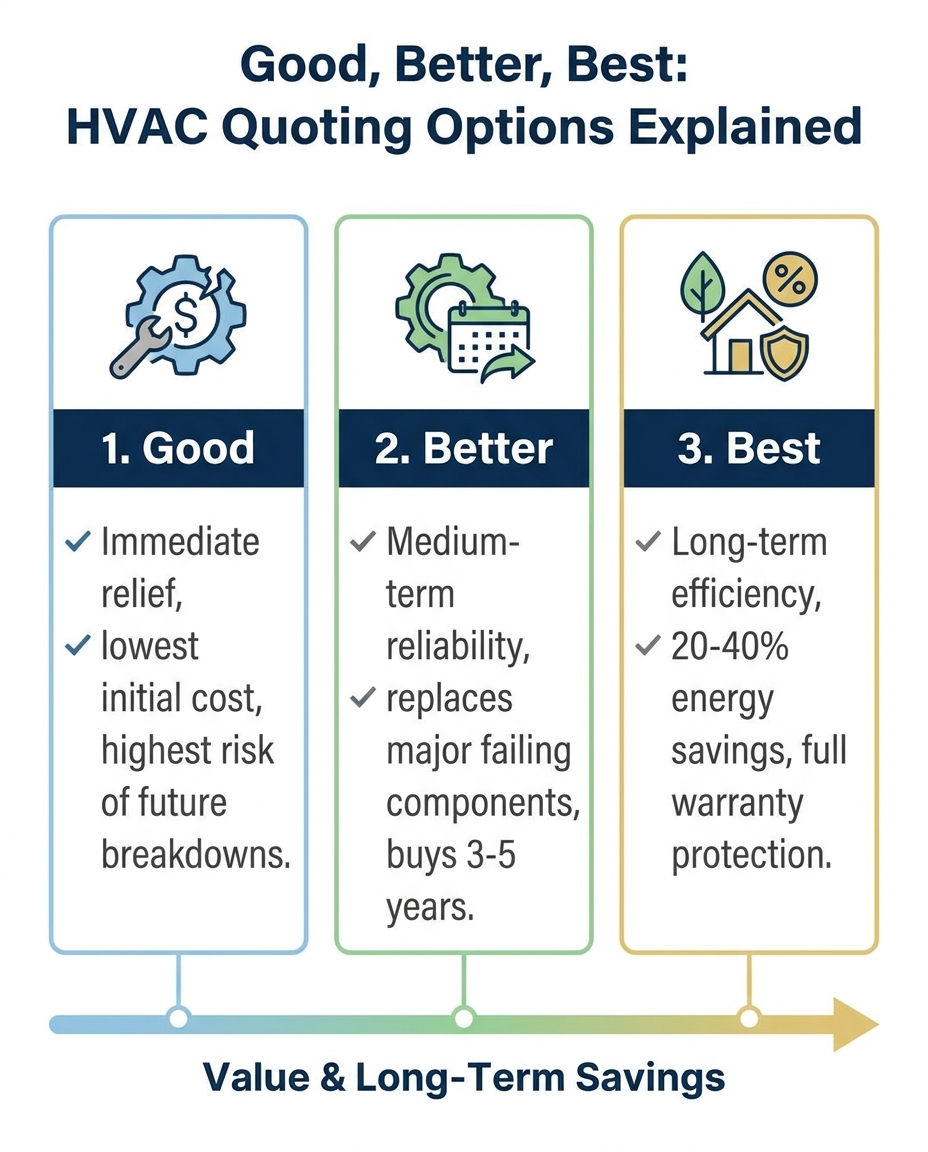
• The "Good" Option: A band-aid repair focused strictly on immediate cooling restoration, addressing only the specific part that caused the system to stop working.
• The "Better" Option: A major component fix designed for medium-term reliability, replacing the failing part along with heavily worn surrounding components to stabilize the system.
• The "Best" Option: A full system upgrade prioritizing long-term efficiency and warranty protection, replacing the aging equipment entirely.
This framework targets the core of our service philosophy. As a company, Reliabee is committed to transparent, no-pressure customer service. We believe in empowering homeowners with educational choices rather than forcing a hard sell. When you see these three options side-by-side, you gain complete visibility into the health of your equipment.
The "Good, Better, Best" method allows you to weigh the immediate relief of a quick fix against the long-term value of a comprehensive upgrade. It removes the guesswork from the process, laying out exactly what each path entails so you can make a confident, informed decision for your home.
The 'Good' Repair: Immediate Relief and Its Hidden Risks
The lowest-tier quote is designed for one primary goal: getting your cold air flowing again right now. There are absolutely scenarios where a basic fix is the right choice. If you are putting your house on the market next month, or if you are facing strict immediate budget constraints, a targeted repair makes logical sense.
For example, during a recent late-summer service call right before the back-to-school rush, a homeowner reached out because their son's two-year-old system wasn't cooling properly. Our Reliabee technician used advanced gauges to pinpoint the exact issue, provided clear pre- and post-service reports, and performed a targeted repair that quickly increased the system's performance back to the necessary level. On a newer unit, this type of immediate fix is highly effective.
However, applying that same basic patch to a degraded, aging system carries significant mechanical risk. When you patch one failing part, the newly restored pressure and electrical flow immediately transfer stress to the next weakest link in the system. This dynamic is exactly why quick fixes often lead to cascading AC failures in older units.
The problem: An aging compressor fails during a holiday weekend heat wave.
The cause: Years of continuous wear-and-tear have weakened the internal motor windings.
The "Good" solution: Installing a hard start kit to force the compressor to turn on. It provides immediate relief for the weekend, but the underlying motor damage remains, leaving the system highly vulnerable to a permanent failure in the near future.
We provide the "Good" quote so you have access to immediate relief, but we also make sure you understand that it is a calculated risk, not a permanent cure.
The 'Better' Fix: Investing in Medium-Term Reliability
The middle-tier option focuses on balancing the age of your system with the cost of major component replacement. A "Better" repair goes beyond the immediate symptom to address the root cause of the instability. This might involve replacing a failing blower motor, addressing significant refrigerant leaks properly, or swapping out a heavily corroded contactor before it destroys the compressor.
Consider a service call we recently handled for a commercial property with a relatively new 5-ton AC unit that was underperforming. The client feared a massive overhaul was necessary. Instead, our technician identified that only a precise adjustment to the outdoor unit was needed—not a completely new installation. That same diagnostic rigor applies to residential "Better" repairs. We identify exactly which major components are failing and focus our efforts there.
Why choose the middle path?
• It bridges the gap: It offers more stability than a temporary patch without the commitment of a total replacement.
• It buys you time: A solid mid-level repair can often squeeze another three to five years out of an aging system, allowing you to plan and save for future upgrades.
• It prevents cascading damage: By replacing heavily worn parts before they fail completely, you protect the rest of the system from secondary damage.
Clear communication from your technician is vital when presenting these mid-level repair options. We walk you through exactly what is being replaced and why, ensuring you understand how this investment improves the overall reliability of your equipment for the medium term.
The 'Best' Solution: Long-Term Efficiency and Peace of Mind
The top-tier quote represents a complete system replacement. While this is the most significant upfront investment, it is often the most financially sound decision for units that have surpassed the ten-year mark in the Texas heat. Eventually, an aging system reaches a point where it is no longer mathematically sensible to repair.
Industry professionals often reference the "repair versus replace" rule of 5000 conceptually. To use this rule, you multiply the age of your equipment by the estimated cost of the repair. If that calculated number exceeds a certain threshold, pouring more money into the old unit is a losing battle. The "Best" solution eliminates this cycle of endless repairs.
The long-term benefits of replacement:
• Massive energy savings: Properly sizing and choosing an efficient replacement can save 20% to 40% on your cooling energy costs compared to an older, failing model. Additionally, federal tax credits or utility incentive programs may apply to qualifying high-efficiency installations (always verify current programs with your utility or a tax professional).
• Total peace of mind: New installations come with comprehensive manufacturer warranties, protecting you from unexpected repair bills for years to come.
• Improved indoor comfort: Modern systems feature advanced airflow and humidity control, eliminating hot spots and keeping your home consistently comfortable.
We understand that a full system upgrade is a major decision, especially during the August late-summer cooling season. That is why exploring HVAC financing options can make the "Best" solution much more accessible than suffering through repeated emergency repairs. Upgrading your system should feel like a step forward for your home, not a financial burden.
Aligning Mechanical Reality With Your Future Living Plans
Ultimately, the decision between a Good, Better, or Best quote is not just about the machinery—it is about your life. The most important question you can ask yourself when reviewing these options is: "How many more years do I plan to live in this house?"
By mapping your living timeline to the repair tiers, the right choice usually becomes obvious.
1. The 1 to 2 Year Timeline: If you are selling your home soon, a "Good" repair makes sense. You need the system operational to pass inspection and keep the house comfortable while it is on the market, but you will not be around to reap the long-term energy savings of a new unit.
2. The 3 to 5 Year Timeline: If you plan to move in a few years, a "Better" repair is often the sweet spot. It provides enough stability to get you through your remaining time in the home without the anxiety of constant breakdowns.
3. The 5+ Year Timeline: If this is your forever home, the "Best" option (replacement) is almost always the smartest move. You will enjoy years of warranty protection, lower utility bills, and superior comfort.
Whichever option you choose, maintaining the system afterward is critical. Enrolling in a preventative maintenance plan extends the viability of your equipment, ensuring your investment is protected year-round. Our ultimate goal is homeowner empowerment. By aligning the mechanical reality of your system with your future plans, we help you make a choice that fits your life perfectly.
Frequently Asked Questions About HVAC Repair Estimates
Why do HVAC companies give three quotes?
Providing three quotes ensures that homeowners have choices that fit different budgets and timelines. It allows the technician to present a basic fix, a reliable mid-level repair, and a long-term replacement option. This transparent approach aligns the repair strategy with how long the homeowner plans to keep the property, rather than forcing a single mandate.
Is it worth fixing a 15-year-old AC?
In most cases, we recommend replacing rather than fixing a 15-year-old AC due to significantly decreased efficiency and a high risk of subsequent component failures. Units this old have usually surpassed their functional lifespan, especially in harsh southern climates. However, rare exceptions exist if the home is being sold immediately and only a minor patch is needed to restore basic function.
What is the difference between good, better, and best HVAC options?
The "Good" option restores basic function by patching the immediate problem. The "Better" option replaces major failing parts to provide medium-term stability and prevent secondary damage. The "Best" option replaces the entire aging system with a new, highly efficient unit, offering maximum energy savings and full warranty coverage.
How do I know if I should repair or replace my aging AC?
A helpful way to decide is to evaluate the cost of the proposed repair multiplied by the age of the unit; if the resulting figure is too high, replacement is the smarter investment. You should also consider the frequent breakdowns of the current unit and the potential energy bill savings you would gain from a newer, more efficient system.
Does a 'band-aid' repair guarantee my AC will last the rest of the summer?
No, a band-aid repair does not provide a long-term guarantee. Patching one failing part often puts renewed stress on other aging components, which can lead to cascading failures. It is a calculated risk designed for immediate relief, rather than a permanent solution for a severely degraded system.
Make an Empowered Choice for Your Next HVAC Service
Receiving multiple quotes for a failing system is the hallmark of a transparent, customer-first contractor. It proves that the technician is looking at the entire health of your equipment, not just trying to make a quick sale. The right choice depends entirely on your unique situation, your budget, and how long you plan to stay in your San Antonio area home.
You deserve to understand exactly what is happening with your equipment before making a major financial decision. We encourage you to schedule a comprehensive inspection to discuss your air conditioning repair and replacement options with an expert who will educate you, respect your timeline, and never pressure you into a choice you aren't ready for.

Ready to Transform Your Home?