Upgrading to a 200 Amp Panel Before Adding EV Charging
The Double Demand: EV Chargers and Summer AC Loads
Are you currently researching upgrading to a 200 amp panel before adding EV charging, but wondering if it is truly necessary for your home? Bringing home a new electric vehicle is an exciting milestone. You look forward to skipping the gas station and waking up to a full battery every morning. However, that excitement often hits a sudden roadblock when you confront the reality of your residential electrical limits. Many older homes simply were not built to handle the massive power demands of modern electric vehicles, leaving homeowners with a critical decision.
Whether you need a quick assessment or comprehensive home services, getting your electrical capacity right is non-negotiable. The primary decision point comes down to this: do you risk tripping the main breaker on an existing panel, or do you invest upfront in a capacity upgrade? This is not just about plugging in a car. The core conflict lies in the intersection of heavy automotive charging demands and relentless HVAC electrical needs. When the July peak summer heat arrives, your air conditioning system requires continuous, heavy power to keep your home habitable. Adding an EV charger to that existing strain changes the entire equation.
The role of your main breaker: Your electrical panel acts as the brain and the gateway for your home's power supply. It distributes electricity to individual circuits and protects your home by shutting off (tripping) when the demand exceeds the safe limit. If you have a 100-amp or 150-amp panel, your total available power is strictly capped. Pushing right up to that limit creates excess heat in the wiring, which degrades insulation and risks electrical fires. Understanding how your EV interacts with your summer cooling needs is the first step in protecting your property and your new vehicle.
Understanding Level 2 EV Charger Amperage Requirements
To understand why a panel upgrade is often necessary, you first have to look at the sheer amount of electricity a Level 2 charger requires. Unlike smaller household appliances that cycle on and off quickly, an EV charger pulls a massive amount of power for an extended period. If you are scheduling electrical services to install a charger, your electrician must follow strict safety guidelines regarding how that power is delivered.
Here is how the electrical requirements break down:
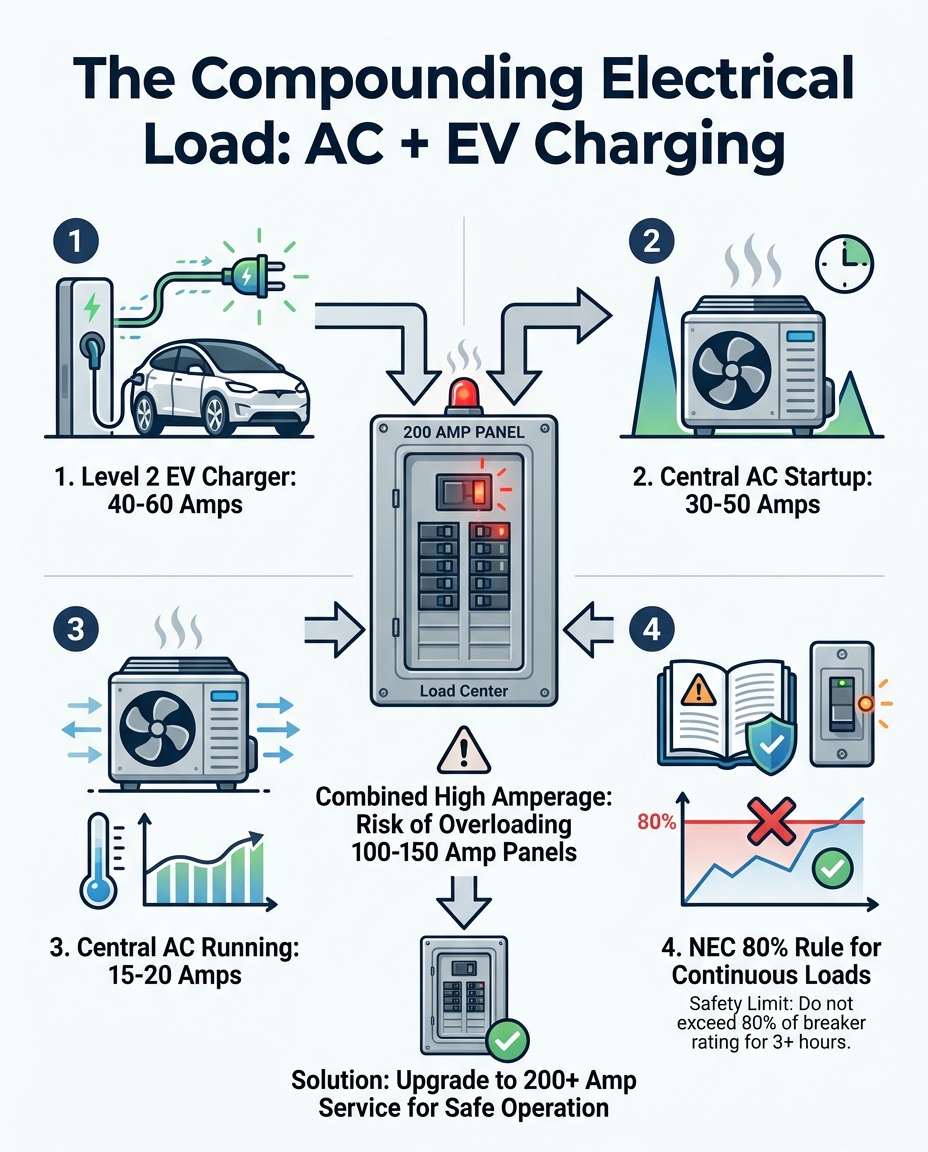
1. The Dedicated Circuit Requirement: Level 2 EV chargers typically require a dedicated 40 to 60-amp circuit to function efficiently. This means the charger must have its own breaker in the panel, sharing power with absolutely nothing else. If you have a 100-amp main panel, dedicating 50 amps to a single car charger instantly consumes half of your home's total available electrical capacity.
2. The Definition of a Continuous Load: In electrical terms, a continuous load is defined as any electrical draw that runs at maximum current for three or more hours. Because most electric vehicles take anywhere from four to eight hours to fully charge on a Level 2 system, the charger is firmly classified as a continuous load. This classification triggers specific regulatory safety standards.
3. The NEC 80% Rule: The National Electrical Code (NEC) dictates that continuous loads can only utilize 80% of a circuit's total capacity for safety. This is known as the 80% rule. Because continuous power generation creates significant heat, the remaining 20% acts as a safety buffer to prevent the wires and the breaker from overheating. Therefore, if your EV charger pulls 40 amps continuously, it must be installed on a 50-amp breaker. If it pulls 48 amps, it requires a 60-amp breaker.
To put this into perspective, compare the different levels of EV charging and their impact on your home's infrastructure:
• Level 1 (Standard Outlet) — Voltage: 120V — Amperage Required: 15 to 20 Amps — Impact on Electrical Panel: Minimal impact, easily supported by most older panels.
• Level 2 (Dedicated Circuit) — Voltage: 240V — Amperage Required: 40 to 60 Amps — Impact on Electrical Panel: Massive impact, often requires load management or panel upgrade.
The Overlooked Factor: Extreme Summer AC Draw
While many national EV guides focus purely on the charger itself, they completely overlook the heaviest electrical draw in your home: your HVAC system. At Reliabee Air Electric Plumbing, our technicians see the severe strain extreme weather puts on San Antonio homes every July. For example, our team was recently called out to a local home where the main breaker kept tripping every evening. We quickly discovered the culprit: their central AC was working overtime to combat the peak summer heat right as their newly plugged-in EV charger kicked on. During these brutal summer months, your reliance on climate control means your central AC transforms into a massive continuous electrical load right alongside your EV charger.
The startup surge vs. running load: Central air conditioners require a massive jolt of electricity to start the compressor. This is known as Locked Rotor Amps (LRA), and it can draw 30 to 50 amps for a split second. Once the system is running, it settles into its Rated Load Amps (RLA), drawing 15 to 20 amps continuously. If your home relies on older 100-amp or 150-amp panels, these numbers leave zero margin for error. If your EV is pulling 40 amps and your AC is pulling 20 amps, you are already using 60% of a 100-amp panel's capacity with just two appliances.
The real danger is the overlap effect. Picture the typical summer afternoon. Homeowners finish their commute and plug in their electric vehicle right around 5:00 PM. This is exactly when the house is at its hottest, and the air conditioning is working its hardest to cool the living space down. Because the intense regional climate means ACs run continuously during summer heatwaves, the San Antonio summer peak AC load overlaps perfectly with the EV charging cycle. The combined continuous draw pushes older panels past their breaking point, resulting in tripped main breakers and a hot, uncomfortable home. When evaluating your home for an EV charger, factoring in your air conditioning systems is just as important as the charger itself.
Signs Your Current Panel Cannot Handle the Combined Load
Before you purchase an EV charger, you need to evaluate the current health and capacity of your electrical infrastructure. If your panel is already showing signs of stress, adding a heavy continuous load will only accelerate a failure. Reading a guide to residential electrical systems can help you understand the basics, but there are specific red flags you should look for right now.
Here are the primary indicators that your current panel cannot handle the combined load of an EV and summer AC:
• You have a 100-amp or 150-amp main breaker: You can usually find the total amperage listed on the main shut-off switch at the very top or bottom of your electrical panel. If it reads 100 or 150, you are highly likely to need an upgrade for Level 2 charging.
• Breakers frequently trip: If your breakers already trip when multiple high-draw appliances (like hair dryers, ovens, or microwaves) run simultaneously, your panel is currently maxed out.
• Lights dim or flicker noticeably: When the central AC compressor kicks on, do your living room lights dim for a second? This voltage drop indicates that your panel is struggling to deliver the necessary startup amperage.
• Lack of physical space: A Level 2 charger requires a double-pole breaker, which takes up two physical slots in the panel. If your breaker box is completely full, you cannot safely add a new circuit without an upgrade or a sub-panel.
• Visible rust, scorching, or buzzing sounds: Any signs of heat damage, brown scorch marks around breakers, or audible buzzing sounds indicate loose connections and failing internal components. Adding an EV charger to a damaged panel is a severe fire hazard.
Why Accurate Whole-Home Load Calculations Matter
Many homeowners make the mistake of assuming that if they have physical space in their breaker box, they can easily add a new 50-amp circuit. This is a dangerous misconception. Electrical capacity is not about physical slots; it is about the mathematical total of power your home can safely draw at one time. This is why a formal residential electrical load calculation is required by code before adding major appliances.
A formal load calculation is a mathematical formula that takes into account your home's square footage, all fixed appliances (like water heaters and ovens), and all continuous loads. Generic national EV advice often fails because it uses standard averages that do not account for heavy regional HVAC demands. Because our team at Reliabee specializes in both air conditioning and electrical systems, we understand exactly how much a struggling AC pulls on a 100-degree San Antonio day. We consistently see firsthand why a holistic load calculation is vastly superior to a standard electrician's estimate when it comes to protecting your home's cooling performance.
The safety risks of skipping the math: Ignoring simultaneous continuous loads can lead to catastrophic failure. If your panel allows more current to flow than the main busbar is rated for, the internal metal components will overheat. This degrades the insulation on your main service wires, potentially leading to a total main breaker failure or an electrical fire inside the wall. Professional specialty services ensure that the math is done correctly, factoring in the peak summer draw of your HVAC system alongside the long overnight draw of your new vehicle.
Frequently Asked Questions About EV Chargers and Panel Upgrades
Do I really need a 200 amp panel for an EV charger?
Not always, but it is highly recommended if you run multiple heavy appliances simultaneously. It depends entirely on your home's existing load calculation. If you have gas appliances for heating and cooking, a 150-amp panel might suffice. However, if your home is fully electric and relies on heavy air conditioning, upgrading to 200 amps is usually the only safe way to accommodate a Level 2 charger.
How many amps does a Level 2 charger use?
A standard Level 2 EV charger typically requires a dedicated 40 to 60-amp circuit. Because it draws a continuous load for several hours, it must adhere to the 80% NEC rule. This means a charger pulling 40 amps of actual power requires a 50-amp breaker to safely dissipate the heat generated during the charging cycle.
Can my house handle an EV charger and central AC at the same time?
Your house can handle both only if the total continuous electrical load does not exceed your panel's safe operating capacity. In extreme heat climates, running a central AC and an EV charger simultaneously often pushes 100-amp panels past their limit. This situation usually requires installing smart power management systems or upgrading the electrical panel entirely.
Can I charge an EV on a 100 amp panel?
You can technically charge an EV on a 100-amp panel if you use a Level 1 charger or strict load management devices. However, it is highly impractical and risky for Level 2 charging while running central AC. A Level 1 charger plugs into a standard outlet and draws minimal power, but it takes significantly longer to charge the vehicle.
What happens if my electrical panel is too small for an EV?
If your electrical panel is too small, the main breaker will trip to prevent potential electrical fires. Continuous overloading without tripping can damage your home's wiring and melt internal panel components over time. It is much safer to upgrade the panel than to constantly reset a tripped main breaker.
Safeguard Your Home's Power Supply This Summer
Balancing heavy AC usage and EV charging requires professional insight and accurate math. The San Antonio summer peak AC load leaves very little room for error when it comes to your home's electrical capacity. Relying on an outdated or undersized panel while running massive continuous loads is a risk you do not want to take during the hottest months of the year.
You deserve the peace of knowing your new vehicle will charge safely without leaving your family sweating in the dark. Before you install a new charger, talk to our expert team for a definitive answer on your home's true capacity. Schedule your professional load calculation today to ensure your electrical infrastructure is ready for the future.

Ready to Transform Your Home?