The Reality of 24-Hour Emergency AC Repair Timelines in Bexar County
Facing a Total AC Breakdown During a South Texas Summer
Here at Reliabee Air Electric Plumbing, we know that summer in San Antonio is unforgiving, and when your system fails during a July heatwave, understanding the reality of 24-hour emergency AC repair timelines in Bexar County is your first step toward relief. You realize something is wrong when the vents stop blowing cold air, and within hours, the house feels like an oven. In our years of serving local families, we've seen how the rapid rise of indoor temperatures during a severe San Antonio summer night is not just uncomfortable; it quickly becomes a genuine safety hazard.
If you are in immediate danger from the heat, reach out for 24/7 emergency HVAC service or standard air conditioning repair.
A total AC breakdown triggers an immediate sense of panic. You might start calling every local company you can find, hoping someone can promise a technician at your door in twenty minutes. However, our team always emphasizes that the reality of overnight logistics dictates what can actually be fixed instantly versus what requires daylight hours and open supply chains. Setting realistic expectations about transparency, triage, and timelines is far more valuable than falling for false promises of instant 2 AM fixes that leave you waiting indefinitely.
• "We can fix any AC problem at 3 AM." — Logistical Reality: Technicians can fix standard electrical failures overnight, but proprietary OEM parts require supply houses to open in the morning.
• "First-come, first-served emergency dispatch." — Logistical Reality: Calls are carefully triaged based on safety risks, vulnerable household members, and extreme indoor temperatures.
• "Exact price quotes over the phone at midnight." — Logistical Reality: An accurate quote is impossible without a physical, on-site diagnosis of the equipment.
Navigating an overnight failure requires a clear head and a solid understanding of how local service logistics actually operate. By knowing exactly what happens after you make that late-night call, you can take the right steps to protect your home and your family while our Reliabee technicians are on the way.
How Dispatch Triage Works During Peak Heat Emergencies
When temperatures soar past 100 degrees in Bexar County, emergency call boards light up across the region. To manage this massive influx of service requests, professional dispatchers use a strict triage system. This process ensures that emergency calls are prioritized by safety risk, not just the exact order in which they were received.
Defining a true HVAC emergency: A routine cooling issue might involve a system that is struggling to keep up but still pushing out somewhat cool air. A true emergency involves a total loss of cooling during extreme heat, especially in households with vulnerable family members such as elderly residents, infants, or individuals with medical conditions that are compromised by high temperatures.
One local homeowner reached out to our Reliabee team during the peak summer heat when their 2-year-old system wasn't cooling properly. A friend had recommended us for cooling issues. Because they were promptly entered into our dispatch queue, our technician arrived, used advanced gauges to diagnose the issue, provided clear pre- and post-service reports, and explained exactly what repairs were needed to get the system's performance back to necessary levels. This level of thoroughness is our standard, even during peak rushes.
Transparent communication: Reliabee focuses on transparent communication regarding triage prioritization, ensuring homeowners aren't left in the dark about when a technician will arrive. Prompt communication and same-day response times are the standard for high-priority situations, but you will always be kept in the loop regarding your place in the queue.
What Dispatchers Need to Know When You Call
To help our dispatch team accurately assess your situation, be prepared to provide specific details. We will ask about the current indoor temperature of your home, whether the system is completely dead or just blowing warm air, and if there are any highly vulnerable individuals in the residence. Providing accurate information allows us to allocate resources effectively and dispatch help where it is needed most urgently.
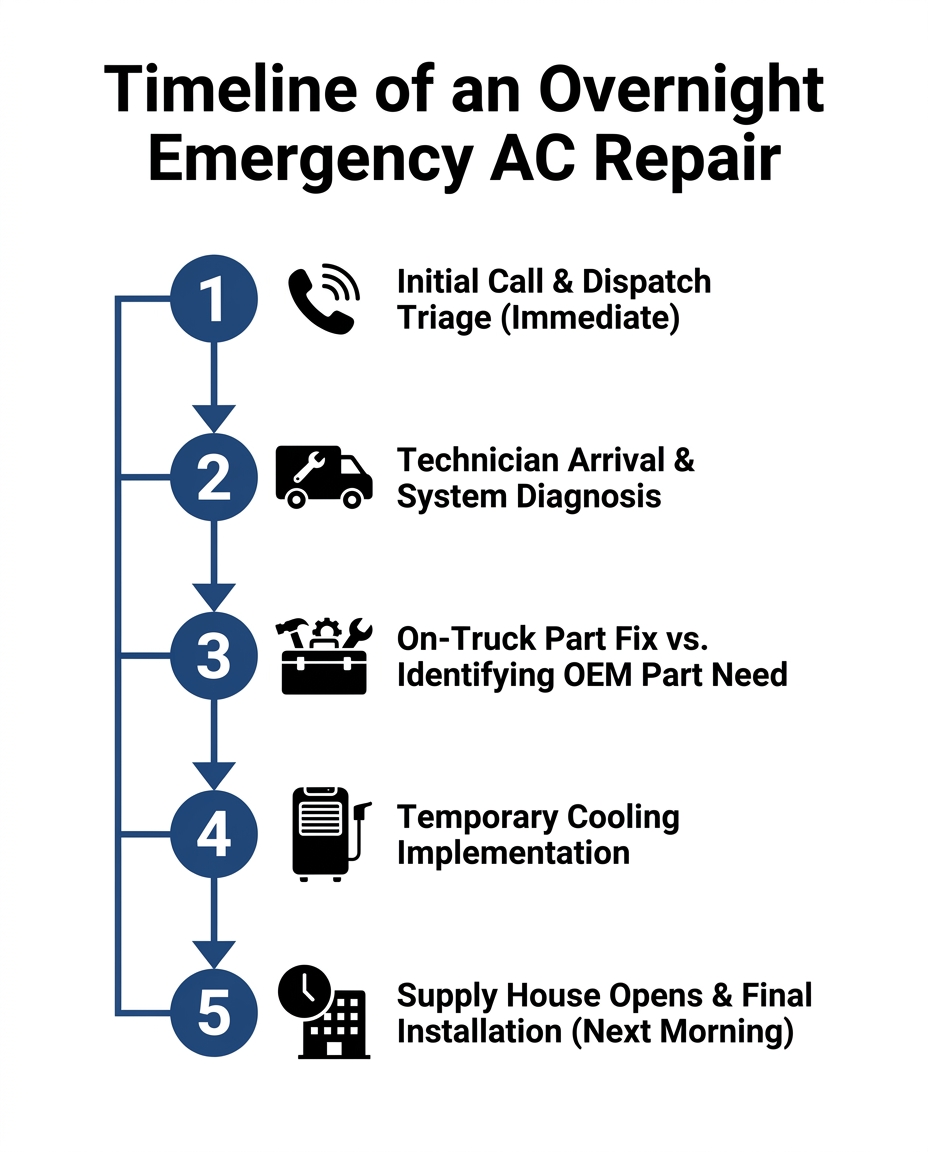
Timeline of an Overnight Emergency AC Repair Process
Understanding the step-by-step process of an after-hours service call helps alleviate the stress of waiting. Here is exactly what happens when you request help from our team during a July heatwave.
1. Step 1: The initial emergency call and immediate dispatcher triage. Your call is answered, and the dispatcher assesses the vulnerability of your household. If your situation is deemed a critical safety risk due to extreme indoor temperatures, you are moved to the top of the priority list.
2. Step 2: Technician dispatch and travel time. A technician is routed to your property. Travel time can vary depending on where you are located within the Bexar County service areas and how many technicians are currently deployed on other critical calls.
3. Step 3: On-site system diagnosis and immediate safety assessment. Upon arrival, our technician inspects the system to identify the root cause of the failure. They also check for any immediate electrical or safety hazards, such as burnt wiring or failing breakers.
4. Step 4: Determining part availability. The technician evaluates whether the broken component is an on-truck universal part (which can be fixed immediately) or if specialized OEM parts are required (which necessitates waiting for local supply chains to open).
5. Step 5: Implementing temporary cooling measures. If the repair must wait for standard business hours to source a proprietary part, the technician will secure the system and advise you on the best ways to keep your home safe and as comfortable as possible until morning.
The Supply House Factor: Why Some Fixes Must Wait for Morning
The Problem: Your air conditioner completely shuts down at 2 AM on a Tuesday. The technician arrives, diagnoses the issue, but tells you the final repair cannot be completed until the sun comes up.
The Cause: The primary logistical hurdle of overnight repairs is access to commercial HVAC supply chains. Most commercial HVAC supply houses in Bexar County operate strictly on standard daytime business hours. While our service trucks are essentially rolling warehouses packed with hundreds of universal parts, they simply cannot carry every proprietary component for every brand and model ever manufactured. Specialized blower motors, specific compressor sizes, and proprietary circuit boards cannot be sourced in the middle of the night.
In one instance, a homeowner had been without AC for eight days during the summer after a communication problem left their system dead, and other companies couldn't fix it. Our Reliabee technician worked diligently for over three hours to diagnose and resolve the complex issue, finally getting the system blowing cold air again. Deep diagnostic work like this often reveals the need for highly specific manufacturer parts that must be ordered or picked up from a regional distributor during business hours.
The Solution: When a proprietary part is required, the reality of the process shifts. The technician will make your system safe overnight, ensure there are no electrical hazards, and help you strategize temporary cooling. They will then return the next day once the supply house opens to secure the exact OEM part and complete the replacement. This logistical reality is exactly why getting an AC price quote over the phone is difficult—until the technician physically opens the cabinet, there is no way to know if you need a standard universal fuse or a proprietary component that requires a morning supply run.
Common Quick Fixes vs. Complex Component Replacements
Not every late-night breakdown means you have to wait until morning. The outcome of your emergency call depends entirely on what component failed.
Standard universal parts: Items like capacitors, contactors, and standard fuses are the most common culprits behind sudden AC failures. Because these parts are universal across many different brands, they are heavily stocked on our service trucks. If your system blew a dual-run capacitor, our technician can swap it out and have your home cooling again immediately, whether it is mid-morning or late at night.
For example, one customer's AC unit stopped working on a Friday night right before a hot Labor Day weekend, leaving their dogs trapped in a sweltering house. Because it was a standard component failure, our technician arrived quickly after hours and repaired the unit on the spot, getting the house cooling again without having to wait for the holiday weekend to pass.
Complex repairs: Conversely, full compressor replacements, refrigerant leak searches, and replacing proprietary variable-speed motors require specific OEM parts and daylight hours. A thorough diagnosis by a qualified professional is the only way to determine which category a breakdown falls into during a July heatwave.
The Diagnostic Process
When our technicians begin diagnosing a system, they start with the electrical basics. They check voltage at the disconnect, test the capacitor's microfarads, and inspect the contactor for pitting or burning. If these universal parts are functioning correctly, the diagnostic process moves deeper into the system's proprietary components, which increases the likelihood that a supply house visit will be necessary.
Actionable Temporary Cooling Strategies for Your Home
If our diagnosis reveals that a proprietary part is needed and you have to wait for the morning, staying comfortable and safe overnight becomes your top priority. The specific challenge of high humidity combined with high heat indexes in Bexar County makes air circulation vital for comfort while waiting.
• Keep doors and windows completely shut: Resist the urge to open windows unless the outside temperature drops significantly below the indoor temperature. Opening windows usually just lets in more humidity, making the house feel stickier and hotter.
• Utilize ceiling fans strategically: Turn on ceiling fans to create a wind-chill effect on your skin. However, remember that fans cool people, not rooms. Turn them off in empty rooms to save electricity and reduce the small amount of heat generated by the fan motor.
• Close blinds and blackout curtains: As soon as the sun comes up, radiant heat will begin baking your home. Keep all window coverings tightly closed to block radiant heat from the morning sun.
• Avoid using heat-generating appliances: Do not use ovens, stovetops, or clothes dryers. Turn off unnecessary incandescent lighting, televisions, and desktop computers, as these all add ambient heat to your living space.
Safety First: Knowing When to Relocate
Temporary cooling strategies are helpful, but they have limits. If indoor temperatures approach dangerous levels and you have vulnerable family members or pets in the home, you must prioritize safety. Do not hesitate to relocate to a friend's house, a local hotel, or a community cooling center until the proprietary parts are secured and your system is fully repaired.
Safeguarding Your System Against Future Extreme Weather
Once your immediate emergency is resolved, our team highly recommends pivoting toward preventative measures to avoid future midnight breakdowns. Many peak-season failures do not happen overnight; they are caused by cumulative wear and tear that goes unnoticed during milder spring months.
The invisible toll of a July heatwave: When your system runs for 14 to 16 hours a day to combat 100-degree heat, minor issues rapidly escalate. A slightly weak capacitor will fail completely under heavy load. A dirty condenser coil forces the compressor to work harder, eventually leading to a thermal overload or a burnt-out motor.
Proactive, professional inspections: Scheduling routine care before the extreme heat arrives is the best defense against after-hours emergencies. A thorough inspection allows a technician to identify and replace weak universal parts before they fail at 2 AM. Routine care significantly reduces the likelihood of needing after-hours component replacements.
The most effective way to stay ahead of these issues is by enrolling in a preventative AC maintenance plan. Regular tune-ups ensure your system is clean, calibrated, and prepared to handle the intense workload of a South Texas summer without leaving you stranded in the heat.
Frequently Asked Questions About After-Hours AC Service
Can an AC be fixed in the middle of the night?
Yes, if the issue involves standard electrical components like capacitors or fuses that are stocked on our Reliabee service trucks. These universal parts allow technicians to restore power and cooling immediately. However, if the repair requires proprietary OEM parts from a local supply house, the final fix must wait until those facilities open in the morning.
How long does emergency AC repair take?
Diagnosis typically takes about an hour upon our technician's arrival at your home. The actual repair time varies wildly based on the problem; it can take 30 minutes for basic electrical parts, or it could stretch into next-day service if major components like a compressor or blower motor need to be ordered.
What is considered an AC emergency in Texas?
A true emergency is a total loss of cooling when outdoor temperatures exceed 90 degrees, causing indoor temperatures to rise rapidly. Situations involving elderly residents, infants, or individuals with medical conditions compromised by heat are always prioritized in our dispatch triage queue.
What to do when AC goes out in the summer?
First, turn off the thermostat entirely to prevent further electrical or mechanical damage to the equipment. Next, call for emergency service immediately to enter the triage queue. Finally, implement temporary cooling measures like running ceiling fans and keeping all blinds closed to trap existing cool air.
Do HVAC technicians carry all replacement parts on their trucks?
No vehicle can hold every possible OEM part for every brand and model of air conditioner ever made. However, our trucks are heavily stocked with hundreds of universal parts to solve the most common breakdowns, allowing us to resolve a large percentage of calls on the very first visit.
How quickly does a house heat up when the AC fails in July?
Depending on your home's insulation, attic ventilation, and sun exposure, indoor temperatures can rise 10 to 15 degrees within just a few hours during peak afternoon heat. This rapid temperature spike is exactly why fast triage and temporary cooling strategies are so important during a breakdown.
Connect with a Transparent Local Team for Your Next Step
Navigating a total system breakdown requires realistic timelines and clear, honest communication from your service provider. When the heat is climbing and your family is uncomfortable, you need a team that prioritizes safety and logistical honesty over unrealistic marketing claims. Reaching out to a trusted local expert like Reliabee Air Electric Plumbing ensures you get a thorough diagnosis and a clear path forward. If you are facing a cooling crisis or want to proactively protect your system, schedule a diagnostic visit with us today to secure an honest step-by-step timeline, practical temporary cooling advice, and clear explanations for your repair needs.

Ready to Transform Your Home?