Solaris IAQ vs Standard Filtration for Summer Dust Control
The Myth of the 1-Inch Filter: Protecting Equipment vs. Protecting Lungs
In our years of providing comprehensive home services across San Antonio, our team at Reliabee Air Electric Plumbing frequently finds that most homeowners mistakenly believe their basic air filter is designed to clean the air they breathe. This makes the debate between Solaris IAQ vs Standard Filtration for Summer Dust Control a frequent topic of confusion. The reality is completely different. That basic 1-inch fiberglass or pleated filter sitting in your hallway return vent is actually engineered to keep large debris—like pet hair, lint, and heavy dust—out of the HVAC blower motor. It is a physical shield for the machinery, not a purifier for your lungs. Here in San Antonio, where the summer dust kicks up and seasonal allergens reach their peak in July, our technicians know firsthand that relying on a standard filter to keep your indoor air pristine is a losing battle.
You are ultimately left facing a critical decision point: balancing the upfront investment of a dedicated, whole-home system against the frustrating, ongoing cycle of replacing basic filters every few weeks while still dealing with a dusty house. If you are tired of constant dusting and sneezing, exploring professional home performance and indoor air quality solutions can help you breathe easier and keep your equipment running safely.
Understanding Passive Capture in Standard Media Filters
To make an informed decision between the Solaris IAQ vs Standard 1-inch filters, you first need to understand the mechanics of passive particulate capture. Standard media filters operate on a very simple premise: they sit in the airstream and wait for particles to crash into them. Whether they are made of spun fiberglass or basic pleated paper (typically rated MERV 1 through MERV 4), these filters rely entirely on the blower motor pushing air through a physical barrier.
Here is how the passive filtration sequence actually works inside your ductwork:
1. Airflow initiation: The system's blower motor activates, creating negative pressure that pulls ambient air from your living spaces into the return vents.
2. Physical barrier interaction: The pulled air is forced through the fibrous media of the 1-inch filter.
3. Particle trapping: Large, heavy particles like carpet fibers, pet hair, and visible dust mites get tangled in the filter fibers.
4. Microscopic bypass: Smaller particles slip right through the gaps in the media and continue into the HVAC equipment and back into your home.
While standard filters successfully catch heavy, visible debris, they completely miss the microscopic allergens, fine pollen, and volatile organic compounds (VOCs) that actually trigger respiratory irritation. To a microscopic pollen spore, a basic fiberglass filter looks like a chain-link fence—it passes right through without touching the sides.
The MERV Rating Misconception
A common pattern our HVAC professionals see in the field is homeowners attempting to solve their dust problems by simply purchasing the highest MERV rating they can find in a 1-inch size. MERV stands for Minimum Efficiency Reporting Value, and while a higher number does indicate a tighter weave capable of catching smaller particles, it does not automatically mean better air quality for your home. If your HVAC system was not originally designed to handle the intense airflow restriction of a MERV 13 filter in a 1-inch slot, the air will take the path of least resistance. This creates a phenomenon known as "bypass," where the negative pressure forces dirty, unfiltered air around the edges of the cardboard filter frame, completely defeating the purpose of the expensive filter.
The Airflow Trap: Why High-MERV 1-Inch Filters Fail Under Peak Load
The Problem: When San Antonio's extreme summer heat arrives, the dry conditions cause dust and pollen levels to skyrocket. In response, we often see homeowners install highly restrictive, premium 1-inch filters to trap the fine dust. However, during July and August, local HVAC systems are already running at maximum capacity to keep up with the triple-digit temperatures.
The Cause: HVAC systems are finely tuned machines that require a specific volume of air moving across the indoor evaporator coil to function correctly. This is measured as static pressure. When you insert a dense, high-MERV 1-inch filter into the return slot, it acts like a thick blanket over the system's "mouth." The blower motor has to work twice as hard to pull the same amount of air through the restrictive material. Compounding this issue is the dry San Antonio summer dust, which rapidly clogs the tiny pores of these premium filters. Within just a few weeks, a filter that was supposed to last three months becomes a solid wall of dirt.
The Solution: This mechanical chain reaction is disastrous for the equipment. Reduced airflow means the cold refrigerant inside the evaporator coil has no warm air to absorb. The coil temperature drops below freezing, causing the condensation on the coil to turn into a solid block of ice. Once the coil freezes, liquid refrigerant can flow backward into the outdoor compressor, potentially destroying the most expensive component of your system. Our repair crews respond to countless calls every summer where trying to solve a severe dust problem with a thick 1-inch filter has created an outright HVAC repair emergency. Instead of risking your equipment, choosing the perfect air conditioner setup means pairing the right mechanical cooling capacity with an air purification strategy that doesn't choke the airflow.
Active Neutralization: The Mechanics of the Solaris IAQ System
The fundamental difference when comparing the Solaris IAQ vs Standard 1-inch filters is the shift from passive capture to active neutralization. Instead of waiting for air to force its way through a restrictive physical barrier, the Solaris system actively treats the air as it circulates through your home's ductwork. This technology targets the exact microscopic threats that slip right through standard media filters.
The Solaris IAQ system integrates directly into your existing HVAC ductwork, usually near the indoor air handler. Rather than relying on a dense weave of paper or fabric, it utilizes advanced oxidation and ultraviolet energy to alter the composition of pollutants. When fine particulates, severe seasonal allergens, and biological contaminants pass through the treatment zone, the system neutralizes them at the molecular level. This process causes microscopic dust particles to clump together (agglomeration), making them large enough to be easily caught by a low-restriction filter or drop out of the breathing space entirely.
Because the Solaris system does not rely on a thick, restrictive physical barrier, it introduces virtually zero static pressure drop to your ductwork. Your blower motor can operate at its optimal, factory-designed speed, ensuring your home cools down quickly and efficiently.
One San Antonio homeowner reached out to our team last spring because their home had wildly inconsistent temperatures between the upstairs and downstairs. Because the home required a complete system replacement, our technician designed a two-zone setup and integrated an active air cleaner directly into the new ductwork. The outcome was not just better temperature control, but a noticeable improvement in indoor air quality without stressing the new blower motor. This is the exact benefit of active neutralization: it handles the heavy lifting of air purification without interfering with the mechanical cooling process.
Side-by-Side Feature Comparison: Upgrading Your Air Quality Strategy
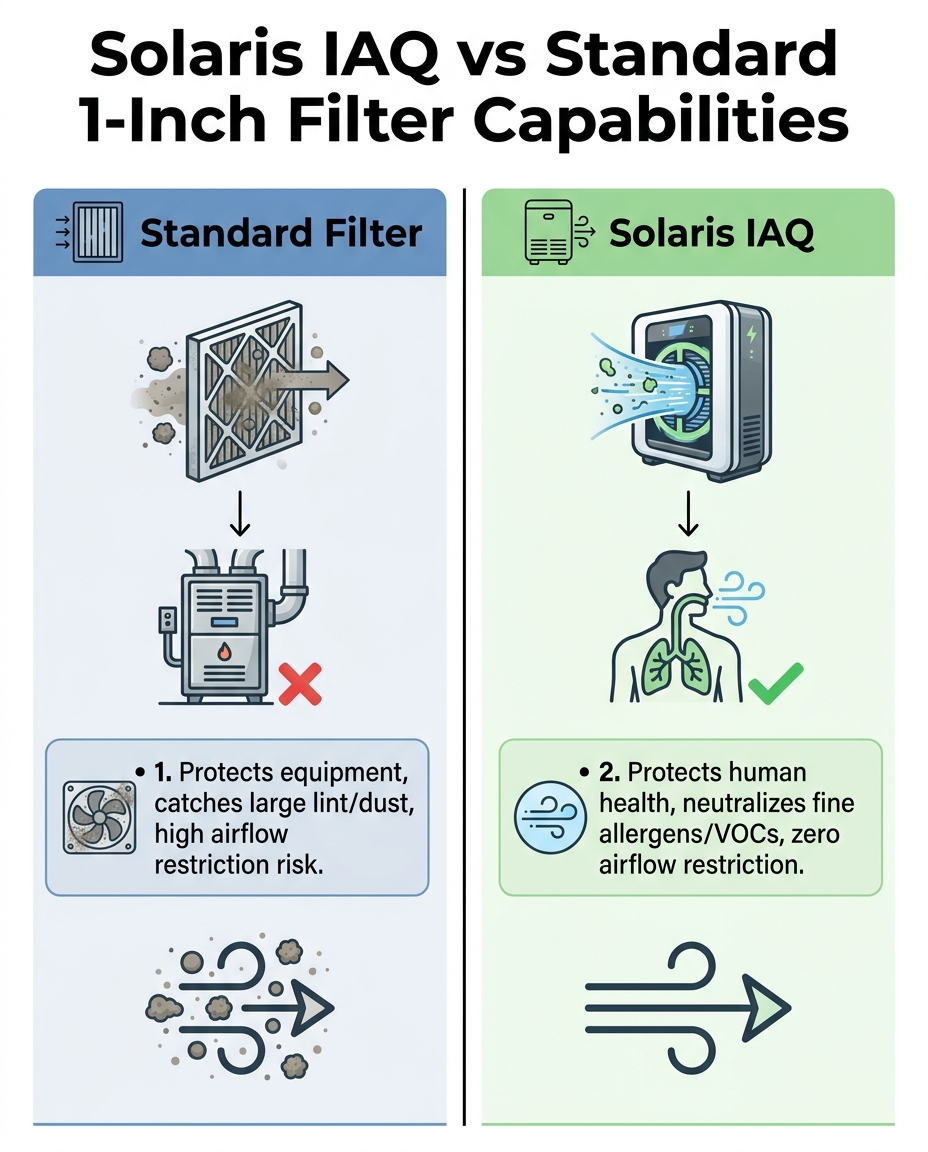
When you look closely at the Solaris IAQ vs Standard 1-inch filters, the differences in daily operation, maintenance, and overall effectiveness become striking. The table below breaks down exactly what each approach brings to your home's ecosystem.
• Primary Purpose — Standard 1-Inch Media Filter: Equipment protection; keeping large debris out of the blower motor. — Solaris IAQ System: Human health protection; comprehensive air quality management.
• Airflow Impact — Standard 1-Inch Media Filter: High risk of restriction, especially when using high-MERV ratings. — Solaris IAQ System: Zero to low static pressure impact; allows optimal blower efficiency.
• Allergen Capture — Standard 1-Inch Media Filter: Only catches large particles (lint, hair, heavy dust). — Solaris IAQ System: Actively neutralizes microscopic allergens, VOCs, and biologicals.
• Maintenance Frequency — Standard 1-Inch Media Filter: Requires replacement every 30 to 90 days depending on dust load. — Solaris IAQ System: Requires annual or semi-annual professional service and bulb replacement.
• System Strain — Standard 1-Inch Media Filter: Increases wear and tear on the blower motor as the filter clogs. — Solaris IAQ System: Reduces system strain by keeping the indoor coil exceptionally clean.
Holistic System Integration: Ensuring Seamless Operation
A critical factor that most homeowners overlook is that an indoor air quality system is not just a "plug and play" box that you can slap onto the side of your air handler. It becomes a permanent, integrated part of your home's infrastructure. When evaluating Solaris IAQ vs Standard 1-inch filters, you have to consider how the upgrade interacts with your home's electrical load and your HVAC system's specific airflow dynamics.
Because active IAQ systems require continuous power to operate their oxidation and UV components, they draw from your home's electrical panel. If you live in an older home, simply wiring a new accessory into an overloaded circuit can cause tripped breakers or premature component failure. Furthermore, the physical placement of the system within the ductwork must be calculated precisely. If installed in the wrong location, the treatment zone won't effectively cover the total volume of air moving through the return plenum.
This is where our holistic approach at Reliabee makes a massive difference. Because we handle air, electric, and plumbing, our team evaluates your home's systems together so the installation is planned comprehensively. Our technicians verify that your electrical panel has the appropriate capacity, ensure that any condensate drainage from the HVAC system is routed properly away from the IAQ electronics, and confirm that the blower motor is pushing the correct cubic feet per minute (CFM) of air. This thorough, multi-trade evaluation ensures the Solaris IAQ system integrates seamlessly, providing maximum air purification without ever straining your existing equipment.
Long-Term Value: Balancing Upfront Investment with Ongoing Efficiency
When analyzing the true cost of managing San Antonio summer dust, you have to look past the price tag on the store shelf. The hidden costs of standard 1-inch filters add up aggressively. First, there is the literal cost of buying premium pleated filters every 30 days during the peak cooling season. Second, there is the hidden energy penalty. When a restrictive filter clogs with dust, your air conditioner has to run significantly longer to satisfy the thermostat. This extended runtime drives up your monthly utility bills.
Finally, there is the risk of catastrophic repair bills. As we discussed earlier, choking the airflow leads to frozen coils, stressed capacitors, and burnt-out blower motors. The upfront investment of the Solaris IAQ system must be viewed as a long-term home performance upgrade. By removing the airflow bottleneck, your air conditioning system operates at peak efficiency, utilizing less electricity and experiencing far less wear and tear.
A local customer scheduled a service call with us this past spring to have their AC unit checked before the hot weather arrived. While inspecting the system, our technician provided useful tips on energy saving and prolonging the unit's life—specifically highlighting how keeping the indoor coils clean through better filtration reduces strain on the compressor. The homeowner walked away with a stress-free experience and a clear understanding of how professional maintenance protects their long-term investment. Keeping optimal airflow preserves the lifespan of the entire AC system, making a routine HVAC maintenance plan an essential pairing with any high-end filtration strategy.
Frequently Asked Questions About Summer Dust and Filtration
What does the Solaris IAQ system actually do?
The Solaris IAQ system actively neutralizes biological contaminants, fine dust, and allergens rather than just trapping them in a physical medium. It uses advanced technology to alter pollutants at the molecular level as they pass through your ductwork. This process cleans the air continuously without restricting the vital airflow your HVAC system needs to operate efficiently.
Why is my house so dusty even with a brand new filter?
Standard filters only catch large particles; fine summer dust bypasses them or circulates before reaching the return vent. Because 1-inch filters are designed to protect the HVAC equipment rather than purify the air, microscopic dust easily slips through the fibers. To truly eliminate household dust, you need an active system that causes those fine particles to bind together so they can be effectively removed.
Do high MERV 1-inch filters damage AC units?
Yes, they can severely restrict airflow, leading to frozen coils and premature blower motor failure. When you place a dense, high-MERV filter into a standard return grille, the system has to work incredibly hard to pull air through it. Over time, this extreme static pressure overheats the motor and disrupts the cooling cycle.
What is the best HVAC filter strategy for heavy summer dust?
Our experts recommend combining a standard filter to protect the equipment with an active IAQ system to clean the air. The basic filter catches the heavy lint and hair, keeping the blower motor clean. Meanwhile, the active system neutralizes the microscopic dust and allergens, providing comprehensive protection for both your machinery and your lungs.
Can an IAQ system help with seasonal allergies?
Yes, by targeting the microscopic pollen and dander that standard filters miss, it significantly improves indoor air quality. Active systems neutralize the specific biological triggers that cause respiratory irritation. For homeowners dealing with heavy seasonal pollen, this upgrade can make a profound difference in daily comfort.
Take Control of Your Indoor Air Quality This Summer
True allergen control and dust management require more than picking up a basic 1-inch filter from the hardware store. As we have seen in homes all across San Antonio, those standard filters do a fantastic job of protecting your equipment from large debris, but they fall short when it comes to capturing the microscopic particles that impact your health. The Solaris IAQ system offers a paradigm shift, actively neutralizing contaminants without choking the airflow your system desperately needs during the hottest months of the year.
At Reliabee, our goal is to provide you with a clear, professional look at what each system actually accomplishes so you can make the right choice for your home. If you are ready to stop battling seasonal dust and want to ensure your air conditioning systems are protected from restrictive airflow, we encourage you to get a professional assessment. A thorough evaluation will help you weigh your options and find the perfect balance between upfront investment and long-term indoor air quality.

Ready to Transform Your Home?