Preventing Premature AC Replacement Through Comprehensive Electrical Diagnostics
Facing a Complete System Failure Diagnosis at the End of Summer?
Preventing premature AC replacement through comprehensive electrical diagnostics starts with questioning the terrifying news that your compressor is completely dead. Your system has been running continuously to fight off the relentless heat, but suddenly, the house is getting warmer by the minute. You call for help, and a technician delivers the worst possible news: the compressor has failed, and you need to replace the entire unit. Receiving a complete system failure diagnosis during the brutal heat of August late-summer end-of-season wear is incredibly stressful. However, before you agree to a massive replacement project, our team wants you to understand how your cooling system actually operates.
An air conditioning system relies heavily on a complex partnership between mechanical parts and electrical infrastructure. The compressor is the mechanical heart of the unit, responsible for pumping refrigerant through the lines. But that mechanical heart cannot beat without a steady, precise flow of high-voltage electricity. When the electrical supply is interrupted, the compressor stops working entirely. To the untrained eye—and even to a rushed technician—a unit that refuses to turn on looks exactly like a unit with a destroyed compressor.
The reality is often much less severe. Comprehensive electrical diagnostics frequently reveal that the mechanical compressor is perfectly fine. Instead, the failure lies in a small, highly stressed electrical component that has simply given out after months of continuous operation. By taking the time to properly test the electrical pathways that feed your unit, we can often save your existing equipment, restore your home's comfort, and avoid an unnecessary replacement.
How Late-Summer Heat Exhausts Your Electrical Components
By the time late summer arrives, your cooling equipment has endured thousands of hours of continuous operation. This relentless cycle maximizes the thermal strain on your system's electrical infrastructure. Every time your thermostat calls for cooling, high-voltage electricity surges through the wires, contactors, and capacitors outside your home. This continuous load generates a significant amount of internal heat within the electrical components themselves.
The toll of continuous operation: Electrical parts have a finite lifespan, and that lifespan is dramatically shortened by extreme ambient temperatures. As the season drags on into August, the constant heating and cooling of these components cause physical wear. Wires become brittle, insulation degrades, and the tiny metal plates inside electrical switches become scarred from repeated electrical arcing. This prolonged stress makes end-of-season electrical failures highly common.
A familiar late-summer pattern: Our team at Reliabee Air Electric Plumbing recently helped a local homeowner who experienced this exact type of sudden failure right before a holiday. Their AC unit stopped working entirely on a Friday night just before Labor Day weekend. With hot weather peaking and kids preparing for the back-to-school transition, the situation was urgent. We provided them with a portable cooling unit while our technicians efficiently diagnosed and fixed the main system. The issue wasn't a destroyed mechanical system; it was a fixable component that had simply reached its limit after a long, hot season.
These late-season electrical failures are frequently misdiagnosed as mechanical deaths because the outward symptoms look identical to the homeowner. The fan might spin, but the air blowing from the vents is warm, or the entire outdoor unit might sit in complete silence. Without digging deeper into the electrical load and testing the specific components that manage the power supply, a technician might assume the worst. Understanding this late-summer exhaustion is the first step in protecting your equipment.
Electrical Issues That Mimic a Dead AC Compressor
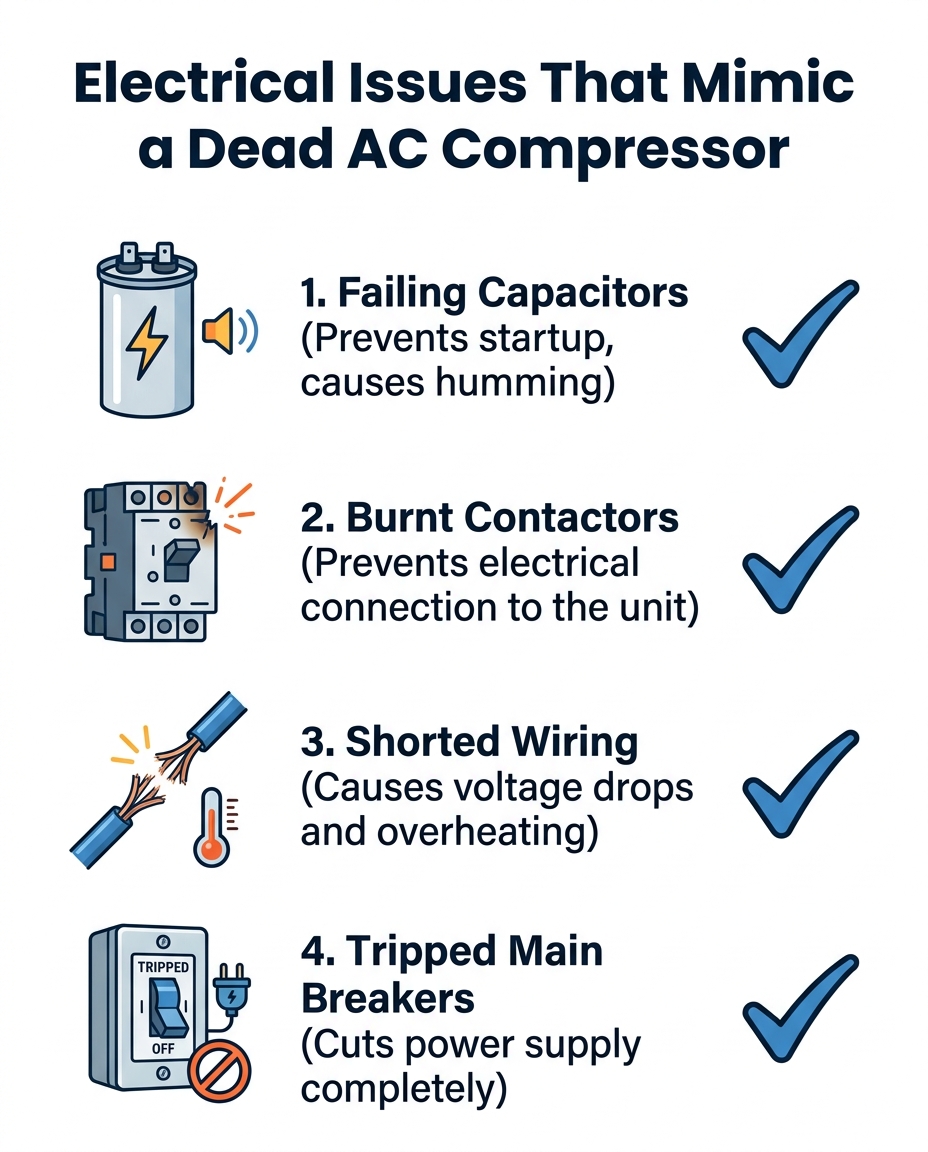
When an outdoor unit fails to cool your home, we often find the root cause hidden inside the electrical access panel rather than the heavy mechanical compressor. Several specific electrical components can fail and completely mimic a total system breakdown.
• Failing Capacitors: The capacitor is a small, cylindrical device that stores electrical energy like a battery. It delivers a massive jolt of power to start the compressor motor. When the capacitor fails, it cannot deliver that necessary jolt. The compressor will try to start, fail, and eventually overheat, causing the unit to shut down completely.
• Burnt or Pitted Contactors: The contactor acts as a heavy-duty switch that controls the flow of high-voltage electricity to the compressor. Every time the switch closes, a small electrical arc occurs. Over time, this arcing can pit the metal contacts or even weld them shut. If the contactor is burnt, electricity cannot reach the compressor, rendering it completely lifeless.
• Shorted Wiring and Blown Fuses: High ambient temperatures increase electrical resistance. This causes the wires inside your outdoor unit to overheat. If the insulation melts, the wires can short out against the metal casing, instantly blowing the safety fuses in the disconnect box. A blown fuse cuts all power to the unit.
• Tripped Breakers at the Main Panel: Sometimes the issue isn't even inside the condenser unit itself. A weak breaker at your home's main electrical panel can trip under the heavy load of a hot afternoon, cutting off the power supply long before it reaches the outdoor equipment.
The Capacitor vs. Compressor Confusion
The most common misdiagnosis we see involves confusing a bad capacitor with a locked-up compressor. When a capacitor is dead, the compressor will often make a distinct, low humming or buzzing sound as it tries to pull power that isn't there. A mechanical compressor that has seized up internally will make the exact same humming sound.
Because the symptoms are identical, a visual inspection or simply listening to the unit cannot tell the two apart. The only way to definitively prove whether the issue is the capacitor or the compressor is by using a specialized multimeter to test the electrical capacitance. If a technician declares your compressor dead without pulling out a meter to test the capacitor first, you are not getting a complete diagnostic.
The Critical Impact of San Antonio's Heat on Your System
The environment your outdoor unit lives in plays a massive role in its electrical health. In our years of serving San Antonio, we've seen firsthand how the intense, prolonged summer heat creates unique challenges for residential cooling systems. When temperatures regularly soar, the ambient heat combines with the internal heat generated by the electrical components, pushing the system to its absolute limits.
Understanding thermal expansion: Extreme heat directly affects the physical properties of the wiring and metal components inside your unit. As the sun beats down on the metal casing during a San Antonio afternoon, the electrical connections heat up and expand. When the sun goes down and the unit occasionally cycles off, those same connections cool and contract. Over months and years, this constant thermal expansion and contraction causes the electrical connections to slowly loosen.
The danger of loose connections: A loose electrical wire is one of the most dangerous things for a heavy appliance. When a connection is not perfectly tight, electricity struggles to jump the gap. This struggle creates electrical resistance, which leads to a significant voltage drop. Because the compressor requires a specific amount of power to run, a drop in voltage forces the motor to pull more amps to compensate.
Tripping safety switches: Pulling excess amperage generates massive amounts of heat inside the compressor motor. Eventually, the internal thermal overload switch will trip to protect the motor from melting. When this happens, the compressor shuts off completely. To a homeowner, the unit is dead. But the root cause wasn't a mechanical failure; it was a loose wire caused by regional heat strain. This environmental strain is completely normal for Texas summers, but it requires precise diagnostic tools to identify and correct before the mechanical components suffer permanent damage.
Why a Second Opinion is Essential for Major AC Diagnostics
Accepting a rushed diagnosis for a major system failure can lead to unnecessary, major expenses. When a technician tells you that your system is dead and needs to be completely replaced, you are facing a significant decision. Empowering yourself to pause, ask questions, and seek a second opinion is the best way to protect your home and your wallet.
The reality of rushed diagnostics: During the peak of summer, technicians are often running from call to call. In a rush to get to the next house, some may perform a superficial check. If the unit isn't turning on and the basic resets don't work, they might quickly write off the 10-year-old system as a total loss. However, our team frequently uncovers complex communication problems or intermittent electrical shorts that were misdiagnosed by technicians who did not take the time to trace the electrical path.
A true diagnostic takes time: Proper troubleshooting involves tracing voltage drops, testing continuity, and verifying the integrity of every wire from the breaker box to the compressor. It is not a five-minute process. For example, our technicians recently helped a homeowner who spent eight miserable days without cooling during the back-to-school rush after other companies were completely unable to fix a complex communication problem. It took our diligent technicians over three hours of careful diagnostic work to finally trace the exact electrical issue and restore the cold air. If that homeowner had given up after the first rushed opinion, they would have replaced a fixable system.
Questions to ask your technician: Before agreeing that a compressor is mechanically dead, ask the technician for specific multimeter readings. Ask them what the capacitance reading was on the run capacitor. Ask if they tested the compressor windings for an internal short to ground. If they cannot provide these specific electrical measurements, you do not have a definitive diagnosis, and a second opinion is absolutely essential.
What a True Dual-Expertise Diagnostic Looks Like
A comprehensive diagnostic requires looking far beyond the metal box sitting in your backyard. The power that runs your cooling system starts inside your house, and a failure anywhere along that path will stop your equipment cold. This is where having a team like ours at Reliabee, who deeply understands both HVAC and residential electrical systems, becomes incredibly valuable. A dual-expertise approach bridges the gap between your home's main breaker box and the outdoor condenser, ensuring no stone is left unturned.
Here is exactly what our thorough, step-by-step diagnostic entails. Note: This process involves testing high-voltage electricity and should only be performed by licensed professionals.
1. Checking the Main Electrical Panel: The diagnostic begins inside the home. Our technician will inspect the dedicated breaker for the cooling system. We use a multimeter to ensure the breaker is not compromised, is not overheating, and is delivering the proper voltage out of the panel. A weak breaker that trips prematurely will mimic a dead outdoor unit.
2. Inspecting the Disconnect Box: Next, we move to the outdoor disconnect box mounted on the exterior wall. This box houses the safety fuses or pull-out switch. Our team will verify that a power surge hasn't blown a fuse or melted a wire inside this enclosure, which would prevent power from ever reaching the condenser.
3. Testing Component Capacitance and Resistance: Once the power supply is verified, our technician opens the condenser panel. We will discharge the capacitor safely and test its microfarad reading to ensure it can start the compressor. We will also inspect the contactor for pitting and test the coil resistance to ensure the switch is operating correctly.
4. Testing the Compressor Windings: The final step is the most critical for proving a mechanical failure. We disconnect the wires directly at the compressor and test the internal motor windings, measuring the resistance between the common, start, and run terminals. If the windings are open, or if they show continuity to the copper ground lines, the compressor has suffered an internal electrical short and is truly dead. If the windings test normal, the compressor is healthy, and the problem lies elsewhere.
By checking the entire electrical path, we eliminate the guesswork. Investing in comprehensive electrical diagnostics ensures you are making a decision based on hard data, not assumptions.
Protecting Your System with Preventative Measures
Transitioning from reactive emergency repairs to proactive care is the best way to extend the life of your equipment. You do not have to wait for your system to fail on a 100-degree afternoon to find out you have an electrical issue. Routine inspections can identify pitted contactors, weak capacitors, and loose wiring long before they cause a complete shutdown.
The value of annual tightening: Because thermal expansion causes wires to loosen over time, we strongly recommend having a professional tighten all electrical connections annually. This simple step prevents the voltage drops that force the compressor to pull excess amperage. Catching a burned wire early costs very little to fix, but ignoring it can lead to a destroyed compressor.
Stopping the Domino Effect
Ignoring minor electrical issues almost always leads to a chain reaction of component failures. Your cooling equipment is designed to operate within very specific electrical parameters. When one component begins to fail, the rest of the system has to work harder to compensate.
• Weak Capacitor — Consequence to Mechanical System: Compressor struggles to start, drawing massive amperage and overheating the internal motor windings.
• Pitted Contactor — Consequence to Mechanical System: Inconsistent voltage delivery causes the compressor to stutter, rapidly wearing down mechanical bearings.
• Loose Wiring — Consequence to Mechanical System: Voltage drops force the motor to pull more current, eventually tripping the internal thermal overload switch.
• Failing Fan Motor Relay — Consequence to Mechanical System: The fan stops pulling heat away from the coils, causing the compressor to operate at dangerously high pressures.
As you can see, a weak capacitor doesn't just stop the unit from turning on; it actively degrades the compressor windings over time due to excess heat. Catching the electrical issue early saves the mechanical components from premature death. Enrolling in a preventative maintenance plan ensures that a licensed professional is testing these specific electrical tolerances every single year. By addressing the small electrical faults immediately, you can successfully prevent cascading AC failures that ultimately lead to full system replacements.
Frequently Asked Questions About AC Electrical Failures
Can a bad capacitor seem like a bad compressor?
Yes, a bad capacitor perfectly mimics a bad compressor to the untrained ear. When the capacitor fails, the compressor cannot start, resulting in a low humming or buzzing sound as the motor tries to pull power. Because a mechanically locked compressor makes the exact same noise, a technician must use a multimeter to test the capacitor before declaring the compressor dead.
What electrical problems cause an AC to stop working?
Several electrical issues can cause a total shutdown, including blown fuses in the disconnect box, tripped breakers at the main panel, burnt contactors, and shorted wiring. If the high-voltage electricity cannot flow smoothly from your home's electrical panel to the outdoor unit, the mechanical components will not operate, regardless of how healthy they are.
Why would my AC compressor suddenly stop in extreme heat?
Extreme heat increases electrical resistance and causes components to overheat. If a loose wire causes a voltage drop, the compressor will pull more amperage to keep running, which generates massive internal heat. Eventually, the compressor's internal thermal overload switch will trip to protect the motor, causing the unit to suddenly stop until it cools down.
Should I get a second opinion on AC replacement?
You should absolutely get a second opinion if a technician diagnoses a dead compressor without showing you specific multimeter readings. Rushed diagnostics often miss fixable electrical shorts or communication errors. A thorough second opinion can prevent you from spending thousands of dollars replacing a system that only needed a minor electrical repair.
How can I tell if the issue is my AC or my electrical panel?
You cannot safely determine this without professional diagnostic tools. A tripped breaker at the panel might mean the breaker itself is weak, or it might mean the AC unit is pulling too much amperage due to a failing component. A licensed technician with dual expertise in HVAC and electrical systems will trace the voltage from the panel to the unit to find the exact root cause.
Make an Informed Decision About Your AC System
A "dead compressor" diagnosis isn't always the end of the line for your cooling equipment. As we have seen, the intense late-summer heat places immense strain on your system's electrical infrastructure, frequently causing small, fixable components to fail and mimic a total mechanical breakdown. Understanding how these electrical parts operate gives you the knowledge to ask the right questions when a technician evaluates your unit.
Before you agree to a costly full-system replacement, take a moment to ensure you have the full picture. Seek a comprehensive diagnostic from our team at Reliabee Air Electric Plumbing, where we deeply understand both HVAC mechanics and residential electrical systems. By insisting on precise multimeter readings and a thorough inspection of the entire electrical path, you can make an informed decision and potentially save your existing system.

Ready to Transform Your Home?