Tracing the Source of Tripping Breakers Linked to AC Compressors
When the Late-Summer Heat Pushes Your Breaker to the Limit
August late-summer heat is bearing down on San Antonio, and as families gear up for the busy back-to-school transition, your home is your only refuge from the blazing temperatures. The last thing you want to hear is the sudden, heavy silence of your cooling system shutting down mid-cycle. You check the electrical panel, and sure enough, a switch has flipped. Tracing the Source of Tripping Breakers Linked to AC Compressors is a critical step in restoring your comfort safely. You might be wondering if you just need to reset the switch, or if there is a deeper, more dangerous issue lurking in your equipment.
When your system loses power during peak summer heat, it creates an immediate dilemma. At Reliabee Air Electric Plumbing, we find that homeowners are often unsure if they are dealing with a localized HVAC failure or a broader electrical safety hazard. Both situations present the exact same symptom: a dark house and a flipped switch in the garage or utility room. Because high-voltage electricity is involved, our team always emphasizes that a professional diagnostic process is absolutely required to safely identify the root cause without putting your property at risk. If you are dealing with this frustrating issue, professional help with your air conditioning is the safest way to get your home cool again.
The Frustration of Sudden Power Loss
Losing your cooling capacity when you need it most is stressful. The house begins to warm up within minutes, and the urgency to find a quick fix sets in. However, the electrical systems that power your heavy appliances are complex and highly sensitive to changes in demand. A tripped breaker is never a random glitch; it is a deliberate safety response to a specific problem. In our years of serving San Antonio, we've learned that understanding why this happens is the first step toward a permanent, safe resolution.
The Hidden Danger of Repeatedly Resetting a Tripped Breaker
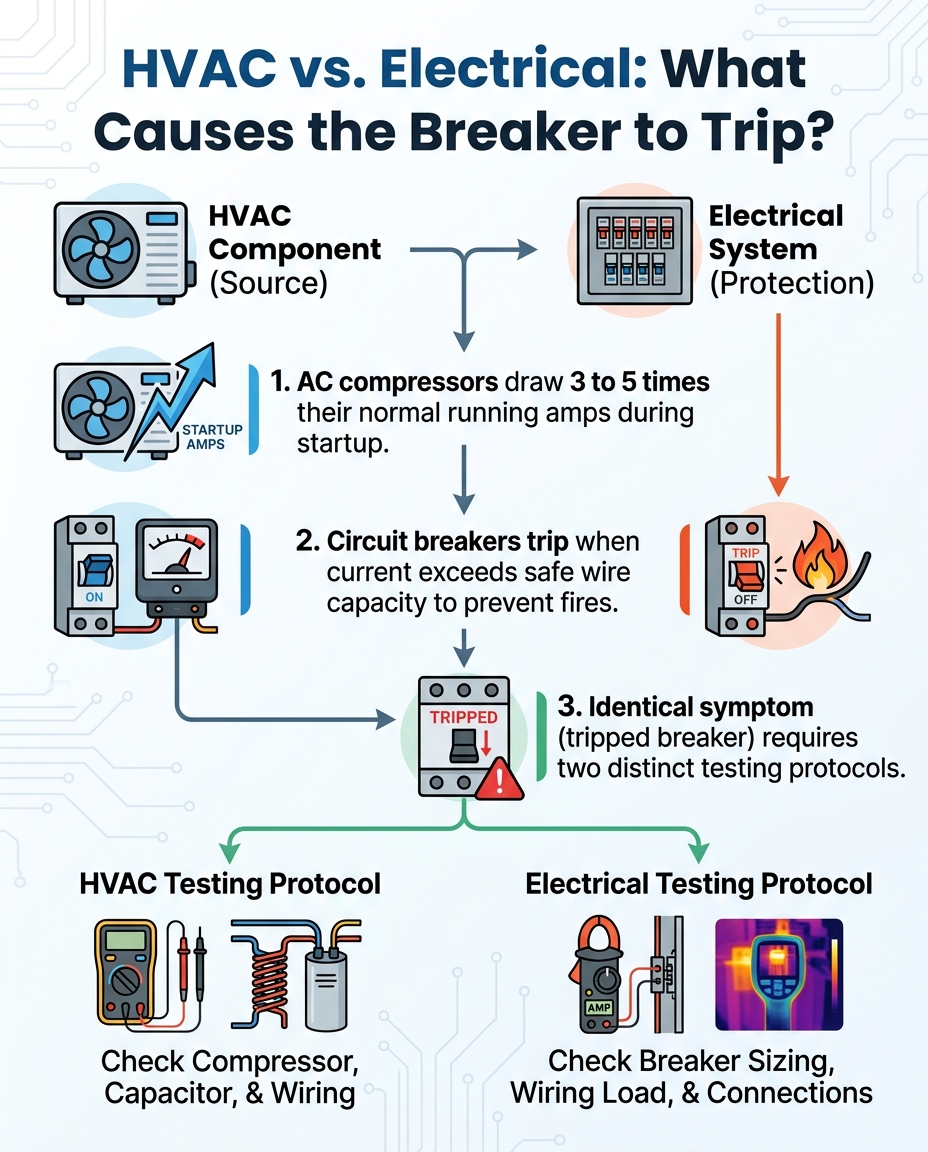
Circuit breakers are designed to do one specific job: prevent electrical fires. They act as the gatekeepers of your home's electrical grid. When the current flowing through a wire exceeds its safe capacity, the breaker trips, cutting the power before the wires can overheat, melt their insulation, or ignite surrounding building materials. This mechanism is crucial for your family's safety.
In San Antonio, prolonged high temperatures lead to significant neighborhood grid strain. We see this pattern often: as every home and business in the area runs their cooling systems simultaneously, the local power grid can experience minor voltage drops. According to electrical principles, when voltage drops, a motor must pull higher amps to achieve the same amount of work. This forces your AC compressor to draw more electrical current just to start up, pushing your breakers right to their safety limits.
Why You Should Never Just "Flip It Back"
It is a common habit for homeowners to walk out to the panel, flip the switch back on, and hope for the best. Our technicians strongly advise against this, as doing it repeatedly is incredibly dangerous. Every time a breaker trips, the internal mechanisms endure physical and thermal stress. Forcing power back into a failing circuit can cause permanent damage to both the electrical panel and the AC unit.
• Internal arcing: Forcing a breaker closed against a short circuit can cause electrical arcing, which damages the panel bus bar.
• Component meltdown: Continuous excess heat will melt the plastic casing of the breaker, permanently fusing it to the panel.
• Compressor death: If the compressor is struggling, repeatedly forcing it to start with inadequate power will burn out its internal windings.
Attempting DIY diagnostics on high-voltage electrical components is extremely dangerous. A tripping breaker is a loud warning sign that something is wrong, and ignoring it by constantly resetting the switch only guarantees a more extensive, and potentially hazardous, repair down the road.
Is It the Electrical Panel or a Failing Compressor Motor?
When the power cuts out, we typically see the true culprit fall into one of two categories: a degraded electrical panel or a failing compressor motor. Because both issues present identical symptoms to the homeowner, distinguishing between them requires the specialized knowledge and testing our dual-trade professionals handle daily.
An overloaded or aging electrical panel often features weak breakers that have lost their tolerance over time. Breakers wear out, especially if they have been subjected to years of heavy loads or frequent tripping. A weak breaker might trip even when the AC unit is drawing a normal, safe amount of electricity. On the other hand, a failing compressor motor might require far too much power to turn over. As the mechanical parts inside the compressor wear down, the motor has to work harder to compress the refrigerant, resulting in an excess amp draw on startup.
Understanding Locked Rotor Amps (LRA)
A critical metric our professionals look at is Locked Rotor Amps (LRA). This is the absolute maximum amount of current the compressor motor will draw the exact millisecond it tries to start turning from a dead stop. If the compressor is mechanically stuck or electrically degraded, it will pull its full LRA for too long, immediately overloading the circuit and tripping the safety switch.
• Primary Symptom — Electrical Panel Issue: Breaker trips randomly or immediately — Failing AC Compressor: Breaker trips as soon as the cooling cycle starts
• Root Cause — Electrical Panel Issue: Weak internal breaker spring or loose connection — Failing AC Compressor: Mechanical wear or electrical short in the motor
• Amp Draw Reading — Electrical Panel Issue: Normal amps, but breaker still trips — Failing AC Compressor: Excess amp draw on startup exceeding limits
• Required Solution — Electrical Panel Issue: Professional electrical services to replace breaker — Failing AC Compressor: HVAC repair or compressor replacement
How Our Professionals Measure Electrical Load Without Guesswork
Because guessing between an electrical fault and an HVAC failure is dangerous and expensive, our team relies on precise, data-driven diagnostic processes. This ensures the root cause is identified accurately without throwing unnecessary parts at the problem.
Our diagnostic process involves measuring the exact amount of electricity the unit is demanding and comparing it to what the panel can safely deliver. This requires specialized tools and a deep understanding of electrical theory. Recently, our team helped a San Antonio homeowner who experienced a complex communication problem with their system that prevented cooling entirely. Two other contractors could not identify the root cause. One of our dual-licensed technicians spent over three hours diligently diagnosing the electrical and communication pathways, finally restoring cold air after the home had been without AC for eight days. This level of thorough testing is exactly what we provide when dealing with tripped breakers.
The Step-by-Step Diagnostic Process
1. Visual and Thermal Inspection: Our technician first inspects the electrical panel for signs of overheating, scorched wires, or loose connections that could cause a false trip.
2. Measuring Startup Draw: Using an advanced digital multimeter with an amp clamp, we safely measure the exact electrical current (amperage) traveling through the wires the moment the AC unit attempts to start.
3. Comparing to Manufacturer Limits: We take the measured excess amp draw on startup and compare it directly to the manufacturer's specified data plate on the side of the condenser unit.
4. Testing Motor Windings: Using an ohmmeter, the technician tests the electrical resistance of the compressor's internal windings to check for short circuits or breaks in the wiring.
5. Generating Performance Reports: Finally, we generate pre- and post-service performance reports to clearly document our findings and verify the root cause for the homeowner.
These measurements require licensed expertise to ensure accurate and safe readings. High-voltage systems carry a lethal risk, and opening a live electrical panel or a high-voltage condenser cabinet should never be attempted without the proper training and protective equipment our technicians carry.
The Dual-Trade Diagnostic Advantage: Ending Contractor Finger-Pointing
One of the most frustrating experiences for a homeowner is getting caught in the middle of contractor finger-pointing. In the traditional service model, if your AC trips a breaker, you might call an HVAC technician. They arrive, test the AC, and if they don't find a blatant mechanical failure, they might tell you, "The AC is fine, you need to call an electrician because your panel is bad." You then pay a diagnostic fee and wait for an electrician.
When the electrician arrives, they might look at the panel, see that it is functioning normally under a standard load, and tell you, "The panel is fine, your AC is pulling too much power. Call your HVAC guy back." You are now out two diagnostic fees, your house is still hot, and no one has fixed the problem.
One Call Solves Both
This is where Reliabee Air Electric Plumbing provides a massive advantage. Because we are a dual-licensed company, our technicians bring expertise in both trades to every service call. We understand the exact intersection where these two systems meet.
Our dual-trade technicians can seamlessly test both the HVAC compressor's electrical load and the panel's breaker health in a single visit. If the compressor is pulling an excess amp draw on startup, we have the HVAC system diagnostics expertise to confirm it. If the compressor is fine but the breaker has weakened, we have the electrical licensing to safely replace the breaker on the spot. This comprehensive approach eliminates the guesswork, prevents contractor finger-pointing, and ensures the true root cause is fixed the very first time, saving you immense time and stress.
Late-Summer Thermal Fatigue: Why Breakdowns Happen Now
It is no coincidence that these critical failures often happen at the worst possible time. By the time August late-summer heat arrives and the back-to-school rush begins, your cooling system has been running almost continuously for months. This relentless operation introduces a phenomenon known as thermal fatigue.
Thermal fatigue occurs when components are subjected to constant, extreme heat without adequate time to cool down. Inside your compressor, the electrical windings are coated in a thin layer of insulation. Over time, the extreme heat degrades this insulation. As the insulation breaks down, the electrical current begins to jump between the wires, creating a partial short circuit. This forces the motor to pull more electricity to keep running, which in turn generates even more heat. It is a destructive cycle that eventually results in a massive amp spike that trips the breaker.
The Cascading Effect of Heat
This relentless operation maximizes the electrical load on your entire home. While the compressor is degrading outside, the circuit breaker inside your hot garage or utility room is also experiencing thermal fatigue. The constant flow of high amperage through the breaker weakens its internal springs and bi-metal strips.
One of our local customers had their main AC unit stop working on a Friday night of Labor Day weekend, leaving their dogs trapped in a rapidly heating house. Our emergency response team provided prompt, after-hours service, diagnosing the cascading failure caused by the extreme heat and ensuring the unit was properly working so the house could cool down safely. This illustrates how a minor issue in one system can cascade into a major failure in the other if ignored. Understanding these cascading AC failures is vital for maintaining a reliable home environment through the toughest parts of the year.
Frequently Asked Questions About AC Breaker Issues
When the power goes out and the house starts warming up, homeowners naturally have a lot of questions. Here are clear, direct answers to the most common concerns we hear regarding tripped breakers and cooling systems.
Why does my AC compressor keep tripping the breaker?
In our experience, this is usually caused by the compressor drawing too much power as it tries to start or run. It can also be caused by a failing, weak breaker in the electrical panel that trips prematurely under a normal load. Because both issues look exactly the same to the homeowner, it requires professional testing to isolate the exact component that is failing.
How do professionals test a tripping AC breaker?
Our technicians use advanced digital multimeters to measure the exact amp draw at startup and while the system is running. We inspect the electrical panel for signs of overheating, loose connections, or burnt bus bars. Finally, we compare these real-world readings against the manufacturer's safety limits to determine if the equipment is operating out of bounds.
Is it the AC unit or the electrical panel causing the breaker to trip?
It is impossible to tell without professional testing using specialized electrical meters. Both issues present the exact same symptom of a flipped switch in the panel. Our dual-trade diagnostic is the most efficient way to find out, as a single Reliabee technician can evaluate both the cooling equipment and the electrical infrastructure simultaneously.
Can a bad capacitor cause a breaker to trip?
Yes, a failing capacitor is one of the most common reasons we see a breaker trip. The capacitor acts like a massive battery that gives the compressor a jolt of energy to start turning. When it fails, the compressor is forced to work much harder to start, pulling excess electricity from the grid, which immediately trips the breaker. Replacing a capacitor is a common and straightforward professional repair.
How do you test if an AC compressor is shorted?
Professionals use an ohmmeter to check the electrical resistance across the compressor's internal terminals. We look for continuity between the terminals and the copper ground line. If the meter shows that the electrical path is grounded or shorted to the casing, the compressor is internally damaged and typically requires a full replacement.
Why is my AC tripping the breaker immediately on startup?
An immediate trip usually indicates a direct short circuit somewhere in the wiring or a completely seized compressor motor that cannot turn at all. When a motor is locked up, it pulls its maximum Locked Rotor Amps (LRA) instantly, causing the breaker to slam shut to prevent a fire. This is a severe safety hazard; do not attempt to reset the breaker, and call our professionals immediately.
Get Expert Answers and Restore Your Cooling Safely
Understanding the professional diagnostic process provides true peace of mind when dealing with sudden power loss. Guessing between an electrical fault and an HVAC failure is not only frustrating, but it is also dangerous. Repeatedly resetting a breaker during the August late-summer heat puts your home at risk of electrical fires and permanent equipment damage.
Instead of dealing with contractor finger-pointing, rely on our comprehensive, dual-trade evaluation to restore your cooling safely. Having one Reliabee expert who understands both the electrical panel and the compressor ensures the root cause is identified and fixed correctly the first time. If you need immediate assistance, reach out for professional emergency repair services to get your home back to a safe, comfortable temperature.

Ready to Transform Your Home?