Integrating Whole-Home Surge Protection During Panel Upgrades
The August Threat: Lightning, Grid Strain, and Your Electrical Panel
Integrating whole-home surge protection during panel upgrades is one of the most critical decisions you can make before the severe weather of late summer arrives. As the intense heat of August sets in across San Antonio, our team at Reliabee Air Electric Plumbing sees firsthand how the region experiences a dramatic increase in late-summer lightning storms and extreme electrical grid strain. If you are preparing to upgrade your home's electrical foundation to a modern 200-amp system, you are already taking a vital step toward better capacity and safety. However, increasing your electrical capacity without adding a defense mechanism leaves your most expensive household investments completely exposed to sudden voltage spikes.
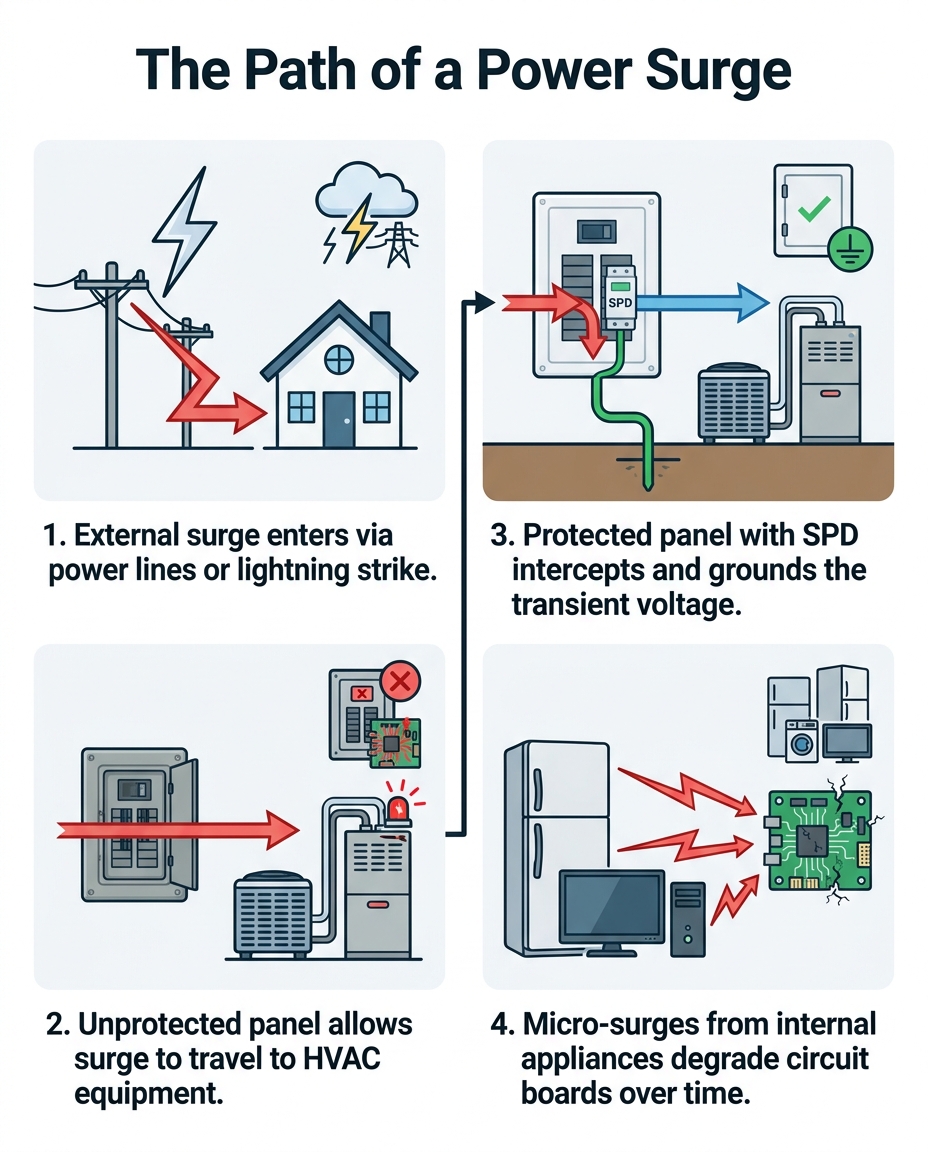
Many homeowners view a panel upgrade purely as a way to accommodate more power for modern living. While it is true that a 200-amp panel provides the necessary bandwidth for heavy appliances, electric vehicle chargers, and advanced cooling equipment, capacity alone does not equal protection. When a lightning strike hits a nearby transformer, or when the utility company restores power after a neighborhood blackout, a massive surge of electricity rushes directly toward your home. Without a dedicated barrier at the main electrical entry point, that transient voltage travels freely through your wiring.
This is where the decision point becomes critical. You have a licensed professional opening up your home's electrical center to install new breakers, bus bars, and grounding systems. Choosing to integrate whole-home surge protection at this exact moment is the most effective way to shield your property. By upgrading your residential electrical services with built-in surge defense, you stop catastrophic voltage spikes at the meter before they can reach the sensitive, high-dollar equipment operating inside and outside your home.
Why High-Efficiency HVAC Systems Are Highly Vulnerable to Power Surges
The problem: The technology driving modern air conditioners has completely transformed over the last decade, making them incredibly efficient but highly susceptible to electrical damage. Older, traditional air conditioners were relatively simple machines. They relied on heavy-duty mechanical contactors, basic relays, and single-speed motors that could often withstand minor electrical fluctuations without missing a beat. If a power surge hit an older unit, it might blow a fuse or damage a cheap capacitor, but the core system usually survived.
The cause: Today's high-efficiency cooling systems operate very differently. Instead of simple mechanical switches, modern units are essentially large outdoor computers. They rely on delicate HVAC inverter control boards to constantly monitor temperatures, adjust compressor speeds, and maximize energy efficiency. These sophisticated microprocessors require a clean, stable flow of electricity to function. When a sudden voltage spike travels from an unprotected electrical panel to the outdoor unit, it instantly overwhelms these delicate electronic pathways. The surge can literally melt the microscopic circuitry on the inverter board, leading to immediate and total system failure.
The solution: Protecting these modern marvels requires specialized defense at the source. If a surge destroys the communication pathways between your thermostat and your outdoor unit, the resulting downtime can be agonizing. In a recent service call, our team helped a local homeowner who found themselves without air conditioning for eight days during the peak of summer when their high-end system suffered a severe communication failure. It took our technicians over three hours of diligent, complex troubleshooting just to resolve the communication error so the cold air could finally blow again. Installing a whole-home surge protector prevents these cascading AC failures by intercepting the voltage spike before it ever reaches the equipment.
The Heart of the System: Microprocessors and Communication
Modern inverter systems rely on continuous, high-speed digital communication between the indoor air handler, the smart thermostat, and the outdoor compressor. This continuous loop of data is what allows the system to achieve such incredible energy efficiency. Unfortunately, data cables and low-voltage communication wires are highly sensitive to electrical interference.
• Traditional Single-Stage AC — Electrical Components: Mechanical contactors, basic capacitors, single-speed motors — Surge Vulnerability: Low to Moderate (often blows a fuse or capacitor) — Typical Repair Complexity: Straightforward component replacement
• High-Efficiency Inverter AC — Electrical Components: Microprocessors, DC inverters, digital communication boards — Surge Vulnerability: Very High (circuitry easily fried by transient voltage) — Typical Repair Complexity: Complex diagnostic and expensive board replacement
When a surge compromises the inverter board, the system loses its ability to translate electrical current into the precise frequencies needed to run the compressor. The unit simply shuts down and flashes a communication error code. Because these boards are proprietary to each manufacturer and model, replacing them requires specialized diagnostics, ordering specific parts, and extensive labor. Protecting them with a robust surge device at the main panel is the only reliable way to ensure their longevity.
The Silent Damage: Micro-Surges and the Texas Power Grid
While August late-summer lightning storms are the most dramatic source of power surges, they are not the most common. The quiet, daily threat to your home's electronics comes from micro-surges. These are small, frequent voltage spikes that happen dozens of times a day, completely unnoticed by the homeowner. Over time, these tiny fluctuations act like rust on a pipe, slowly degrading the sensitive circuit pathways inside your appliances until they eventually fail prematurely.
External Grid Fluctuations: During the late summer, the Texas ERCOT grid experiences massive strain as millions of air conditioning systems run simultaneously to combat the heat. This heavy demand frequently leads to voltage drops, commonly known as brownouts. When the grid stabilizes and the voltage suddenly returns to normal, it creates a transient surge that pushes excess electricity into your home. Your heavy appliances and sensitive electronics bear the brunt of this sudden influx.
Internal Micro-Surges: Surprisingly, up to 80% of all power surges originate from inside the home itself. Every time a major motorized appliance cycles on or off, it creates a brief electrical imbalance on your home's wiring network.
• HVAC Compressors: The sudden draw of power when a traditional AC kicks on can send a ripple through the panel.
• Refrigerators and Freezers: The heavy motors in refrigeration units constantly cycle, creating small spikes.
• Washers and Dryers: The tumbling action and water pumps demand fluctuating amounts of electricity.
• Power Tools: High-draw tools in the garage can easily disrupt the voltage stability of the entire house.
Each time one of these internal micro-surges occurs, the excess voltage seeks a path to ground. If your electrical panel lacks a whole-home surge protective device (SPD) to filter and absorb these anomalies, the excess electricity travels to other plugged-in devices, slowly degrading the microprocessors inside your televisions, computers, and smart appliances.
Code Compliance: Understanding NEC 2020 Surge Protection Requirements
The necessity of whole-home surge protection is no longer just a strong recommendation from industry experts; it is now a mandated safety standard. The National Fire Protection Association (NFPA), which authors the National Electrical Code (NEC), recognized the shifting landscape of home technology and updated their guidelines accordingly. Understanding these code requirements is essential for any homeowner planning a major electrical update.
Under the NEC 2020 update, specifically Article 230.67, a surge-protective device (SPD) is explicitly required for all new and replaced electrical services supplying dwelling units. This means that if you are upgrading your home to a 200-amp panel, the installation of a whole-home surge protector is not just a good idea—it is required by code to pass electrical inspection in jurisdictions that have adopted this standard.
Why did the code change? The NEC updated this requirement because the modern home is fundamentally different than it was twenty years ago. In the past, surge protection was primarily marketed as a way to save a desktop computer or a television. Today, life-safety equipment and critical infrastructure—such as hardwired smoke detectors, smart security systems, and HVAC inverter control boards—are permanently wired into the home's electrical system. You cannot simply plug your central air conditioner into a power strip.
By mandating SPDs at the main service panel, the NEC ensures that all hardwired, critical systems receive a baseline level of defense against both external grid events and internal micro-surges. When you hire a professional to perform a 200-amp panel upgrade, integrating this protection ensures your home meets modern safety compliance while safeguarding your most valuable built-in appliances.
The Efficiency of Combining Surge Protection with a 200-Amp Panel Upgrade
The problem: Upgrading an electrical panel is a major undertaking that requires coordinating with the utility company, pulling permits, and temporarily shutting down all power to the home. If a homeowner decides to skip adding surge protection during this process, they leave their equipment vulnerable and guarantee that they will have to pay for another, separate service call in the future to have an SPD installed.
The cause: Installing a whole-home surge protector safely requires opening the main panel, exposing the live bus bars, and routing wires directly to the grounding system. Doing this as a standalone job means a licensed electrician must travel to your home, safely disconnect the power, remove the dead front cover of the panel, perform the installation, and test the system. This separate trip incurs additional labor costs and travel fees.
The solution: The most efficient and cost-effective time to install an SPD is exactly when the panel is already being replaced. During a 200-amp upgrade, the electrician already has the main power disconnected, the panel completely open, and the grounding system exposed. Snapping in a surge protector and wiring it to the neutral bar takes only minutes in this scenario.
This proactive step prevents catastrophic failures right when cooling demand is at its peak. Proper electrical foundations also prevent costly misdiagnoses later on. In one instance involving a commercial 5-ton AC unit, the original installers recommended adding an entirely new, unnecessary unit when electrical issues arose. However, our skilled Reliabee technicians later identified that only a precise electrical adjustment to the outdoor unit was needed—saving the business significant time and headache. Ensuring your electrical panel is properly configured and protected from day one means your advanced Daikin FIT inverter systems receive the clean, stable power they need to operate flawlessly, avoiding unnecessary replacements down the road.
Bridging the Gap: Why Dual Electrical and Cooling Expertise Matters
When it comes to protecting the sophisticated climate control systems in your home, the divide between traditional electrical work and HVAC service can create dangerous blind spots. A single-trade electrical contractor might view a 200-amp panel upgrade purely as a mathematical exercise in load calculation and capacity increase. While they know how to install the box safely, they may miss the nuanced vulnerabilities of the specific cooling equipment connected to it.
Conversely, a single-trade HVAC technician understands the delicate nature of HVAC inverter control boards but cannot legally or safely open your main electrical panel to install the necessary whole-home surge protection. This disconnect often leaves homeowners caught in the middle, managing multiple contractors and hoping the systems integrate correctly.
This is where dual expertise becomes invaluable. Working with our multi-trade team at Reliabee Air Electric Plumbing means you have professionals who understand the complete picture—from the utility meter on the side of your house to the microprocessors inside your outdoor compressor. This holistic approach ensures that the chosen surge protective device is appropriately rated to shield the specific electrical loads of your home, and that the panel upgrade directly supports the longevity of your high-efficiency cooling system.
Frequently Asked Questions About Panel Upgrades and Surge Protection
Why is surge protection required during a panel upgrade?
The NEC 2020 code requires surge protection during panel upgrades to safeguard modern, sensitive home infrastructure. Because today's homes rely on hardwired electronics for life-safety, security, and climate control, a baseline level of protection at the electrical service entrance is now a mandatory safety standard to prevent catastrophic damage from transient voltage.
How do power surges affect modern HVAC systems?
Power surges directly attack the delicate microprocessors found in modern HVAC systems. Unlike older units with mechanical parts, high-efficiency systems use complex inverter boards to communicate and regulate temperatures. Even a brief voltage spike can melt the microscopic pathways on these boards, leading to total system failure and expensive repairs.
Can you add a surge protector to an existing electrical panel?
Yes, a licensed electrician can add a whole-home surge protector to an existing panel, provided there is physical space and sufficient capacity. The device is typically installed on a dedicated dual-pole breaker and wired directly to the panel's grounding bar to safely divert excess voltage away from your home's circuits.
Does NEC require whole home surge protection?
Yes, under Article 230.67 of the NEC 2020 guidelines, a surge-protective device (SPD) is required for all new electrical services and all service replacements (panel upgrades) supplying dwelling units. This code was implemented to protect the increasing amount of sensitive electronics permanently wired into modern homes.
What is the difference between a whole-home surge protector and a point-of-use power strip?
A whole-home surge protector is hardwired directly into your main electrical panel to filter massive external surges before they enter your home's wiring. A point-of-use power strip only protects the specific devices plugged into it and is generally only capable of handling much smaller, localized voltage fluctuations. Both should be used together for layered defense.
How do micro-surges degrade appliances over time?
Micro-surges are tiny, frequent voltage spikes often caused by large appliances turning on and off inside the home. While they rarely cause immediate failure, these daily fluctuations act like friction on a machine, slowly degrading the delicate circuitry inside your appliances and significantly shortening their overall lifespan.
Secure Your Home's Electrical Future Before the Next Storm
Upgrading to a 200-amp electrical panel provides the robust capacity modern homes require, but capacity without defense leaves your most valuable investments exposed. By integrating whole-home surge protection during your panel upgrade, you establish a critical barrier against late-summer lightning and unpredictable grid fluctuations. This proactive approach ensures your sensitive HVAC inverter boards and daily appliances receive clean, stable power. Protect your comfort and your equipment—explore your options for integrated surge defense during your next electrical service upgrade.

Ready to Transform Your Home?