Addressing Plumbing Emergencies Triggered by AC Condensate Line Backups
The Hidden Source of Late-Summer Ceiling Leaks
Our team at Reliabee knows that a central air conditioning system can extract up to 20 gallons of water per day from your home's indoor air during peak humidity. That means addressing plumbing emergencies triggered by AC condensate line backups becomes a sudden, stressful reality for many homeowners when that water has nowhere to go. We frequently field panicked calls from locals who notice a growing brown water stain on their ceiling or find a puddle forming in the hallway, leaving them scrambling to figure out what just broke inside their walls. If you are dealing with this type of sudden water damage, understanding whether you need residential plumbing services or an immediate emergency plumbing repair is the critical first step to protecting your home.
When this massive volume of extracted moisture cannot drain properly, it creates severe, sudden water damage that perfectly mimics a burst supply pipe. Homeowners often struggle to identify whether they need to call a plumber to fix a leaking pipe or an HVAC technician to service their cooling equipment. The confusion is completely understandable, as the symptoms we see look identical from the outside: wet drywall, ruined paint, and pooling water on the floor.
Understanding the root cause is the first step in managing this unique type of crossover emergency. In our years of working in neighborhoods across San Antonio, we've found that a ceiling leak is frequently not a plumbing failure at all, but rather an overworked air conditioning system that has lost its ability to channel condensation safely outside. By recognizing the hidden source of these late-summer leaks, you can take the right steps to halt the damage and get the proper professional help before your ceiling suffers a catastrophic collapse.
How High Humidity Overwhelms Condensate Drain Lines
To understand why these backups happen, we always point out the sheer volume of work your cooling equipment performs. Standard AC condensate drain lines are typically constructed from 3/4-inch PVC pipe. While this diameter is standard across the industry, our technicians know it is highly susceptible to blockages if the system is not meticulously maintained. The pipe is relatively narrow, and it relies entirely on gravity to move water from your indoor unit to the exterior of your home.
San Antonio's average August morning relative humidity frequently exceeds 70%, forcing your air conditioning system to run non-stop and extract maximum moisture from the air. This continuous operation turns a minor design vulnerability into a major household risk. Here is how we typically see the breakdown occur:
1. Continuous Moisture Extraction: As warm, humid air passes over the freezing cold evaporator coil, moisture condenses into liquid water and drips into a primary drain pan located beneath the unit.
2. Biological Growth Accumulation: Months of continuous moisture extraction create the perfect breeding ground for algae, mold, and heavy dust accumulation inside that wet drain pan. Because the pan is dark and constantly damp, biological sludge grows rapidly.
3. The Late-Summer Restriction: By the time the cooling season reaches its peak in late August, this sticky, thick sludge migrates into the 3/4-inch PVC drain line. The restricted pipe can no longer handle the daily water volume.
4. Gravity-Fed Overflow: Once the primary drain pan fills up, the water spills over into a secondary emergency pan. If that secondary drain is also clogged or overwhelmed, gravity pulls the water directly into the attic floor, saturating the insulation and wall cavities below the air conditioning equipment.
By the time our crews are running end-of-season cooling calls around the back-to-school transition, your system has been battling high humidity for months. We consistently see the accumulation of dust and algae reach a critical mass, turning a highly efficient cooling machine into an indoor flooding hazard.
Is It a Burst Pipe or an AC Overflow?
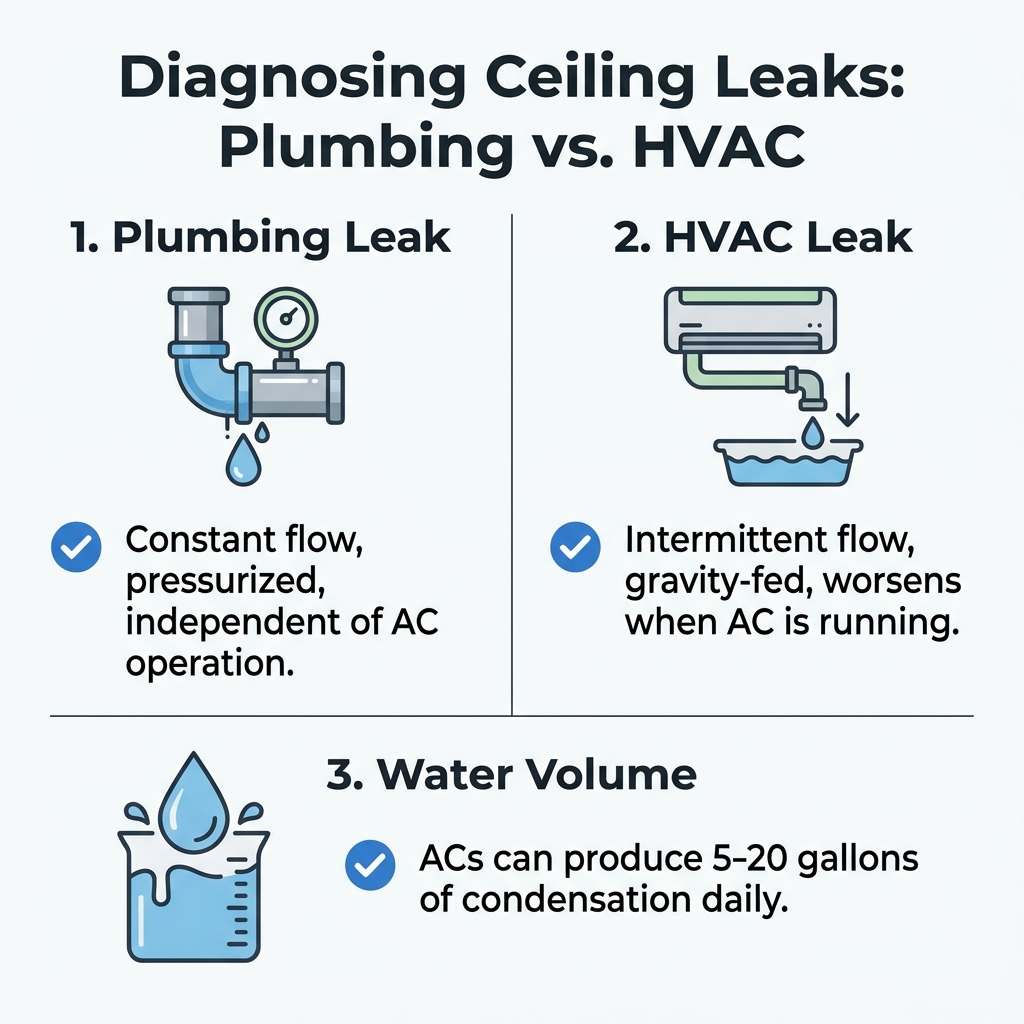
When water starts dripping from your ceiling, your first instinct is to panic and assume a pipe has burst. However, providing clear, diagnostic criteria can help you distinguish between a pressurized plumbing leak and a gravity-fed AC condensate backup. When our dispatchers take these emergency calls, the most reliable way we tell if a leak is plumbing or AC is by asking homeowners to observe the water's flow pattern and its relationship to their cooling system's operation.
Pressurized plumbing leaks typically present as a constant, forceful flow of water. Because your home's water supply is under constant pressure from the municipal grid, a broken pipe will spray or leak continuously, regardless of whether you are running any appliances. In contrast, AC condensate overflows are gravity-fed and intermittent. They usually worsen while the HVAC unit is actively cooling your home and slow down significantly when the thermostat cycles the system off.
• Water Flow Pattern — Pressurized Plumbing Leak: Constant, steady flow that never stops. — AC Condensate Overflow: Intermittent dripping; worsens when AC runs.
• Location of Leak — Pressurized Plumbing Leak: Can occur anywhere near supply lines or bathrooms. — AC Condensate Overflow: Directly beneath attic air handlers or near the indoor coil.
• Water Temperature — Pressurized Plumbing Leak: Usually cold or warm depending on the broken pipe. — AC Condensate Overflow: Typically very cold water straight from the evaporator coil.
• Required Solution — Pressurized Plumbing Leak: Pipe repair and water mitigation. — AC Condensate Overflow: HVAC line clearing and structural drying.
Location is a key indicator during these emergencies. AC leaks almost always originate directly beneath attic-mounted air handlers or near the indoor evaporator coil closet. If the wet spot on your ceiling is directly below your attic HVAC installation, you are likely dealing with a condensate backup. While standard drain clearing might easily resolve a kitchen sink clog, clearing a condensate line requires specialized HVAC knowledge to avoid damaging the delicate fins of the evaporator coil or cracking the drain pan.
When an HVAC Nuisance Becomes a Water Damage Crisis
We've seen firsthand how ignoring a slow drip or misdiagnosing the source of the water can lead to devastating structural consequences for your home. Water overflowing from an attic AC unit does not just leave a small stain; it actively destroys the building materials it touches. The first casualty is usually your attic insulation. When fiberglass or cellulose insulation becomes saturated with cold condensation, it becomes incredibly heavy and completely loses its thermal resistance, rendering it ineffective.
Prolonged moisture exposure severely compromises the structural integrity of your drywall. Drywall is highly porous and acts like a sponge. As it absorbs the overflowing condensation, it loses its rigidity, leading to sagging ceilings or sudden, dangerous collapses directly into your living space. What begins as a simple clogged drain quickly escalates into cascading AC failures and extensive interior property damage.
The Hidden Costs of Delayed Action
The damage extends far beyond the visible water stains. Trapped moisture in dark, warm wall cavities accelerates mold and mildew growth at an alarming rate, often taking hold within 24 to 48 hours of the initial overflow. During late August, the heat trapped in your attic creates a greenhouse effect that our crews see supercharging this biological growth.
Furthermore, there is a significant risk of secondary damage to electrical wiring hidden inside saturated walls. Water running over light fixtures, ceiling fans, or electrical junctions creates an immediate fire and shock hazard. The compounding effect of running a compromised system means that every hour you leave the AC on, you are actively pumping more water into your home's structural framework.
Safe Steps to Mitigate Damage Before Help Arrives
If you discover water pouring from your ceiling or pooling around your walls, taking immediate action can save you from extensive secondary damage. However, it is vital to prioritize safety and avoid attempting dangerous DIY repairs that could void your warranty or cause injury. One San Antonio family we recently helped found themselves in a highly stressful situation when their home AC unit overflowed on a Friday night right before a hot Labor Day weekend. With pets in the house and temperatures climbing, our prompt professional intervention—including emergency cooling support and expert repairs—saved their weekend. Until our professionals arrive, we recommend following these safe mitigation steps:
• Turn off the thermostat immediately: Halt the production of new condensation by shutting down the air conditioning system completely. As long as the compressor is off, the evaporator coil will stop pulling moisture from the air.
• Clear the affected area: Move valuables, electronics, rugs, and furniture away from the drip zone to prevent secondary water damage to your personal property.
• Catch the residual water: Place large buckets, heavy-duty tarps, or plastic bins under the active drip zone to catch any remaining water draining from the saturated ceiling or insulation.
• Protect your flooring: Lay down thick towels around the splash zone to protect hardwood floors or carpets from standing water.
• Never attempt to open waterlogged drywall: Do not poke holes in sagging ceilings or attempt to snake the condensate line yourself. Specialized tools and training are required to ensure safety and system integrity.
Seek prompt professional intervention as soon as you secure the area. During peak late-summer heat, a rapid response is critical to saving your home's interior from irreversible mold and structural failure.
Resolving the Root Cause and the Structural Damage
When you are facing a crossover emergency, traditional service models often force homeowners into a frustrating dilemma. You have to choose between an HVAC technician who can clear the condensate line but cannot fix the damaged plumbing or drywall, and a plumber who can fix pipes but is not licensed to service the air conditioning system. This fragmented approach leads to multiple service call fees, extended downtime, and massive headaches.
Crossover emergencies require a unified approach to simultaneously clear the HVAC blockage and address the resulting water damage in the walls. Because our team at Reliabee provides Air, Electric, and Plumbing services under one roof, our technicians can resolve the HVAC root cause and the plumbing emergency in a single coordinated visit. This eliminates the friction of hiring separate companies and ensures that your home is secured quickly.
Our comprehensive diagnostic process ensures that the condensate line is fully cleared, treated for algae growth, and tested under a heavy cooling load to verify it is draining properly. Having a single team manage the entire crisis reduces your downtime, lowers your stress, and ensures no underlying electrical or plumbing issues hidden behind the wet drywall are missed during end-of-season cooling demands.
Frequently Asked Questions About AC Water Leaks
How do you know if a leak is plumbing or AC?
The most reliable way to tell is by observing the timing and location of the water flow. If the leak is constant and pressurized regardless of what appliances are running, it is likely a plumbing issue. If the leak is intermittent, located under an attic air handler, and worsens when the air conditioner is running, our experts note it is almost certainly an AC condensate overflow.
Who do you call when the AC leaks through the ceiling?
You should call a multi-trade contractor who specializes in both HVAC and plumbing services. Because an AC leaking through the ceiling involves both cooling equipment failure and structural water damage, having a professional who can clear the condensate line and evaluate the compromised pipes or fixtures nearby is the safest approach for San Antonio homeowners.
Can a clogged AC drain cause a plumbing leak?
While a clogged AC drain does not technically break your pressurized plumbing supply pipes, it creates a massive water overflow that mimics a severe plumbing leak. The backed-up condensation spills out of the drain pan and saturates the surrounding building materials, causing extensive water damage that requires emergency mitigation.
Why is water leaking from my ceiling directly under the AC unit?
Water leaking directly under your AC unit means that your primary and secondary condensate drain pans have overflowed. This usually happens because the 3/4-inch PVC drain line has become completely blocked by a buildup of algae, mold, and wet dust, leaving the extracted humidity nowhere to go but down into your ceiling.
How quickly can mold grow after an AC condensate overflow?
Mold and mildew can begin to grow within 24 to 48 hours after your drywall and insulation become saturated with AC condensation. Because attics and wall cavities are dark and warm, they provide the perfect environment for rapid fungal growth, making immediate professional water extraction and structural drying absolutely essential.
Secure Your Home Against Crossover Emergencies
Do not wait for a minor drip from your ceiling to become a major structural crisis. The intense demands of end-of-season cooling mean your system is working overtime, and a neglected drain line can quickly flood your living space. Ensure your condensate lines are clear, your drain pans are clean, and your home is fully protected from unexpected water damage. Reach out to our multi-trade experts at Reliabee who can handle every aspect of the repair, from clearing the stubborn HVAC blockage to ensuring your home's structural integrity remains intact. By proactively addressing plumbing emergencies triggered by AC condensate line backups, you can enjoy reliable cooling and total peace of mind all season long.

Ready to Transform Your Home?