Managing High Electrical Loads: Window Units vs Mini-Splits
The Hidden Electrical Cost of Cooling Persistent Hot Spots
Standard window air conditioning units can draw a massive 12 to 15 amps of electricity the moment their compressor kicks on. When our Reliabee technicians help homeowners with managing high electrical loads: window units vs mini-splits, we often find that this initial power surge is the root cause of frequent breaker trips and flickering lights in your home. It is an incredibly common frustration we see when clients try to cool down an uncomfortably warm upstairs room or a recent garage conversion. You plug in a temporary window unit to find relief, only to realize that the electrical strain is causing more problems than it solves.
During the intense late-summer August heat across San Antonio—especially as families transition back to school and spend more time indoors—we frequently see these supplemental air conditioners forced to run continuously just to keep up with the rising temperatures. That constant operation transforms a temporary cooling fix into a persistent electrical hazard. You are suddenly faced with a critical decision: continue dealing with the ongoing electrical strain, the tripped breakers, and the loud operating noise of a window unit, or invest in the safety and permanence of a dedicated ductless system.
Permanently resolving a stubborn hot spot requires you to look beyond just the cooling capacity of the equipment. Our team always evaluates your home's infrastructure to ensure it can safely handle the demand. By exploring dedicated air conditioning solutions, such as a hardwired mini-split system, you can achieve consistent, whisper-quiet comfort without pushing your electrical panel past its breaking point.
Understanding Shared Bedroom Circuits and Overloads
To understand why window units cause so many electrical issues, we have to look at how a typical home is wired. Most standard bedroom and living area circuits are rated for a total maximum capacity of 15 amps. These are known as shared circuits because multiple wall outlets, overhead lights, and switches are all drawing power from the same single breaker in your electrical panel.
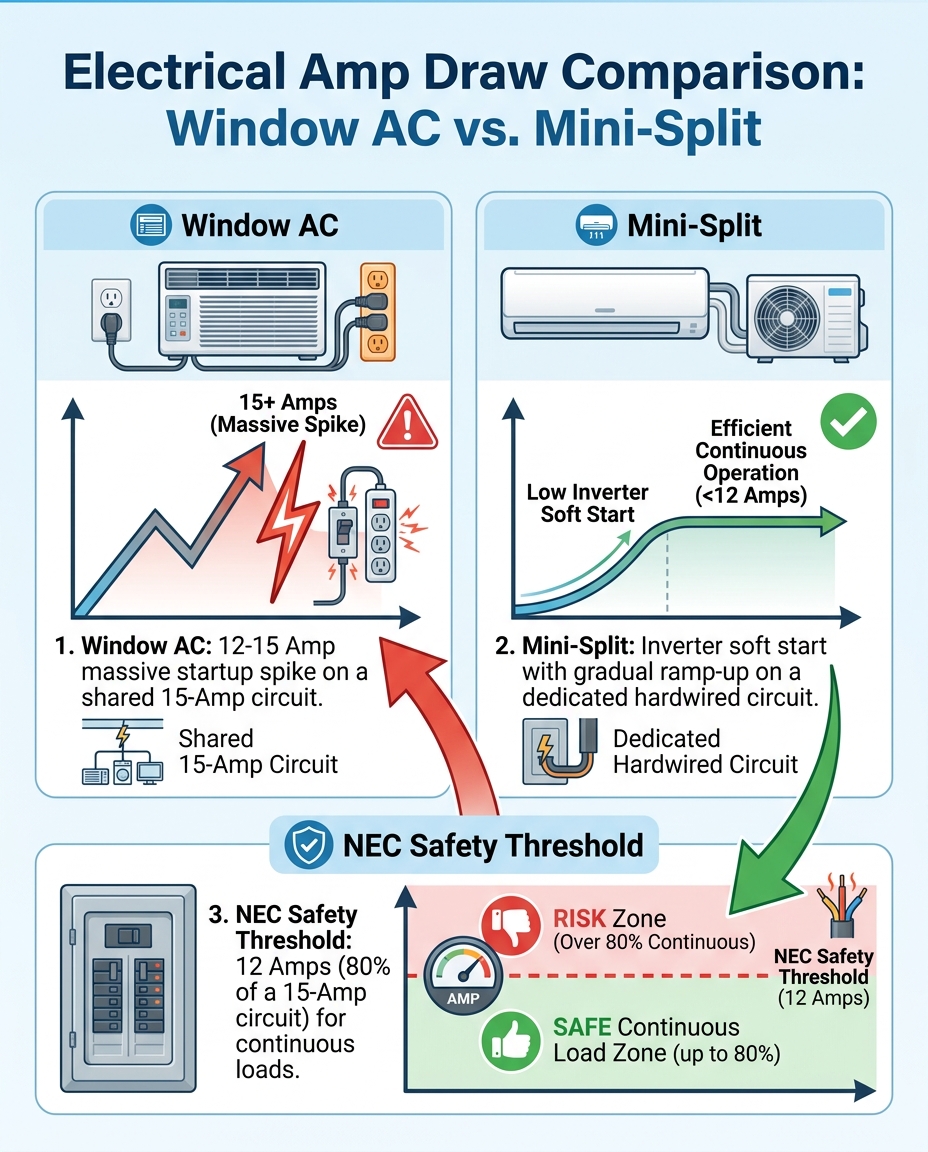
When you plug a 12,000 BTU window unit into the wall, it can easily draw 12 amps while the compressor is running. That leaves a mere 3 amps of available capacity for everything else in the room. If you turn on a television, plug in a vacuum cleaner, or even switch on a few high-wattage lamps, you will instantly exceed the circuit's 15-amp limit. The breaker does exactly what it is designed to do—it trips to prevent an electrical fire.
Persistent overloaded circuits are dangerous. Constantly resetting a tripped breaker without addressing the root cause can lead to overheated wiring behind your walls, melted outlet receptacles, and a significantly shortened lifespan for your electrical panel. Our electrical team sees this frequently in San Antonio homes with older electrical panels that were never designed to handle the heavy electrical demands of modern supplemental cooling. Upgrading to a hardwired, dedicated circuit eliminates this risk entirely. If you are experiencing frequent breaker trips, having our professionals evaluate your system for proper electrical services is a critical first step for your family's safety.
The NEC 80% Rule for Continuous Loads
As licensed professionals, we strictly adhere to the National Electrical Code (NEC), which sets vital safety standards to prevent electrical fires. One of the most important regulations we follow is the 80% rule for continuous loads. Here is how it impacts your home cooling:
• Defining a continuous load: The NEC defines a continuous electrical load as any device or appliance that operates at its maximum current for three hours or more.
• The 80% safety threshold: For any continuous load, the NEC mandates that the device should only utilize 80% of the circuit's maximum capacity. On a standard 15-amp circuit, 80% equals exactly 12 amps.
• The window unit violation: Because a heavy window AC often draws 12 amps and runs non-stop during the peak heat of the day, it maxes out the safety threshold all by itself, leaving absolutely zero safe capacity for any other plugged-in devices.
Startup Amp Spikes vs. Inverter Technology Soft Starts
The mechanical operation of an air conditioner dictates how much electricity it consumes, particularly when it first turns on. Standard window units utilize traditional single-stage compressors. When the thermostat signals that the room is too warm, the compressor slams on at 100% capacity. This creates a massive electrical surge—often called a "hard spike"—which requires a huge influx of power for a split second to get the heavy mechanical parts moving. These hard spikes are exactly what cause your lights to dim momentarily when the AC kicks on.
Modern ductless systems operate on entirely different mechanical principles. Instead of a single-stage compressor, they utilize variable-speed inverter technology. We often tell our clients to think of an inverter like the accelerator pedal in a car. Instead of slamming the pedal to the floor (100% capacity) or turning the engine completely off (0% capacity), an inverter compressor ramps up slowly and smoothly.
This gradual ramp-up is known as a "soft start." Because the compressor eases into its cooling cycle, it completely eliminates those massive electrical spikes. It reduces the sudden wear and tear on your home's electrical grid and prevents the heavy power surges that trip breakers during the late-summer August heat. Once the room reaches the desired temperature, the inverter simply dials back its speed, continuously maintaining the climate with a fraction of the electricity.
The difference in comfort and efficiency is profound. For example, our team recently helped one homeowner struggling with a house that was always uncomfortably hot upstairs by installing a permanent solution. By setting up a two-zone system with smart thermostats and an integrated air cleaner, they achieved vastly improved, even temperature control across both floors—along with the potential for significant energy bill savings. If you want to eliminate electrical spikes while enjoying consistent temperatures, exploring modern Daikin ductless units is a smart upgrade we highly recommend.
Side-by-Side: Window Units vs. Dedicated Mini-Splits
When primary air conditioning fails, temporary cooling becomes a necessity. We recently had a homeowner experience a complete system failure on a Friday night right before Labor Day weekend; we provided them with a portable AC unit to keep the house tolerable until the main system was efficiently fixed. But while plug-in units are great for emergency, temporary relief, they fall short as permanent solutions. When evaluating long-term comfort for a persistent hot spot, we find it helpful to show our clients how these two options stack up across key categories.
• Electrical Safety — Standard Window Unit: Plugs into a shared wall outlet; high risk of overloading the circuit and tripping breakers. — Dedicated Mini-Split System: Hardwired to a dedicated circuit at the main panel; safely handles the electrical load.
• Cooling Performance — Standard Window Unit: Cycles on and off at 100% capacity; creates uneven hot and cold spots in the room. — Dedicated Mini-Split System: Variable-speed inverter provides continuous, even cooling without temperature swings.
• Noise Levels — Standard Window Unit: Loud mechanical compressor sits directly in the window, disrupting sleep and conversation. — Dedicated Mini-Split System: Whisper-quiet indoor air handler; the noisy compressor is located outside the home.
• Security and Aesthetics — Standard Window Unit: Blocks natural light, prevents window usage, and creates a potential entry point for intruders. — Dedicated Mini-Split System: Sleek wall-mounted design allows full use of the window and maintains home security.
Making the right choice for your home involves weighing these daily operational realities. If you are tired of losing your window view and resetting your breaker box, it might be time to start choosing the perfect air conditioner that is actually built for long-term, permanent installation.
Why Permanent Cooling Requires an Electrical Assessment
Permanently resolving a hot spot isn't just about picking out a new piece of HVAC equipment; it is fundamentally about ensuring your home has the infrastructure to power it safely. In our years of service, we've seen that ignoring the electrical panel when adding new, heavy cooling loads is a dangerous oversight that can lead to severe electrical hazards.
Our electricians frequently encounter San Antonio homes with older electrical panels that are still operating on 100-amp main services. While this was perfectly adequate decades ago, today's modern homes feature multiple televisions, heavy kitchen appliances, home office computers, and advanced HVAC systems. Before adding a permanent ductless system to an older panel, we always perform a professional evaluation to determine if the main service can handle the additional demand without a heavy-up or panel replacement.
Installing a mini-split requires running a dedicated 110v or 220v circuit directly from the main breaker panel to the outdoor compressor. This ensures that the air conditioner has its own isolated power supply, completely separate from your bedroom outlets and lighting. Because Reliabee operates as a combined HVAC and Electrical company, our homeowners benefit from a seamless, single-provider solution. There is no need to hire a separate electrical contractor to evaluate your panel or run the dedicated circuit before our HVAC technicians can install the cooling unit. The entire process—from panel assessment to final AC installation—is handled efficiently by our unified team.
Frequently Asked Questions About Supplemental Cooling and Electrical Loads
Why does my window air conditioner keep tripping the breaker?
In our experience, your window air conditioner keeps tripping the breaker because it is drawing more electrical current than the circuit can safely handle. Most bedroom circuits are rated for 15 amps, and a window unit can draw up to 12 amps on startup. If you have lights, a television, or other devices running on that same shared circuit, the combined demand exceeds the 15-amp limit, causing the breaker to trip to prevent an electrical fire.
Does a mini split require a dedicated electrical circuit?
Yes, a mini-split system requires a dedicated electrical circuit hardwired directly to your main breaker panel. Our electricians install these to ensure the system has an isolated power supply, preventing it from overloading shared household circuits. Depending on the size and capacity of the unit, it will require either a dedicated 110v or 220v circuit installed by a licensed professional.
Can a window AC overload a standard bedroom circuit?
Absolutely. We constantly remind homeowners that a standard bedroom circuit is generally not designed to support heavy, continuous motorized loads. Because a window AC often utilizes 80% or more of the circuit's total capacity all by itself, plugging in almost any other device can instantly overload the wiring and trigger a breaker trip.
Do mini splits use less electricity than window units?
Mini-splits generally use significantly less electricity than standard window units over time. Because they utilize variable-speed inverter technology, they do not require massive power surges to turn on and off constantly. Instead, they gently ramp up to speed and maintain a consistent temperature using minimal electrical current, making them a highly energy-efficient choice we recommend.
What is the NEC 80% rule for continuous electrical loads?
The National Electrical Code (NEC) 80% rule states that any continuous electrical load—defined as a device running for three hours or more—should not exceed 80% of a circuit's maximum capacity. For a standard 15-amp circuit, this means the continuous load must stay at or below 12 amps to prevent the internal wall wiring from overheating.
How does inverter technology prevent electrical spikes?
Inverter technology prevents electrical spikes by slowly and smoothly ramping up the compressor's speed rather than turning it on at 100% capacity all at once. This "soft start" eliminates the sudden, massive demand for electricity that traditional single-stage compressors require, protecting your home's electrical grid from sudden surges.
Secure Your Home's Comfort and Electrical Safety
At Reliabee, we believe true indoor comfort should never come at the expense of overloaded wiring, flickering lights, or constantly tripped breakers. As a combined HVAC and electrical company, we see firsthand the immense, continuous strain temporary plug-in units place on circuits that were simply not designed for heavy motorized loads. Especially in San Antonio homes with older electrical panels, this strain can quickly escalate from a daily annoyance into a genuine safety hazard.
A dedicated, hardwired ductless system provides a safer, permanent, and far more efficient solution to those stubborn hot spots. By utilizing inverter technology and an isolated power supply, you can enjoy whisper-quiet, even cooling without ever worrying about your electrical panel. Don't let another season of electrical frustration compromise your peace of mind. Schedule a professional evaluation of your room and your electrical panel with our team today, and take the first step toward a safer, more comfortable home.

Ready to Transform Your Home?