Evaluating the Solaris IAQ System for Back-to-School Allergen Reduction
Are Portable Purifiers Enough for San Antonio's Back-to-School Season?
As kids bring home a fresh wave of classroom germs, is a plug-in room purifier actually protecting the whole family? When evaluating the Solaris IAQ System for back-to-school allergen reduction, our team at Reliabee Air Electric Plumbing finds that many San Antonio parents stand at a crossroads. The August back-to-school transition brings a unique set of challenges to homes across the region. Between the sudden spike in viral exchanges from crowded hallways and the simultaneous peak of late-summer allergens, indoor air quality takes a significant hit. The typical, knee-jerk response is to purchase a portable air purifier for the bedroom. But is spot-treating a single room enough when your central air conditioner is constantly circulating air throughout the entire house?
To get the most out of your HVAC system, it pays to explore comprehensive home performance and indoor air quality solutions.
Treating air at the source is fundamentally different from attempting to clean it after it has already entered the living space. A standalone unit sitting in the corner of a bedroom can only filter the air that happens to drift over to it. Meanwhile, the central blower motor pushes hundreds of cubic feet of air per minute through your ductwork, sweeping up dust, dander, and biological contaminants from the living room and delivering them directly into the nursery. Relying on portable units often means buying half a dozen machines, managing multiple filter replacement schedules, and still leaving vast areas of the home entirely unprotected.
Making the right choice requires looking at how your home actually breathes. By understanding the mechanical realities of residential cooling, you can make an informed decision between scattering multiple standalone room purifiers across your floor plan versus investing in a unified, whole-home solution that leverages the equipment you already own.
The August Air Quality Trap: Heat, AC, and Airborne Contaminants
The Closed-Loop Environment: With extreme late-summer heat regularly pushing past 97°F in San Antonio, our technicians see firsthand how homes are forced to remain tightly sealed. Opening windows for fresh air ventilation simply is not an option when the humidity and temperature are oppressive. This creates a closed-loop environment where your central air conditioning system continuously recirculates the exact same stale air. Every time the thermostat calls for cooling, the system pulls indoor air through the return vents, cools it, and pushes it back out. If contaminants are present, they are trapped in this relentless cycle.
The Contaminant Overlap: The August back-to-school transition is the perfect storm for indoor air pollution. First, you have the biological factor: children returning to school and bringing home bacteria and viruses. Second, you have the environmental factor: August marks the beginning of peak ragweed season in Texas. These tiny, highly aggressive pollen particles easily infiltrate the home through opening doors, clothing, and pets. Once inside, the HVAC blower motor acts as a distribution network, ensuring these particles reach every corner of the house.
The EPA Reality Check: Environmental Protection Agency data reveals a startling fact: indoor air can be two to five times more polluted than outdoor air. This metric is especially true during peak cooling months when homes are hermetically sealed against the heat. Without a dedicated strategy for neutralizing these trapped particles, the central air conditioner inadvertently becomes a vehicle for cross-contamination. Understanding how clogged air ducts impact your air quality is a critical piece of the puzzle, as dirty ductwork provides the perfect breeding ground for the exact biological contaminants you are trying to eliminate.
The Continuous Circulation Factor: Because the AC runs almost constantly to combat the Texas heat, airborne particles never get a chance to settle. They remain suspended in the breathing zone. A sneeze in the downstairs family room is pulled into the return grille, travels through the ductwork, and is exhausted into the upstairs bedrooms mere moments later. This continuous circulation highlights exactly why localized, single-room filtration struggles to keep up with the volume of air moving through a modern home.
The Limitations of Standalone Room Air Purifiers
The Problem of Limited Reach: The most significant limitation of a portable air purifier is its Clean Air Delivery Rate (CADR). CADR measures the volume of filtered air delivered by the unit, and it is strictly tethered to room square footage. A unit rated for a 150-square-foot bedroom is entirely useless if placed in an open-concept living room. Because they rely on their own small, internal fans to pull air in, portable units only filter the air in their immediate vicinity. This creates massive "dead zones" in larger spaces where contaminants remain untouched by the filter.
The Cause of Maintenance Fatigue: To achieve whole-home protection using portable units, a homeowner would need to purchase a separate device for the primary bedroom, each child's room, the living room, and the home office. This leads directly to maintenance fatigue. Each of these units contains a pre-filter and a HEPA filter, and they rarely degrade at the same rate. You find yourself tracking five different filter replacement schedules, ordering various proprietary filter sizes, and spending a small fortune annually just on replacement media. When maintenance becomes this cumbersome, we frequently notice during our routine service calls that it gets neglected, rendering the purifiers ineffective.
The Solution's Unintended Consequences: To get the advertised CADR performance out of a standalone HEPA filter, the machine must run on its highest fan speed. In a sleeping area, the acoustic disruption is significant. Running a portable HEPA filter on high sounds similar to running a loud box fan, which can interfere with sleep quality. If you turn the fan speed down to a "whisper" or "sleep" mode to solve the noise problem, the unit is no longer moving enough air to effectively filter the room, leaving you unprotected precisely when you need it most.
Furthermore, portable units take up valuable floor space, require dedicated electrical outlets, and present tripping hazards with their power cords. They are an ad-hoc fix to a systemic problem. While they offer localized relief for a specific corner of a room, they simply lack the mechanical power to overcome the aggressive air distribution of a central HVAC system.
How the Solaris IAQ System Transforms Your Entire Home
A whole-home solution takes a fundamentally different approach. Rather than fighting against the central air conditioner, the Solaris IAQ System partners with it. By integrating directly into the main ductwork, this technology treats the air for the entire house simultaneously.
1. Direct Ductwork Integration: The Solaris IAQ unit is installed directly into the supply or return plenum of your central HVAC system. This means it is entirely out of sight, takes up no floor space, and operates silently. Every cubic foot of air that your blower motor moves must pass through this purification zone before it reaches your living spaces.
2. Advanced Photo-Catalytic Oxidation (PCO): Unlike traditional HEPA filters that merely trap particles, the Solaris IAQ System actively neutralizes them. It utilizes Photo-Catalytic Oxidation technology. A specialized catalyst (often titanium dioxide) reacts with ultraviolet light to create hydroxyl radicals. These microscopic purifiers actively break down the molecular structure of volatile organic compounds (VOCs), odors, and biological contaminants.
3. Targeted UV Germicidal Irradiation: Alongside PCO, the system utilizes high-intensity UV-C light. This is the same technology used in hospitals to sterilize equipment. As airborne viruses, bacteria, and mold spores pass through the light field, the UV-C energy penetrates their cell walls and scrambles their DNA, rendering them unable to reproduce or cause infection. This is highly effective against the back-to-school germs circulating in the late summer.
4. Continuous Whole-Home Treatment: Because the system leverages the continuous runtime of the AC unit during the hot Texas summer, it actively purifies the air in every room simultaneously. You are not waiting for a small fan to pull air across a room; you are using a powerful, multi-ton blower motor to scrub the entire volume of the house multiple times per hour.
In our years of experience optimizing San Antonio homes, real-world applications show the impact of holistic system upgrades. We recently worked with a local homeowner dealing with inconsistent temperatures between upstairs and downstairs during the grueling late-summer heat. By upgrading to a two-zone system and integrating a dedicated whole-home air cleaner, they transformed their indoor environment. They achieved precise temperature control while setting the stage for positive changes in energy efficiency and overall indoor air quality. That is the power of treating the home as a unified mechanical system rather than a collection of isolated rooms.
Head-to-Head Comparison: Solaris IAQ vs. Portable Units
When weighing the decision between these two approaches, an objective comparison clarifies the long-term value and daily operational differences.
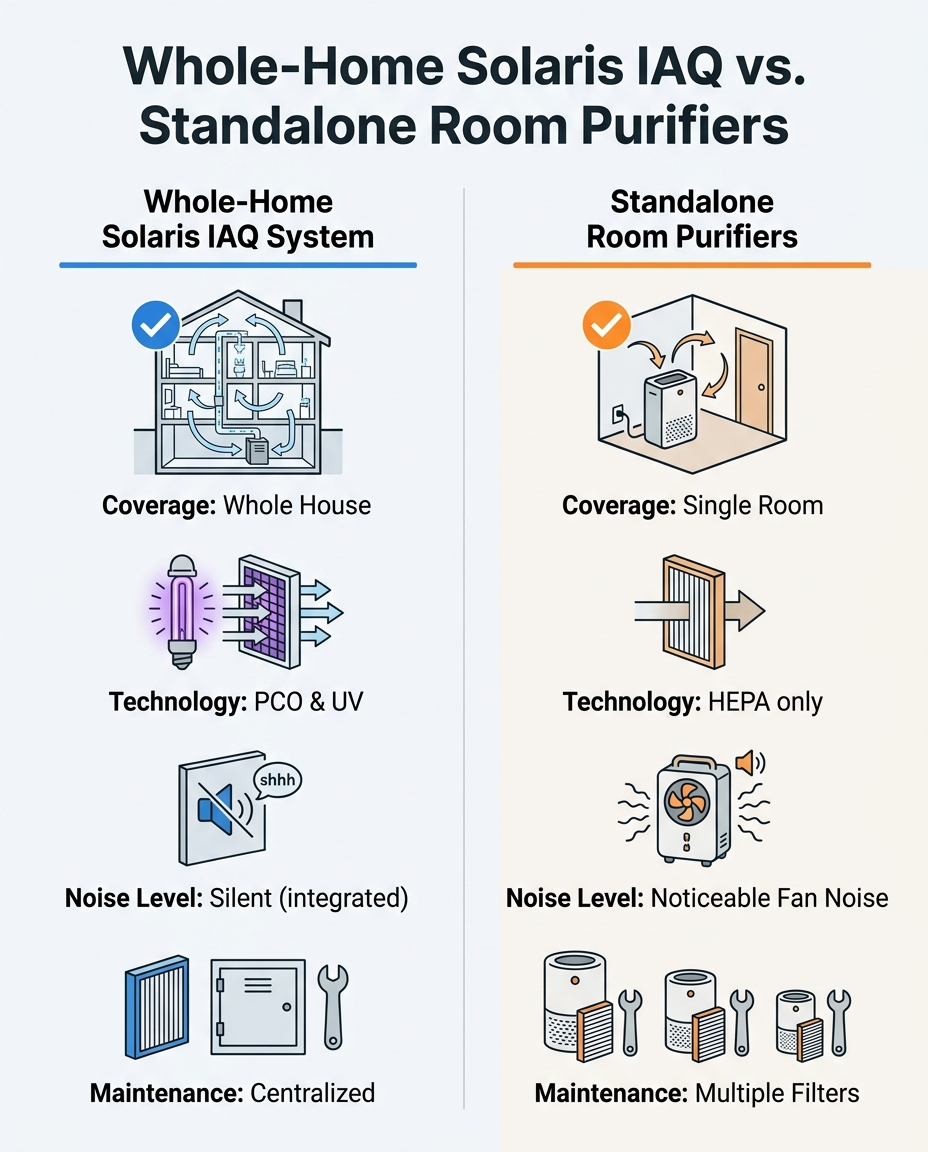
• Coverage Area — Solaris IAQ System: Whole-home continuous circulation — Standalone Room Purifiers: Isolated, single-room treatment
• Maintenance — Solaris IAQ System: Single central unit service (annual) — Standalone Room Purifiers: Tracking/replacing multiple distinct filters
• Aesthetic & Noise — Solaris IAQ System: Silent, out-of-sight duct integration — Standalone Room Purifiers: Floor space usage and noticeable fan noise
• Overall Efficiency — Solaris IAQ System: Utilizes existing central blower motor — Standalone Room Purifiers: Requires running additional electrical appliances
• Technology — Solaris IAQ System: Active PCO and UV-C neutralization — Standalone Room Purifiers: Passive HEPA particulate trapping
Coverage and Efficiency
The difference in air volume treated per hour is staggering. A standard portable unit might move 150 to 250 cubic feet of air per minute (CFM) on its highest, loudest setting. A residential central HVAC blower motor typically moves between 1,200 and 2,000 CFM. By leveraging the central blower, the Solaris IAQ System maximizes purification reach, pushing actively treated air into every bedroom, bathroom, and living area simultaneously. You get hospital-grade air turnover rates without adding a single extra fan to your living space.
Long-Term Maintenance
The hassle of long-term upkeep is where many homeowners abandon their portable units. With room purifiers, you must vacuum pre-filters monthly and replace expensive HEPA filters every 6 to 8 months. If you have four units, that is constant maintenance. The Solaris IAQ System centralizes this effort. Maintenance typically involves a single annual check during your regular HVAC tune-up to wipe down the PCO catalyst and replace the UV bulb. It is a "set it and forget it" solution that provides continuous peace of mind.
Why Safe, Multi-Trade Integration Matters for Whole-Home IAQ
Upgrading to a whole-home purification system is not a DIY weekend project. Because these systems integrate directly into the central nervous system of your home, they require precise electrical and HVAC integration. The unit must be mounted securely within the ductwork, positioned to maximize airflow across the UV and PCO components without creating static pressure restrictions that could choke the blower motor.
Furthermore, whole-home systems require dedicated electrical wiring. Tapping into the furnace control board improperly can short out the HVAC system's transformer, leaving you without air conditioning on a 100-degree day. The risks of improper wiring or disrupting the delicate airflow dynamics in the ductwork are simply too high to leave to chance.
This is where comprehensive Air, Electric, and Plumbing expertise becomes a distinct advantage. Working with a multi-trade provider like Reliabee means the installation is handled safely and holistically. There is no need to hire a separate electrician to wire the unit or a third-party contractor to modify the plenum. Our certified professionals ensure the system is wired safely, integrated flawlessly, and operates in perfect tandem with your primary cooling equipment. This multi-trade capability guarantees that the addition of an IAQ system enhances your home's performance without compromising the safety or efficiency of your existing HVAC setup.
Maximizing Your Investment with Clean Ducts and Routine Care
Even the most advanced purification technology cannot overcome a severely neglected HVAC system. If your ductwork is lined with an inch of dust, or your evaporator coil is choked with debris, the air quality will suffer regardless of the purifier you install. To ensure your Solaris IAQ System operates at peak performance during the back-to-school season, foundational HVAC health is mandatory.
• Maintain optimal airflow: Keep the central blower motor and coils clean. A dirty blower wheel loses its ability to pull air efficiently, reducing the volume of air that passes through the purification system.
• Change standard filters regularly: The Solaris system handles microscopic biologicals and VOCs, but you still need a clean pleated filter at the return grille to catch large dust bunnies, pet hair, and heavy particulate matter before it enters the equipment.
• Schedule seasonal check-ups: Proactive care extends the lifespan of both the purifier and the cooling equipment. A technician will ensure the UV lights are functioning correctly and the PCO components are clean and active.
• Address ductwork integrity: Leaky ducts in a hot attic will pull in fiberglass insulation fibers and stagnant air, overwhelming any purification system. Ensuring ducts are sealed is a critical step in overall air quality.
By enrolling in a regular HVAC maintenance plan, you guarantee that our experts are consistently monitoring the health of your blower, coils, and IAQ accessories, ensuring your family breathes clean air year-round.
Frequently Asked Questions About Home Air Purification
Is a whole house air purifier better than portable units?
The short answer is yes, a whole house air purifier is significantly more effective for comprehensive protection. Because it integrates directly into your central HVAC ductwork, it actively filters and neutralizes the air in every room simultaneously. Portable units are strictly limited by their fan size and can only treat the air in their immediate vicinity, leaving large dead zones throughout the home.
How does the Solaris IAQ system reduce allergens?
The Solaris IAQ system reduces allergens by utilizing Photo-Catalytic Oxidation (PCO) and high-intensity UV-C light. As air flows through the ductwork, the system actively breaks down the molecular structure of volatile organic compounds and biological contaminants. This active neutralization process is highly effective at neutralizing airborne triggers before they are circulated into your living spaces.
Do whole home air purifiers help with ragweed and seasonal allergies?
Yes, whole home systems are highly effective at combating seasonal allergies like ragweed. Because the central air conditioner constantly circulates the indoor air, the purifier repeatedly scrubs the entire volume of the house. This continuous filtration captures and neutralizes fine pollen particles that slip indoors during peak allergy seasons.
What is the best way to reduce airborne germs at home during back-to-school season?
The most effective method is combining whole-home UV/PCO purification with continuous HVAC fan circulation. As children bring home viruses and bacteria, a system like the Solaris IAQ uses germicidal UV light to scramble the DNA of these biological contaminants as they pass through the ducts, drastically reducing the transmission rate within the household.
Can the Solaris IAQ system be installed in any existing HVAC unit?
In most cases, yes. The Solaris IAQ system is designed to be installed directly into the supply or return plenum of standard central heating and cooling systems. However, it requires proper electrical wiring and spatial clearance inside the ductwork, which is why it must be installed and calibrated by a certified HVAC professional.
Make an Informed Choice for Your Family's Air Quality
As the August back-to-school transition collides with peak ragweed season, protecting your home's indoor environment becomes a top priority. While portable room purifiers offer a quick, localized band-aid, they ultimately fall short when tasked with defending an entire house. They are noisy, require constant filter changes, and simply cannot compete with the sheer volume of air moved by your central cooling system.
Evaluating the Solaris IAQ System for back-to-school allergen reduction reveals a clear advantage: comprehensive, silent, whole-home defense. By leveraging the continuous runtime of your air conditioner during the intense San Antonio heat, this technology actively neutralizes germs, pollen, and odors in every room simultaneously. If you are tired of managing multiple standalone units and want to make a lasting, effective upgrade to your home's air quality, consult with our local experts at Reliabee to evaluate your specific ductwork and cooling setup. Making the switch ensures your family breathes easier, sleeps better, and stays healthier all year long.

Ready to Transform Your Home?