Navigating 24-Hour Emergency Plumbing Calls for Clogged Main Lines
Is a Main Sewer Line Backup at 2 AM a True Emergency?
Are those strange gurgling sounds coming from the downstairs shower drain just a minor plumbing quirk, or the immediate start of a major household disaster? Here at Reliabee Air Electric Plumbing, our dispatch team fields these panicked calls every week. Navigating 24-hour emergency plumbing calls for clogged main lines is a stressful reality when you wake up in the middle of the night to discover wastewater surfacing inside your home. The sheer panic of a 2 AM sewer backup leaves most homeowners scrambling, unsure of what to do while waiting for professional help to arrive.
To put it simply: yes, a main sewer line backup is a definitive, time-sensitive emergency. When the primary exit route for your home's wastewater becomes completely blocked, everything you flush or drain has nowhere to go but backward. In our years serving San Antonio area homes, our team typically sees raw sewage forcefully enter through the lowest elevation points, which are usually basement floor drains, ground-level showers, or downstairs bathtubs. The priority right now is strictly damage control.
While you wait for our 24-hour emergency plumbing services to dispatch a technician to your property, your immediate actions dictate how much secondary damage your home will sustain. You cannot fix a main line failure on your own, but you can absolutely stop the situation from escalating. Having our reliable, responsive team ready to intervene is critical, but knowing exactly how to bridge that stressful "wait-time gap" will protect your property, your family's health, and your peace of mind.
Immediate Damage Control: Shutting Off the Main Water Valve
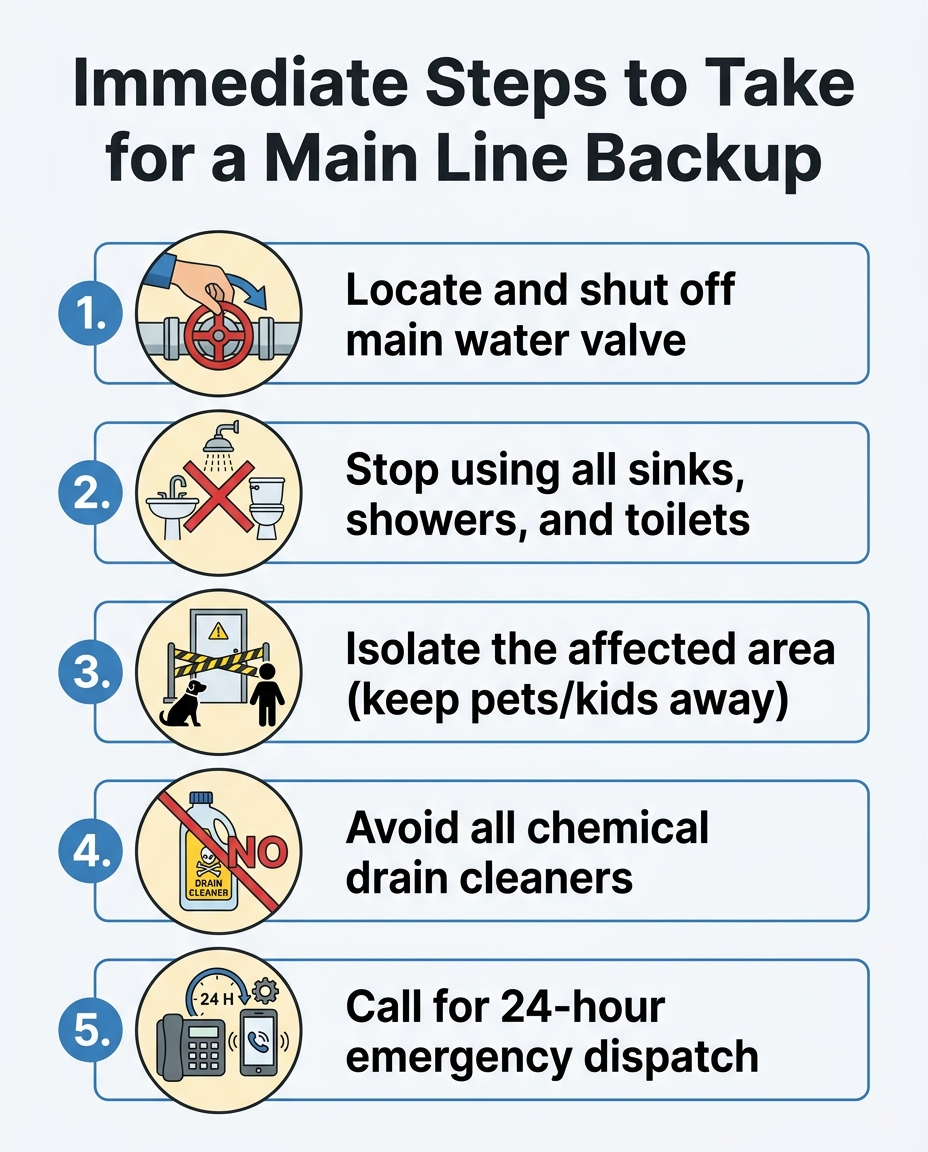
The single most important step you can take during a late-night plumbing crisis is to stop the flow of new water. A clogged main sewer line cannot process any outgoing wastewater, meaning every drop of water introduced into your plumbing system will eventually end up on your floors. Until our professionals arrive for clearing clogged main sewer lines, you must halt all water usage immediately.
Taking control of your home's water supply requires locating and operating your main shut-off valve. Here is exactly how we advise our San Antonio customers to safely secure their water system:
1. Locate the main shut-off valve: In many San Antonio area homes, this valve is situated near the street inside a utility box, attached to an exterior wall near the garden hose bib, or located in a utility closet near the water heater. Grab a flashlight and locate it quickly.
2. Identify the valve type: You will typically see either a gate valve (which looks like a circular wheel, similar to a garden hose handle) or a ball valve (which features a straight, lever-style handle).
3. Turn the water off: If you have a gate valve, turn the circular wheel clockwise (to the right) until it stops completely. Do not force it if it feels stuck, but ensure it is tight. If you have a ball valve, turn the lever a quarter-turn so that it sits perpendicular (at a 90-degree angle) to the pipe.
4. Verify the shut-off: Open a faucet on the highest floor of your home. A small amount of residual water will trickle out as the pipes depressurize, but it should stop completely within a few seconds.
5. Enforce a strict "no plumbing" rule: Communicate clearly to everyone in the household that toilets, sinks, showers, and appliances like washing machines or dishwashers cannot be used under any circumstances until our team clears the system.
By shutting off the main water supply, you effectively freeze the emergency in place. The standing wastewater will not recede on its own, but you guarantee that the volume of raw sewage entering your home will not increase while you wait for our dispatch team.
Securing the Perimeter: Isolating the Category 3 Hazard
Once the water is off, your next priority is health and safety. The wastewater backing up into your home is not just dirty water; it is classified by environmental and restoration guidelines as Category 3 water, commonly known as "Black Water." This classification means the water is highly contaminated and contains pathogenic agents, bacteria, viruses, and toxic organic matter that pose severe health risks upon contact or inhalation.
Treat the affected area as a hazardous bio-zone. Our technicians frequently see San Antonio area homes suffer extensive secondary damage simply because homeowners attempt to clean up raw sewage without the proper protective equipment. To safely secure the perimeter while waiting for our emergency team, follow this safety checklist:
• Evacuate the immediate zone: Keep all children, elderly family members, and pets far away from the pooling water. Pets are particularly vulnerable to tracking pathogens throughout the rest of the house on their paws.
• Turn off localized electricity: If the sewage backup is occurring near low-lying electrical outlets, baseboard heaters, or utility equipment, shut off the power to that specific room at your main breaker panel. Never wade into standing water to unplug a device.
• Improve ventilation: Category 3 water emits noxious sewer gases, including methane and hydrogen sulfide, which can cause dizziness and nausea. If it is safe to do so, open nearby windows to allow fresh air to circulate and dilute the concentration of toxic fumes.
• Close HVAC vents: If the backup is in a room with floor-level return vents, close them to prevent aerosolized bacteria from being pulled into your ductwork and distributed throughout the home.
• Block off the doorways: Close the doors to the affected bathroom or basement area. Place rolled-up dry towels outside the door frame to act as a temporary dam in case the standing water shifts.
Why You Must Avoid DIY Main Line Repairs at All Costs
In the panic of a 2 AM emergency, the temptation to take matters into your own hands is strong. Many homeowners rush to the garage for a plunger, a bottle of chemical drain cleaner, or a rented plumbing snake. We always warn our customers that attempting DIY repairs on a main sewer line is not only ineffective, but it is incredibly dangerous and often transforms a standard clearing job into a catastrophic pipe replacement.
The Chemical Cleaner Problem: Store-bought liquid drain cleaners rely on caustic chemical reactions to dissolve hair and grease in small, localized sink traps. They are completely useless against a full main line blockage, which is often composed of dense tree roots or compacted soil. Pouring these chemicals down the drain simply adds toxic, skin-burning acids to the hazardous Category 3 water already pooling in your home. When our professional plumbers arrive, they will now have to navigate a pool of chemically reactive, toxic sewage.
The DIY Snaking Danger: Handheld augers or rented mechanical snakes lack the torque and specialized cutting heads required to clear a 3-inch or 4-inch main sewer pipe. In our experience rescuing botched DIY attempts, inexperienced snaking usually results in the cable folding over on itself, knotting up, and becoming permanently stuck inside the line. Alternatively, aggressive snaking can punch a hole directly through an older, fragile pipe wall.
• Symptoms — Localized P-Trap Clog: Only one specific fixture (e.g., a bathroom sink) drains slowly. — Main Sewer Line Failure: Multiple lower-level fixtures back up simultaneously; toilets bubble when sinks run.
• Typical Causes — Localized P-Trap Clog: Hair, soap scum, or small objects caught in the immediate pipe curve. — Main Sewer Line Failure: Tree root intrusion, crushed pipes, or heavy flushing of non-degradable wipes.
• DIY Feasibility — Localized P-Trap Clog: Can often be cleared with a standard household plunger. — Main Sewer Line Failure: Requires commercial-grade hydro-jetting or heavy-duty mechanical augers.
Understanding the difference between a localized clog and a main line failure is crucial for San Antonio area homes. If wastewater is surfacing in a bathtub when you flush a toilet across the hall, the blockage is deep underground in the main line. Put the tools down and wait for our experts.
How Late-Summer Weather Triggers Sudden Underground Pipe Failures
It is incredibly frustrating when a plumbing system that worked perfectly at dinner time suddenly fails completely by 2 AM. While some clogs build up slowly over months of flushing incompatible items, many main line emergencies are triggered rapidly by environmental factors. Specifically, as families transition into the back-to-school routine this August, late-summer dry soil shifting is a primary culprit we see for sudden, catastrophic pipe failures.
During our late-summer service calls across San Antonio, we often find that the region's expansive clay soils are to blame. This type of soil is highly reactive to moisture levels. During the rainy spring season, the clay absorbs water and expands, gripping tightly around your underground sewer pipes. However, as the intense heat of summer sets in and end-of-season drought conditions take hold, that same clay soil rapidly dries out, shrinks, and pulls away from the infrastructure.
This aggressive contraction creates massive underground voids. Without the support of the surrounding earth, heavy cast iron or older PVC sewer pipes begin to sag under their own weight. This sagging creates "bellies"—low spots in the pipe where solid waste and paper accumulate instead of flowing smoothly to the municipal sewer.
Furthermore, the immense physical stress of this shifting earth can cause the pipes to shear, crack, or completely collapse. Once a microscopic crack forms, thirsty tree roots aggressively seek out the moisture and nutrients inside the sewer line. Within a matter of weeks, a tiny root hair can grow into a dense, impenetrable root ball that completely chokes off the main line. This is a pattern we see often, explaining why a system can go from functioning normally to backing up raw sewage overnight during the peak of the late-summer drought.
Multi-System Risks: When Sewage Threatens Your HVAC and Electrical Systems
A severe main line backup rarely isolates itself to just the plumbing system. Because wastewater naturally seeks the lowest point in the home, utility closets, finished basements, and ground-floor mechanical rooms are often the first areas to flood. This introduces complex, multi-system hazards that require a comprehensive approach to safety and mitigation.
As a comprehensive Air, Electric, and Plumbing provider, our team at Reliabee is uniquely positioned to handle these intersecting crises. When a backup occurs, our cross-trained experts can safely assess and neutralize threats across all your home's critical systems simultaneously, ensuring that a plumbing disaster doesn't permanently destroy your electrical panel or air handler.
Electrical Hazards in Standing Water
The most immediate life-safety threat during a severe backup is the intersection of Category 3 water and your home's electrical system. If sewage levels rise enough to submerge low-lying wall outlets, baseboard heaters, or the electrical components of major appliances (like washers and dryers), the standing water becomes highly conductive. This creates an invisible, lethal shock hazard. Our professional mitigation teams must verify that the area is electrically safe—often by shutting down specific circuits at the main panel—before any plumbing work or water extraction can safely begin.
HVAC Contamination Risks
If your indoor HVAC unit (the air handler or furnace) is located in the affected basement or utility closet, the risks multiply. Raw sewage pooling around the base of the HVAC system can easily seep into the ductwork. Even if the water doesn't physically touch the equipment, the powerful blower fan can pull aerosolized sewage particles, noxious methane gas, and dangerous bacteria directly into the return vents.
If the system continues to run, it will actively distribute these pathogens into every bedroom and living space in the house. This is a leading reason why your home might smell like sewage long after the initial plumbing issue is resolved. Because we are an integrated service provider, our cross-trained professionals know to immediately shut down the HVAC system to prevent catastrophic cross-contamination of your indoor air quality.
The Arrival Timeline: What Happens When the Plumber Pulls In
Waiting in the middle of the night can feel like an eternity. Knowing exactly what to expect when the headlights finally sweep across your driveway can help lower your stress levels. When the residential plumbing experts from Reliabee arrive at your San Antonio area home, we follow a strict, highly efficient protocol to restore your system.
Step 1: Immediate Site Safety Assessment
Before touching a tool, our technician will evaluate the flooded area to ensure it is safe to enter. We check for electrical hazards, verify that the main water supply is completely shut off, and assess the severity of the Category 3 hazard to determine the appropriate personal protective equipment needed.
Step 2: Diagnostic Camera Inspection
Guesswork has no place in emergency plumbing. We will locate a cleanout access point (usually in the yard or basement) and insert a high-definition, fiber-optic camera into the main sewer line. This live video feed allows us to travel deep underground to pinpoint the exact location, depth, and composition of the blockage. We will determine if the clog is caused by a flushed object, dense tree roots, or a structural collapse caused by soil shifting.
Step 3: Deployment of Commercial Clearing Equipment
Once the enemy is identified, our technician will deploy the appropriate heavy-duty equipment. For soft clogs and sludge, we may use a hydro-jetter, which blasts highly pressurized water to scour the pipe walls clean. For invasive tree roots or hard blockages, we will utilize a commercial-grade mechanical auger with specialized cutting blades to physically chop through the obstruction and restore flow.
Step 4: Post-Clearing Verification
After the wastewater recedes and the line is clear, our technician will perform a secondary camera inspection. This crucial final step verifies that the pipe walls are intact and assesses whether the line requires long-term structural repairs to prevent the emergency from happening again.
Frequently Asked Questions About Late-Night Sewer Backups
What to do immediately when a main sewer line backs up?
Shut off the main water valve immediately to stop the flow of incoming water. Stop using all plumbing fixtures, isolate the affected area to keep family members away from the hazardous wastewater, and call a 24-hour emergency plumbing service like Reliabee for immediate dispatch.
How do I turn off my main water valve?
Locate the valve near the street, your water meter, or an exterior wall. If it is a round gate valve, turn it clockwise (to the right) until it stops completely. If it is a lever-style ball valve, turn the handle so it sits perpendicular (at a 90-degree angle) to the water pipe.
Is a main line backup considered a plumbing emergency?
Yes, a main line backup is a definitive emergency. It exposes your home to Category 3 hazardous waste (raw sewage) and completely prevents the safe use of all household plumbing until the underground blockage is professionally cleared by our team.
Can I use the toilet if the main line is clogged?
No. Flushing a toilet when the main line is clogged will force the new wastewater to back up into the lowest drains in the home. Because the main exit is blocked, the flushed water will likely surface in a downstairs basement shower, bathtub, or floor drain.
Will homeowners insurance cover a main sewer line backup?
Coverage varies heavily by policy and often requires a specific "water backup and sump overflow" endorsement. Homeowners should check with their insurance provider as soon as possible, but mitigation and damage control must begin immediately regardless to prevent secondary structural damage.
Secure Your Home with Immediate Professional Response
Waking up to a main sewer line backup at 2 AM is undoubtedly one of the most stressful experiences a homeowner can face. However, by taking swift, decisive action to shut off your water supply and isolate the hazardous area, you take control of the situation and prevent a bad scenario from becoming a catastrophic one. For San Antonio area homes facing the unpredictable pressures of late-summer soil shifting and the busy back-to-school transition, having a trusted partner is essential. Rely on our cross-trained professionals at Reliabee Air Electric Plumbing to navigate the complex multi-system risks safely, clear the blockage efficiently, and restore your home's safety and comfort with precision.

Ready to Transform Your Home?