Do You Need an HVAC Inspection After Installation? The Hidden Risks of Skipped Post-Install Audits
Why Consider an HVAC Inspection After Installation?
Are you assuming your recently installed system is perfectly calibrated for the upcoming November pre-winter transition just because it turns on? An HVAC inspection after installation is a critical step that many homeowners overlook, mistakenly believing that a brand-new unit guarantees flawless operation. The reality is that systems installed during the busy summer months often have their heating components left completely untested. If your air conditioner is blowing cold air, the installation crew might pack up and leave before verifying how the system will handle a sudden drop in temperature.
This leaves you with a major decision: trusting the initial installation blindly, or scheduling an independent post-install audit to verify work that may have been rushed. Before you assume everything is operating at peak efficiency, bringing in our team for professional HVAC services establishes a reliable baseline for your new equipment. A post-installation audit is not just a quick glance at the outdoor unit. It is a comprehensive performance verification that ensures every wire, duct, and valve meets strict manufacturer specifications. In our years of serving the greater San Antonio metro area, where weather shifts rapidly, we've found that having this documented baseline is one of the most effective ways to maximize the lifespan of your new investment.
The Danger of Untested Heating Components Before Winter
The problem: Many home comfort systems are replaced during the peak cooling season. When temperatures soar, the immediate priority is restoring cool air to the house. Installers focus their time and energy entirely on the air conditioning side of the equipment, calibrating the refrigerant and checking the indoor coil. As a result, the heating components—whether that means a gas furnace or the reversing valve on a heat pump—often remain uncalibrated and untested.
The cause: As local technicians, we know San Antonio's drastic temperature swings and extreme summer heat dictate this initial installation focus. When an installation crew is working in a sweltering attic in August, their goal is to get the AC running safely and efficiently. The winter heating components are wired up, but they sit idle until November's unpredictable temperature drops force you to switch the thermostat to "heat" for the first time. This creates a massive seasonal blind spot. If you want to avoid common furnace installation pitfalls, you cannot wait until freezing weather arrives to find out if your burners actually ignite.
The solution: Verifying these components early prevents emergency breakdowns. By testing the heating sequence during a controlled audit in the fall, our technicians can identify uncalibrated sensors, stuck reversing valves, or improper gas pressure before you actually need the heat. Catching these issues while the weather is still mild ensures that your home stays warm during the first major cold snap, exactly when emergency repair technicians are at their busiest.
What Does a Post-Installation HVAC Inspection Check?
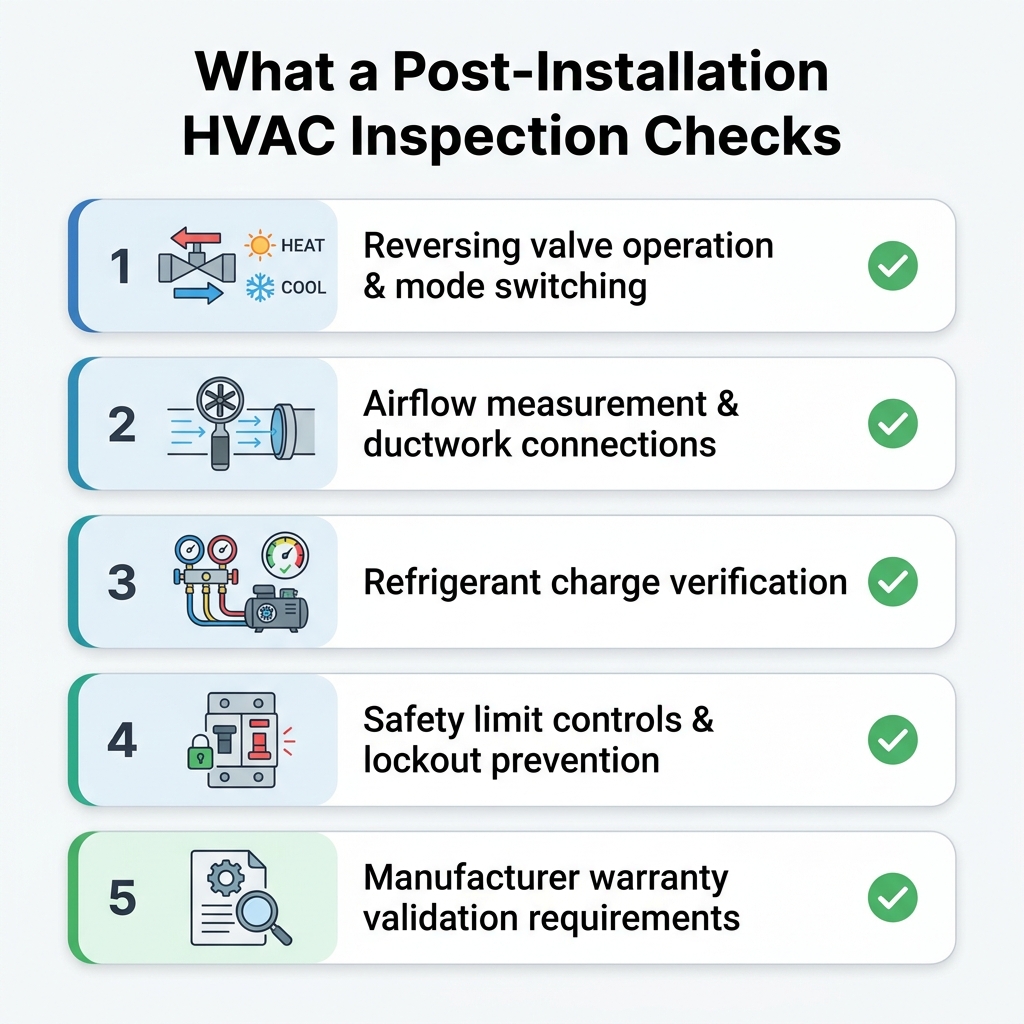
A true performance audit goes far beyond a basic visual check. When you invest in a heating system installation, you expect it to deliver the exact efficiency rating printed on the box. At Reliabee Air Electric Plumbing, our rigorous, multi-point post-install inspection actively tests all seasonal modes and safety controls, rather than just verifying that the unit turns on and off. Here is exactly what our comprehensive audit measures:
• Reversing valve operation: For heat pumps, the audit tests the seamless mode switching between cooling and heating. A stuck reversing valve will leave you blowing cold air in the middle of winter.
• Airflow measurement and ductwork: Technicians measure static pressure to ensure the new equipment matches your existing ductwork. Improper airflow connections can easily cause a 30 percent efficiency loss right out of the gate.
• Refrigerant charge verification: Systems often arrive from the factory with a pre-set refrigerant charge that must be adjusted for your specific line set length. An audit ensures the system isn't overcharged or undercharged, preventing compressor damage.
• Safety limit controls: On gas furnaces, technicians intentionally test high-limit switches and flame sensors to ensure they shut the system down safely if overheating occurs, preventing dangerous winter lockouts.
• Electrical draw and connections: The audit measures the exact amperage pulled by the blower motor and compressor to ensure they are operating within safe, efficient ranges.
How Untested Safety Limits Trigger Winter Lockouts
Skipping a post-installation audit doesn't just cost you money on your utility bills; it can actually leave your home freezing due to a mechanical safety shutdown. Modern heating systems are packed with advanced sensors designed to protect the equipment from destroying itself. If the system was rushed during installation, those sensors will eventually trip.
What Are Safety Limits?
Safety limits are internal switches that monitor the temperature and operation of your furnace or heat pump. The most common is the high-limit switch, which measures the temperature inside the heat exchanger. If the internal temperature gets too hot, this switch immediately cuts the power to the burners to prevent a fire hazard or cracked heat exchanger. On a brand-new system, these limits must be tested to ensure they are reading temperatures accurately.
The Connection Between Airflow and Overheating
Improper airflow configurations are one of the most common issues our team sees missed during a rushed installation. If your new blower motor is pushing more air than your old ductwork can handle, or if the return air drop is undersized, the heat generated by the furnace cannot escape into the home fast enough. The heat builds up inside the cabinet, rapidly increasing the internal temperature until the high-limit switch is triggered.
Understanding Winter Lockouts
A lockout is a protective measure. When a safety switch trips repeatedly within a short timeframe, the system's control board will enter a "hard lockout" mode. It shuts down completely and refuses to turn back on until a professional resets and diagnoses it. While this keeps your home safe from fire hazards, it leaves you freezing if it happens during a cold snap.
Intentional Testing Prevents Freezing
A proper audit tests these safety limits intentionally before the weather turns. By restricting airflow slightly during the test, a technician can verify that the high-limit switch trips exactly when it is supposed to. Verifying these controls ahead of the November pre-winter transition guarantees that your system will protect itself without leaving you stranded in the cold due to a preventable airflow issue.
Municipal Permit Checks vs. Comprehensive Performance Audits
Many homeowners assume that because their new system passed a city permit inspection, it must be running perfectly. This is a dangerous misconception. A municipal inspection and a comprehensive performance audit serve two entirely different purposes. Relying solely on the city inspector leaves massive gaps in your system's performance verification.
• Primary Goal — Municipal Permit Inspection: Basic legal compliance and life safety. — Comprehensive Performance Audit: Maximum efficiency and manufacturer calibration.
• What They Check — Municipal Permit Inspection: Electrical disconnects, gas line clearances, and local building codes. — Comprehensive Performance Audit: Refrigerant charge, static air pressure, and temperature drops.
• Time Required — Municipal Permit Inspection: Usually 10 to 15 minutes. — Comprehensive Performance Audit: Typically 1 to 2 hours of rigorous testing.
• Efficiency Focus — Municipal Permit Inspection: None. They do not measure airflow or utility usage. — Comprehensive Performance Audit: High. Ensures the system delivers the advertised SEER/AFUE ratings.
• Warranty Impact — Municipal Permit Inspection: Required by law, but does not prove proper commissioning. — Comprehensive Performance Audit: Provides the baseline documentation required by manufacturers.
A city permit inspection simply verifies that the equipment was installed safely according to local codes. The inspector does not hook up gauges to check your refrigerant levels, nor do they measure the static pressure of your ductwork. Passing a municipal inspection does not guarantee the system is running at its advertised efficiency. A secondary performance audit catches the simple, critical adjustments that prevent major premature wear and high utility bills across the San Antonio metro area.
Protecting Your Warranty and System Efficiency
Protecting your financial investment means looking beyond the day of installation. Most major manufacturer warranties require proof of professional installation and proper commissioning to remain valid. If a compressor fails two years down the road and you cannot prove that the system was charged correctly on day one, the manufacturer can legally deny your warranty claim. Documenting baseline performance with advanced digital gauges protects you if disputes arise later.
Preventing efficiency loss is another major benefit of an early audit. Catching an improper installation right away prevents up to a 30 percent reduction in system efficiency. When ductwork isn't sealed properly or blower speeds are set incorrectly, you pay for heating and cooling that never reaches your living space. Recently, our crew helped a local homeowner who reached out during the winter needing an attic duct and plenum box replacement because their system was struggling. After our technicians professionally replaced the flexible duct and plenum box to restore proper airflow, the customer booked an upcoming early summer inspection with complete confidence, knowing their system's baseline was finally established and protected by our team.
Maintaining the baseline requires ongoing attention. Once the post-installation audit proves your system is running perfectly for the November pre-winter transition, you must maintain that standard. Enrolling in a routine HVAC maintenance plan ensures that the precise calibration achieved during the audit is preserved year after year, keeping your utility bills low and your warranty fully intact.
Frequently Asked Questions About Post-Install Audits
Upgrading your home's climate control is a major financial decision. Whether you paid upfront or utilized HVAC financing options, you likely have questions about how to protect that new equipment. Here are the most common questions homeowners ask about auditing a brand-new system.
Do I need an inspection after installing a new HVAC?
Yes, you absolutely need an inspection to verify manufacturer specifications. A post-install audit ensures that all seasonal modes operate safely and efficiently. Without this verification, you risk operating a system with hidden airflow or refrigerant issues that will slowly damage the compressor.
What happens if a new HVAC is installed incorrectly?
An incorrectly installed system can lose up to 30% of its operating efficiency immediately. It will draw more electricity, struggle to heat or cool the home evenly, and suffer premature component failure. Furthermore, improper installation can void your manufacturer warranty, leaving you responsible for expensive future repairs.
Who inspects a new HVAC system?
Municipal inspectors check the system for basic code compliance and safety clearances. However, independent HVAC professionals perform comprehensive performance audits. The city inspector ensures the unit is legal, while the HVAC professional ensures the unit is actually running efficiently.
How do I know if my HVAC was installed correctly?
The only definitive way to know is through a multi-point performance audit. This audit uses digital tools to measure airflow static pressure, verify the exact refrigerant charge, and test safety controls. If the system matches the precise specifications outlined in the manufacturer's manual, it was installed correctly.
Will a post-installation audit void my manufacturer warranty?
No, a professional audit actually helps protect and validate your manufacturer warranty. By documenting that the system meets all installation requirements and was properly commissioned, you have proof of a correct setup. This documentation is invaluable if a factory defect causes a part to fail down the road.
Schedule Your Post-Install Audit With a Local Expert
The takeaway is simple: A clear understanding of your new system's performance brings lasting peace of mind. You spent hard-earned money to upgrade your home's comfort, and you deserve to know that the equipment is delivering exactly what was promised. Reiterate the importance of checking those critical heating components before freezing temperatures arrive during the November pre-winter transition.
Don't wait for a cold snap to reveal that your summer installation was rushed. Talk to our local experts at Reliabee Air Electric Plumbing today and schedule an HVAC inspection after installation to verify your investment is fully protected. Establishing a baseline now guarantees reliable, efficient comfort for years to come.

Ready to Transform Your Home?