The Hidden Electrical Demands of Upgrading to a Heat Pump
The End-of-Summer HVAC Dilemma: Moving from Gas to Electric
As your air conditioner runs nonstop through the late-summer heat and you consider replacing your entire system before the back-to-school rush, understanding the hidden electrical demands of upgrading to a heat pump is absolutely essential. It is a frustrating reality that many homeowners face when an aging AC finally gives out in August. Rather than just swapping out a failing air conditioner, many families decide it makes more sense to upgrade both their heating and cooling. If your home currently relies on an older gas furnace, transitioning to a modern, fully electric heat pump is often the most appealing upgrade path.
However, there is a catch that catches many homeowners off guard: switching from gas heating to fully electric heating fundamentally changes how your home consumes power. A traditional gas furnace barely makes a dent in your electrical panel, while a high-efficiency heat pump requires significant, sustained amperage to keep your home comfortable year-round. Before you commit to removing your gas heating system, you have to evaluate your home's existing electrical infrastructure to ensure it can safely handle the new load.
If you are exploring residential electrical services to support a new heat pump installation, understanding your home's power capacity is the critical first step.
Why a Heat Pump Demands More Power Than a Traditional Furnace
The primary difference between traditional heating and modern heat pumps comes down to the fuel source. A standard gas furnace burns natural gas to generate heat. The only electrical component it relies on is the blower motor, which pushes the warmed air through your ductwork. This blower motor usually runs on a standard 120-volt circuit and draws very little power. If you are replacing your gas furnace with a heat pump, you are moving to a system that uses electricity for the entire heating process.
With San Antonio's intense summer heat, your cooling system already runs constantly. A heat pump handles this end-of-season cooling demand efficiently. However, our team frequently reminds homeowners that the real electrical challenge occurs during sudden winter cold snaps. When temperatures drop near freezing, a heat pump requires backup power to maintain indoor comfort, and that backup power requires massive amounts of electricity.
The Role of Auxiliary Heat Strips
When the outside air gets too cold for the heat pump to extract warmth efficiently, the system activates auxiliary heat strips. You can think of these heat strips as giant toaster coils located inside your ductwork. As air passes over these glowing hot electric coils, it warms up before entering your living spaces.
The electrical reality: These heat strips require a dedicated high-voltage 240-volt circuit to operate safely. While the heat pump compressor might draw a moderate amount of power, the auxiliary heat strips can draw anywhere from 40 to 80 amps all on their own. This sudden surge in electrical demand is what overloads older electrical panels, leading to tripped breakers or dangerous overheating.
Year-Round Electrical Reliance
When you transition to a heat pump, your home becomes reliant on heavy electrical draws year-round. Instead of a seasonal split—where your AC uses heavy electricity in the summer and your furnace uses gas in the winter—your electrical panel must now support high-amperage HVAC equipment 365 days a year. This constant, heavy draw impacts your electrical panel's overall available capacity.
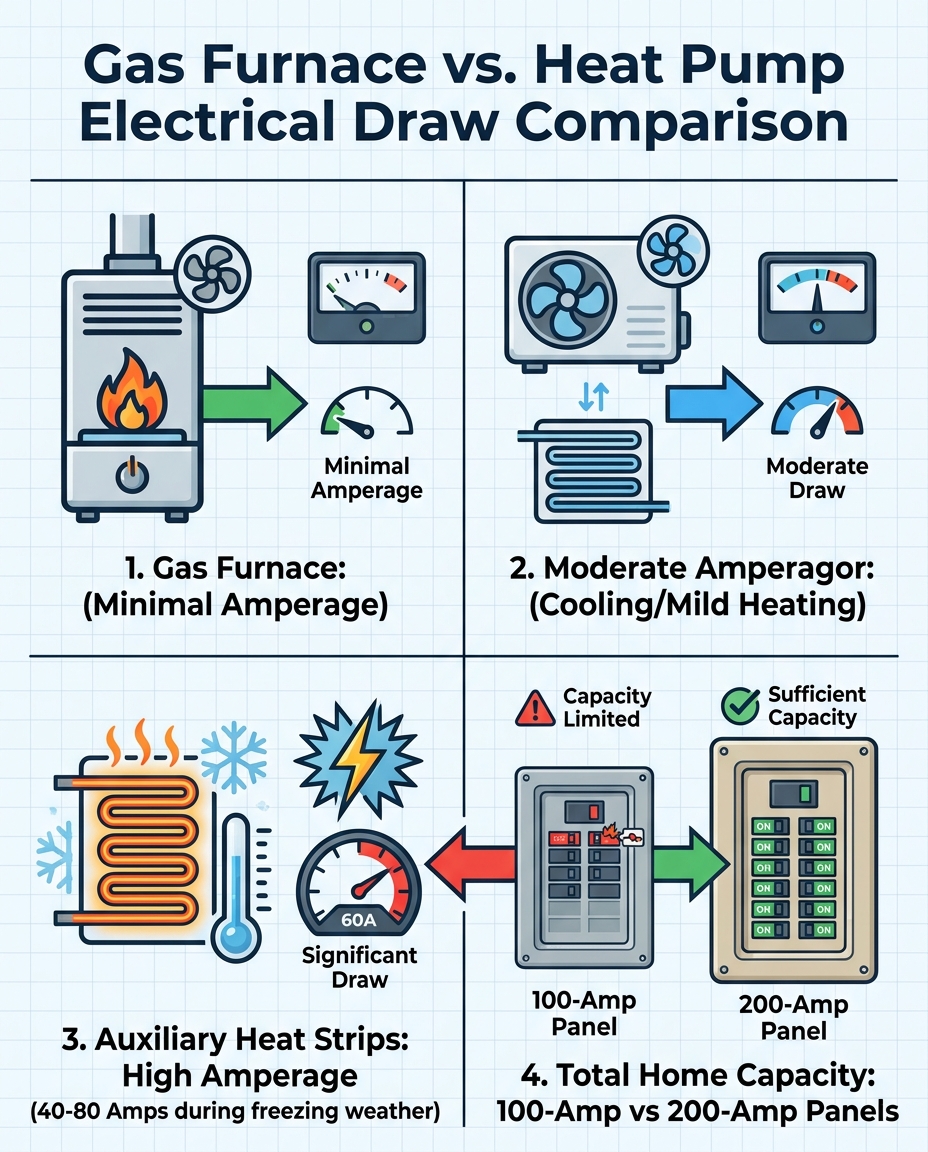
• Gas Furnace (Blower Only) — Primary Fuel Source: Natural Gas — Typical Voltage Required: 120 Volts — Estimated Amperage Draw: Minimal (Under 15 Amps)
• Heat Pump (Cooling Mode) — Primary Fuel Source: Electricity — Typical Voltage Required: 240 Volts — Estimated Amperage Draw: Moderate (20-40 Amps)
• Auxiliary Heat Strips — Primary Fuel Source: Electricity — Typical Voltage Required: 240 Volts — Estimated Amperage Draw: High (40-80 Amps)
Protecting Your Home: The Electrical Load Calculation
Because of the massive power requirements of auxiliary heat strips, evaluating your electrical system is a non-negotiable safety requirement. The National Electrical Code (NEC) mandates that your home must have sufficient electrical capacity to support any new, high-draw appliance safely. This is determined through a formal, mathematical assessment known as an electrical load calculation (Amperage capacity).
This calculation assesses the total amperage capacity of your home against all existing appliances, plus the anticipated draw of the new heat pump. Skipping this step is incredibly dangerous. Overloading an electrical panel creates severe fire hazards, melted wires, and constantly tripped breakers. This assessment must always be performed by a licensed professional—never attempt a DIY electrical evaluation.
What an Amperage Capacity Test Reveals
A professional load calculation takes a comprehensive inventory of how your home uses power. The licensed technician will evaluate several key factors:
1. Total square footage: Larger homes require more baseline lighting and receptacle power.
2. Kitchen and laundry appliances: Electric ovens, dryers, and water heaters consume large amounts of dedicated power.
3. Modern additions: EV chargers, hot tubs, or heavy power tools in the garage all reduce the available capacity in your panel.
4. The HVAC upgrade: Adding the exact amperage requirements of the new heat pump and its auxiliary heat strips to the total load.
This mathematical breakdown identifies exactly how much buffer room is left in your existing breaker box. If the calculation shows that the new heat pump will push your home past its safe limit, an electrical panel upgrade becomes mandatory.
Why This is a Mandatory Safety Step
Performing this calculation prevents catastrophic panel failure during peak winter operation. It also ensures full compliance with local building codes and manufacturer warranty requirements. In our years of serving San Antonio, we frequently see the value of doing things by the book. For example, when one local homeowner reached out during winter to replace a flexible duct and a plenum box in their attic, handling the job safely, thoroughly, and transparently established a long-term relationship for all their heating and cooling needs. That same level of rigorous trust and safety is required when calculating your home's electrical load before a major equipment upgrade.
Assessing Older Electrical Panels
In our experience across various San Antonio neighborhoods, our team typically sees that many older homes were originally constructed with gas heating in mind. Because gas furnaces require so little electricity, these homes were often built with smaller electrical services that simply cannot support modern, fully electric HVAC solutions.
The 100-Amp vs. 200-Amp Threshold
If your home was built several decades ago, there is a high probability it is equipped with a 100-amp electrical panel. For a home using gas heating, gas water heating, and a gas stove, 100 amps was perfectly adequate. However, modern fully electric homes typically require at least a 200-amp service to run safely.
When you attempt to install Daikin high-efficiency heat pumps onto an old 100-amp panel, the math rarely works out. If your home is already using 70 amps during peak evening hours, and the new heat pump's auxiliary strips suddenly demand an additional 60 amps on a cold winter night, your 100-amp panel will instantly overload. Upgrading to a 200-amp panel provides the necessary headroom to run your HVAC system, kitchen appliances, and electronics simultaneously without risking a breaker trip or an electrical fire.
Visual signs of an outdated panel:
• No empty breaker slots: If every slot in your panel is full, there is no room to add the dedicated 240-volt double-pole breaker required for a heat pump.
• Double-tapped breakers: If you see two wires crammed into a single breaker switch, your panel is already overcrowded and operating unsafely.
• Rust or scorch marks: Any signs of heat damage, melting, or corrosion indicate that the panel needs immediate replacement, regardless of your HVAC plans.
• Flickering lights: If your lights dim when the current AC unit kicks on, your system is already struggling with the electrical load.
The Advantage of Combined HVAC and Electrical Expertise
One of the most common frustrations homeowners face during a whole-system upgrade is the disconnect between different trades. Often, a homeowner will hire an HVAC company to install a new heat pump, only to be told halfway through the consultation that they must separately hire an electrician to upgrade the panel before the HVAC work can begin.
This fragmented approach leads to massive headaches. You have to coordinate schedules between two different companies, pay two separate dispatch fees, and deal with multiple permitting delays. If something goes wrong during the installation, the HVAC technician might blame the electrician, and the electrician might blame the HVAC technician.
As a combined HVAC and electrical contractor, our dual-licensed team at Reliabee eliminates this frustration entirely. We handle the mandatory load calculation, the electrical panel upgrade, and the heat pump installation entirely in-house. Another local homeowner recently needed to replace all their AC units and their furnace during a breakdown. By relying on our single team to handle the entire replacement process, the final results exceeded expectations for quality and customer service. Having single-source accountability means you get a seamless, stress-free installation without having to act as a general contractor for your own home.
Planning for Energy-Efficient Upgrades and Incentives
Upgrading both your HVAC system and your electrical panel at the same time is a significant home investment. However, transitioning away from fossil fuels to highly efficient electric heating is heavily encouraged by various energy programs.
Federal tax credits and local utility incentive programs may apply to qualifying high-efficiency heat pump installations. What many homeowners do not realize is that the electrical panel upgrades required to support these modern systems often qualify for related incentives as well. Because these programs change frequently and have specific efficiency requirements, we always advise readers to verify current programs with their utility provider or a tax professional to maximize their return on investment.
Proper financial planning makes this transition much smoother. Exploring flexible HVAC financing options can help you bundle the electrical panel upgrade and the heat pump installation into one manageable project, ensuring your home is safe and comfortable without delay.
Frequently Asked Questions About Heat Pump Electrical Needs
Do I need to upgrade my electrical panel for a heat pump?
It depends entirely on your current electrical capacity and the size of the new system. If you live in an older home with a 100-amp panel, an upgrade to a 200-amp service is almost always required to safely support the heavy electrical draw of a modern heat pump. A licensed professional must perform a load calculation to give you a definitive answer.
Why does a heat pump require more electricity than a gas furnace?
A heat pump relies entirely on electricity to heat your home, whereas a gas furnace uses natural gas for heat and only uses a small amount of electricity to spin the blower motor. During very cold weather, a heat pump activates electric auxiliary heat strips, which consume massive amounts of power compared to a simple gas burner.
How many amps does a heat pump require?
The total amperage depends on the size of the unit and the climate. The heat pump compressor itself typically draws between 20 and 40 amps. However, the auxiliary heat strips required for freezing temperatures can draw an additional 40 to 80 amps, requiring a substantial dedicated circuit in your breaker box.
Can a standard 100-amp panel handle a modern heat pump?
In most cases, a 100-amp panel cannot safely handle a modern heat pump, especially if your home uses other electric appliances like an electric oven, dryer, or water heater. Adding a 60-amp heat pump circuit to a 100-amp panel leaves very little capacity for the rest of the house, creating a high risk of overloaded circuits.
What is an electrical load calculation and why is it required for HVAC upgrades?
An electrical load calculation is a mathematical assessment required by the National Electrical Code to determine a home's total power usage. It ensures that adding a large new appliance, like a heat pump, will not exceed the safe physical limits of your electrical panel and wiring, preventing fire hazards and system failures.
Ready to Evaluate Your Home's Electrical Readiness?
A successful transition from gas heating to a fully electric system starts with knowing exactly what your home can handle. The hidden electrical demands of upgrading to a heat pump don't have to be a roadblock, provided you take the time to assess your infrastructure first. By securing a professional electrical load calculation, you protect your home from dangerous overloads and ensure your new system runs flawlessly for years to come. Schedule an evaluation with a dual-licensed expert before the seasons change to get a clear, non-technical explanation of your home's capacity and find out exactly what it takes to upgrade safely.

Ready to Transform Your Home?