The Role of Proper Refrigerant Charge in Whole-Home Dehumidification
The Frustration of a Sticky Home When the AC is Running Constantly
Your air conditioner is running nonstop, but the living room still feels like a swamp. If you are dealing with high indoor humidity despite a 72-degree thermostat setting, understanding the role of proper refrigerant charge in whole-home dehumidification is the first step to finally getting comfortable. It is incredibly frustrating to hear your cooling system working hard while your skin still feels clammy. For immediate help, explore our air conditioning services, or read on to learn exactly why your system is struggling to keep you dry.
As we enter the late-summer back-to-school season, the weather outside often shifts. The intense, baking heat of July gives way to the heavy, thick air of August. In our years of serving San Antonio, where late-summer heat and humidity combine to create oppressive outdoor conditions, our team at Reliabee Air Electric Plumbing has learned that dehumidification is a strict necessity, not a luxury. You expect your home to be a refuge from that heavy air. Yet, many homeowners find themselves staring at a thermostat that boldly claims the room is 72 degrees, even while the air feels thick and heavy.
The Dual Purpose of Air Conditioning
To understand why this happens, we have to look at what an air conditioning system actually does. Most people assume an AC unit is just a giant refrigerator for the house, designed solely to pump cold air into the rooms. While lowering the temperature is a major part of the job, it is only half of the equation.
A properly functioning air conditioner performs two distinct tasks simultaneously: it removes sensible heat (the temperature you read on a thermometer) and it removes latent heat (the moisture suspended in the air). If your system is only removing sensible heat, your home will cool down but remain incredibly humid. The hidden factor that dictates your system's ability to pull that moisture out of the air is the refrigerant charge. If that chemical balance is off by even a small amount, the entire dehumidification process breaks down.
The Physics of Dehumidification: How Your AC Extracts Moisture
To grasp why your home feels so sticky in August late-summer weather, you need a basic understanding of how the indoor portion of your cooling system operates. The magic of dehumidification happens at the evaporator coil, a series of copper or aluminum tubes located inside your home's air handler or furnace.
The evaporator coil acts as a giant sponge for heat and moisture. As warm, humid air from your return vents blows across this chilled metal coil, a specific physical reaction takes place. If you want to dive deeper into the mechanics of this process, learning how the refrigeration cycle works provides great foundational knowledge. For now, let's look at the exact steps your system takes to dry out your air.
The Moisture Extraction Process
1. Warm air circulation: The blower motor pulls warm, damp air from your living spaces and pushes it over the indoor evaporator coil.
2. Heat absorption: The cold liquid refrigerant inside the coil absorbs the sensible heat from the air, causing the refrigerant to boil and turn into a gas.
3. Reaching the dew point: Because the coil is incredibly cold, it forces the moisture in the air to condense on the metal fins. Think of a glass of ice water sitting on a patio table in the summer—condensation forms on the outside of the glass because the surface temperature is below the air's dew point.
4. Moisture removal: The condensed water drips off the coil into a drain pan and flows safely out of your house through the condensate line.
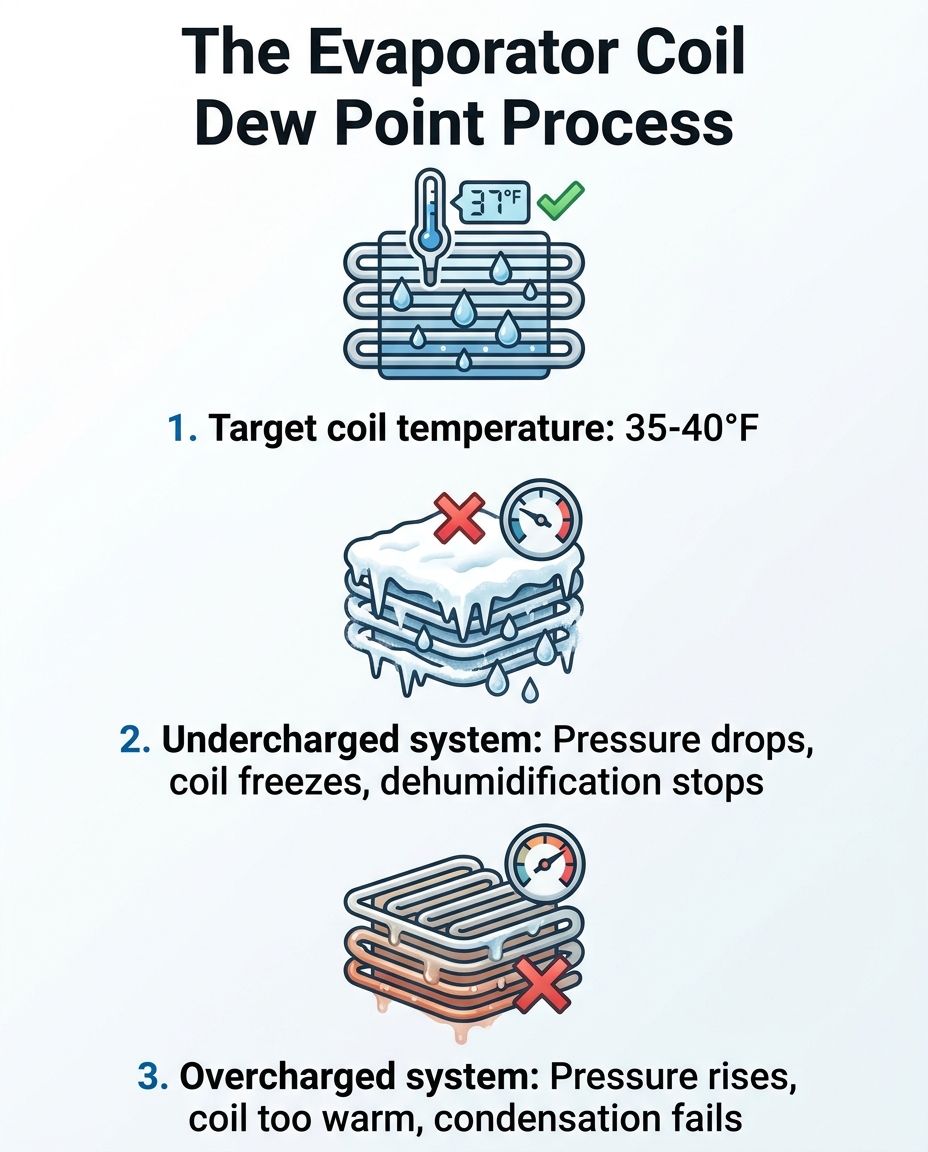
The critical temperature balance: For this condensation process to work, the evaporator coil must maintain a highly specific temperature, roughly between 35 and 40 degrees Fahrenheit. If the coil is warmer than 40 degrees, it won't hit the dew point, and moisture will stay in the air. If the coil drops below 32 degrees, the moisture will freeze into ice rather than dripping away into the drain pan. Maintaining this precise 35-to-40-degree window is entirely dependent on having the exact factory-specified amount of refrigerant in the system.
What Happens to Dehumidification When Refrigerant is Low?
When our technicians are called to homes experiencing high indoor humidity despite a 72-degree thermostat setting, one of the most common culprits we find is a low refrigerant charge. Refrigerant operates in a closed-loop system. It does not get "used up" like gas in a car. If your system is low on refrigerant, it means there is a leak somewhere in the copper lines, the coils, or the fittings.
When refrigerant leaks out, the pressure inside the entire system drops. In the world of thermodynamics, pressure and temperature are directly linked. When the pressure inside the indoor evaporator coil drops too low, the temperature of the coil plummets along with it. Instead of sitting comfortably in that 35-to-40-degree condensation zone, the coil temperature falls below freezing.
The Chain Reaction of a Freezing Coil
As the coil temperature drops below 32 degrees, the moisture pulled from your indoor air no longer condenses into liquid water. Instead, it instantly freezes onto the metal fins of the coil. This creates a cascading series of mechanical failures:
• Blocked airflow: A layer of ice forms over the coil, physically blocking the warm air from passing through the fins.
• Halted dehumidification: Because the air can no longer touch the cold metal of the coil, the system stops extracting any new moisture from the house.
• Warm air delivery: The ice acts as an insulator, preventing the refrigerant from absorbing heat. Your vents may start blowing lukewarm or slightly cool air instead of crisp, cold air.
Common symptoms to watch for: If your system is undercharged, you will likely notice ice buildup on the copper refrigerant lines outside near the compressor, a faint hissing or bubbling sound near the indoor unit, and a home that feels distinctly damp and swampy.
• Proper Factory Charge — Coil Pressure: Normal / Optimized — Coil Temperature: 35°F - 40°F — Dehumidification Result: Moisture condenses and drains away perfectly.
• Low Refrigerant Charge — Coil Pressure: Abnormally Low — Coil Temperature: Below 32°F — Dehumidification Result: Moisture freezes to the coil; dehumidification stops entirely.
The Hidden Danger of an Overcharged AC System
While low refrigerant is a widely known issue, our diagnostic team frequently encounters overcharged air conditioning systems, which are just as detrimental to your home's humidity control. A pattern we see often is that this happens when an inexperienced technician attempts to guess the refrigerant levels without using precise digital gauges, accidentally pumping too much chemical into the lines.
When an AC system has too much refrigerant, the pressure inside the evaporator coil increases significantly. Just as low pressure causes the temperature to drop, high pressure causes the temperature of the coil to rise. Instead of staying in that crucial 35-to-40-degree window, an overcharged coil might sit at 45 or 50 degrees.
Why Overcharging Wastes Massive Amounts of Energy
At 50 degrees, the coil is still colder than the air inside your house, so it will continue to absorb sensible heat. The air blowing out of your vents will feel relatively cool, and the system will eventually satisfy the thermostat's temperature setting. However, because the coil is not cold enough to reach the dew point, it fails to pull any latent heat (humidity) out of the air.
During the heavy heat of an August late-summer afternoon, this creates a miserable indoor environment. The thermostat registers that the room is cool, but your body still feels sweaty and uncomfortable because the sweat cannot evaporate in the humid indoor air. Even worse, because humid air holds heat longer and feels warmer than dry air, you will likely keep turning the thermostat down. This forces the overcharged system to run 24-hours a day in a desperate, failing attempt to dry the air, wasting massive amounts of electricity and driving up your monthly utility costs.
Why Lowering the Thermostat Won't Fix a Clammy House
When faced with a sticky, uncomfortable home, the most common homeowner instinct is to walk over to the hallway and crank the thermostat down to 68 degrees. It makes logical sense—if you feel hot and sweaty, you want more cold air. However, behavioral changes cannot overcome mechanical imbalances.
If your system is suffering from an improper refrigerant charge, lowering the thermostat will not force the system to remove more moisture. The coil is still operating at the wrong temperature. All you are doing is forcing the system to pump more sensible cooling into a highly humid space. The result is an environment that professionals refer to as "cold and clammy." You might find yourself shivering under a blanket on the couch, yet your skin still feels sticky and the air still smells slightly musty.
The Toll on Your Equipment
We see this "cold and clammy" effect frequently during San Antonio mornings, where the relative humidity often exceeds 70 percent. The latent cooling load on your house is massive before the sun even fully rises. By setting the thermostat lower and lower, you are demanding that an already compromised system run continuously.
Running an imbalanced system harder accelerates wear and tear on the compressor, the most vital and expensive component in your outdoor unit. The compressor relies on the cool refrigerant returning from the house to keep its own internal motor from overheating. If the charge is wrong, the compressor runs too hot for too long, leading to premature mechanical failure. Instead of treating the symptom by playing with the thermostat, you have to address the root cause of the mechanical performance. Evaluating your overall home performance starts with ensuring the core machinery is operating exactly to factory specifications.
The 'Quick Top-Off' Myth vs. Precise Professional Diagnostics
When homeowners realize they have high indoor humidity despite a 72-degree thermostat setting, they often search for a fast, cheap fix. Unfortunately, there are contractors who will offer a quick "freon top-off" without locating the source of the leak or measuring the system's internal pressures accurately. Our team at Reliabee strongly advises against this; it is a dangerous myth that will cost you heavily in the long run.
First, handling refrigerant requires an EPA Section 608 certification. It is a highly regulated chemical, and venting it into the atmosphere is illegal. Second, adding a pound or two of refrigerant without finding the leak guarantees that you will be paying for another top-off in a few months when the chemical leaks out again. More importantly, guessing the charge level by feeling the copper pipes or looking at basic analog gauges almost always results in an overcharged or undercharged system, ruining your dehumidification.
The Value of Advanced Diagnostics
During a recent late-summer heatwave, our Reliabee technicians responded to a local homeowner who noticed their two-year-old system simply wasn't cooling properly. Rather than guessing, our technician arrived, attached advanced digital gauges, and ran a full diagnostic. By providing pre- and post-service performance reports, we explained exactly how precise adjustments increased the system's performance back to necessary levels. In our experience, this is the difference between a band-aid and a true solution.
Our comprehensive diagnostic approach at Reliabee relies on advanced digital tools to measure "superheat" and "subcooling"—the exact temperatures of the refrigerant as it changes from liquid to gas and back again. This is the only reliable way to restore the exact coil temperatures needed for optimal moisture removal.
• Ignores the source of the leak. — Comprehensive Professional Diagnostic: Locates and repairs the leak before adding refrigerant.
• Uses analog gauges or "rules of thumb." — Comprehensive Professional Diagnostic: Uses digital gauges to measure exact superheat and subcooling.
• Often results in an overcharged system. — Comprehensive Professional Diagnostic: Restores system to precise factory specifications.
• Leaves the home feeling cold and clammy. — Comprehensive Professional Diagnostic: Restores proper 35-40°F coil temps for perfect dehumidification.
Long-Term Solutions for Optimal Indoor Air Quality
Proper refrigerant charge is the absolute foundation of whole-home dehumidification. You can install the best smart thermostats and the thickest insulation, but if your AC's evaporator coil cannot reach the correct dew point, you will never feel completely comfortable in your own home.
Once a professional corrects the charge and repairs any underlying leaks, your air conditioner can finally manage the latent heat effectively. The heavy, sticky feeling will vanish, replaced by crisp, dry air that feels comfortable even at higher thermostat settings. Our clients frequently tell us that once their humidity is under control, they can comfortably set their thermostat to 74 or 75 degrees, saving significant wear and tear on the machinery.
The Importance of Proactive Care
The best way to prevent a sticky home is to catch slow refrigerant leaks before they ruin your home's humidity balance. These leaks often start incredibly small—pinhole leaks caused by formicary corrosion on the copper coils. By the time you notice high indoor humidity despite a 72-degree thermostat setting, the system has likely been running undercharged for weeks.
Scheduling routine AC maintenance allows a certified technician to evaluate your system's pressures, clean the coils, and ensure the equipment is fully prepared for the heaviest cooling loads of the year. Proactive care stops minor leaks from turning into major compressor failures.
Restore Your Home's Comfort with Expert Diagnostics
Living in a sticky, uncomfortable home during an August late-summer heatwave is incredibly frustrating, and completely unnecessary. You do not have to settle for air conditioning that only does half its job. If you are tired of shivering in a damp living room while the AC runs constantly, it is time to look beyond the thermostat.
A comprehensive professional evaluation can pinpoint exactly why your system is underperforming. By analyzing the precise pressures, temperatures, and airflow of your equipment, our certified technicians can correct the refrigerant charge and restore your indoor air quality to perfect balance. Take the proactive step today to ensure your home remains the cool, dry sanctuary you deserve.
Frequently Asked Questions
Why is my house so humid with the AC on?
Your AC may be struggling to remove moisture due to an incorrect refrigerant charge, restricted airflow, or an oversized unit. When the system's evaporator coil cannot reach the precise temperature needed to condense water vapor, the AC will cool the air without actually dehumidifying it. A professional diagnostic from our Reliabee technicians is required to find the exact cause.
Does low refrigerant cause high humidity in house?
Yes, low refrigerant directly causes high indoor humidity. When refrigerant levels drop, the pressure in the evaporator coil drops, causing the coil to freeze rather than condense moisture. Once the coil is covered in ice, it can no longer extract humidity from the air passing over it.
Will adding refrigerant make my AC colder?
Adding refrigerant will only improve cooling if the system is currently undercharged due to a leak. If the system already has the correct factory charge, adding more refrigerant will actually decrease performance, raise indoor humidity, and potentially damage the compressor. Refrigerant should only be added after a professional measures the system's superheat and subcooling.
How does an air conditioner remove humidity?
An air conditioner removes humidity by blowing warm indoor air over a cold indoor evaporator coil. The coil is kept between 35 and 40 degrees Fahrenheit, which is below the air's dew point. This causes the moisture in the air to condense into liquid water on the coil, which then drips safely into a drain pan.
Can an overcharged AC system cause indoor humidity problems?
Absolutely. An overcharged system operates with too much internal pressure, which forces the evaporator coil's temperature above the optimal dew point. While the system may still blow cool air and satisfy the thermostat, the coil will not be cold enough to pull latent heat (humidity) out of the air, leaving your home feeling cold and clammy.

Ready to Transform Your Home?