Why We Check for Gas Leaks During Early Fall Furnace Tune-Ups
The Hidden Risks of Firing Up a Dormant Furnace
If you are wondering why we check for gas leaks during early fall furnace tune-ups, the answer usually lies in what happens to your heating equipment while it sits completely idle over the summer. In our years of serving San Antonio homes at Reliabee Air Electric Plumbing, we often see a common habit: homeowners wait for that first undeniable chill in the air, walk over to the thermostat, and simply switch the system from cooling to heating. You expect warm air to flow immediately. However, turning on a dormant gas furnace without a prior professional inspection ignores the invisible mechanical and plumbing stresses that develop when a system sits completely unused for months at a time.
To ensure your home is safe and ready for winter, you can explore our heating services or schedule a dedicated gas line inspection and repair today.
Throughout the San Antonio summer, your heating equipment is subjected to extreme environmental conditions, even when it is turned off. An early fall tune-up is not just a basic efficiency booster designed to lower your energy bills; it is a critical safety verification for your home. Gas furnaces rely on a complex network of valves, seals, and heat exchangers to safely contain and combust natural gas. When these components sit dormant, they become vulnerable to degradation. A professional safety check verifies that every piece of your gas plumbing and heating infrastructure is intact, sealed, and ready to operate safely before the heavy demands of winter arrive.
How Summer Attic Heat Compromises Dormant Heating Systems
To understand why a dormant furnace requires a safety check, you have to look at where the equipment is located. In many San Antonio homes, furnaces are installed in unconditioned spaces like attics or utility closets. During the peak of summer, local attics routinely exceed 130°F. This creates a highly volatile, high-stress environment for HVAC equipment that is not actively running.
Our team recently helped a San Antonio homeowner who experienced the consequences of this intense environment firsthand. Extreme attic heat and deteriorating materials required our technicians to completely replace a flexible duct and a plenum box, which ultimately led to the installation of an entirely new heating and air conditioning system. The sheer ambient heat in an unconditioned space takes a severe toll on the materials that make up your HVAC system.
The Impact of Thermal Expansion
The physics of thermal expansion play a massive role in the degradation of dormant heating equipment. As attic temperatures soar during the day and cool down slightly at night, the metal components of your furnace continuously expand and contract.
• Structural stress: Repeated cycles of expansion and contraction weaken the structural integrity of metal housings and mechanical fasteners over months of inactivity.
• Seal degradation: Rubber gaskets and synthetic seals that prevent gas and carbon monoxide from escaping can become brittle, crack, or lose their elasticity under sustained extreme heat.
• Valve sticking: Gas valves that are not cycled open and closed for half the year can seize up or fail to close completely when finally engaged.
This continuous environmental stress accelerates wear on your system long before the heating season actually begins. By the time you are ready to turn on the heat, the physical state of the furnace may be vastly different from when you last used it in the spring.
The Mechanics of Gas Line and Fitting Degradation
The furnace itself is only one part of the safety equation. The gas plumbing feeding the unit requires equal attention after a long period of summer dormancy. Natural gas is supplied to your furnace through heavy-duty piping, but the joints and connections rely on specialized materials to maintain a perfect seal.
Because our team at Reliabee handles both HVAC and plumbing, we have a unique perspective on how these systems interact. We use specialized pipe dope and thread sealants to ensure gas fittings remain airtight. However, under intense, prolonged heat—especially when the gas is not flowing regularly to keep the lines pressurized and the ambient temperature stable—these sealants can dry out, flake, or degrade. When pipe dope becomes brittle, the natural vibration of the AC unit running all summer can be enough to disturb the weakened seal on the attached furnace.
Furthermore, dormant gas valves that haven't been cycled in months are highly vulnerable. A valve that sits in the closed position in a 130°F attic can suffer from dried-out internal lubrication. When the thermostat finally calls for heat during the September pre-heating season, that sticky valve might open but fail to close perfectly. It is important to understand that a microscopic gap in a degraded fitting or a slightly stuck valve is all it takes for a slow, highly dangerous gas leak to develop inside your home.
Heat Exchangers and the Threat of Carbon Monoxide
Perhaps the most critical safety component checked during a fall tune-up is the heat exchanger. The heat exchanger is a series of metal coils or tubes that act as the physical barrier between the toxic combustion gases (created by burning the natural gas) and the clean breathing air that is pushed through your home's vents. If this barrier is compromised, the results can be catastrophic.
According to the CDC, carbon monoxide is an odorless, colorless gas that is responsible for hundreds of non-fire-related incidents every year. Because you cannot see or smell it, a compromised heat exchanger is a silent threat. The extreme thermal stress of summer, combined with the sudden expansion when the furnace burners ignite for the first time in the September pre-heating season, can create microscopic cracks in the metal.
Another major risk factor is delayed ignition. If dirt, dust, or rust has built up on the dormant burners, the gas may not ignite immediately when the valve opens. When it finally does catch, it creates a small explosion inside the combustion chamber. Over time, these recurring concussions can physically warp or crack the heat exchanger.
Why Visual Inspections Aren't Enough
You cannot determine the safety of a heat exchanger just by looking at it with a flashlight.
• Temperature-dependent cracks: Microscopic cracks expand when the furnace heats up and the metal expands. This means a crack might close completely and hide when the unit is cold, only opening up to leak carbon monoxide once the system is actively heating your home.
• Specialized detection: Professional technicians use specialized combustion analysis tools and carbon monoxide detectors to identify trace amounts of escaping gas that the naked eye would never catch.
If a severe issue is detected, knowing the proper steps to take during an emergency furnace breakdown can protect your home from immediate danger while you wait for a repair team.
Standard Operational Checks vs. Comprehensive Safety Inspections
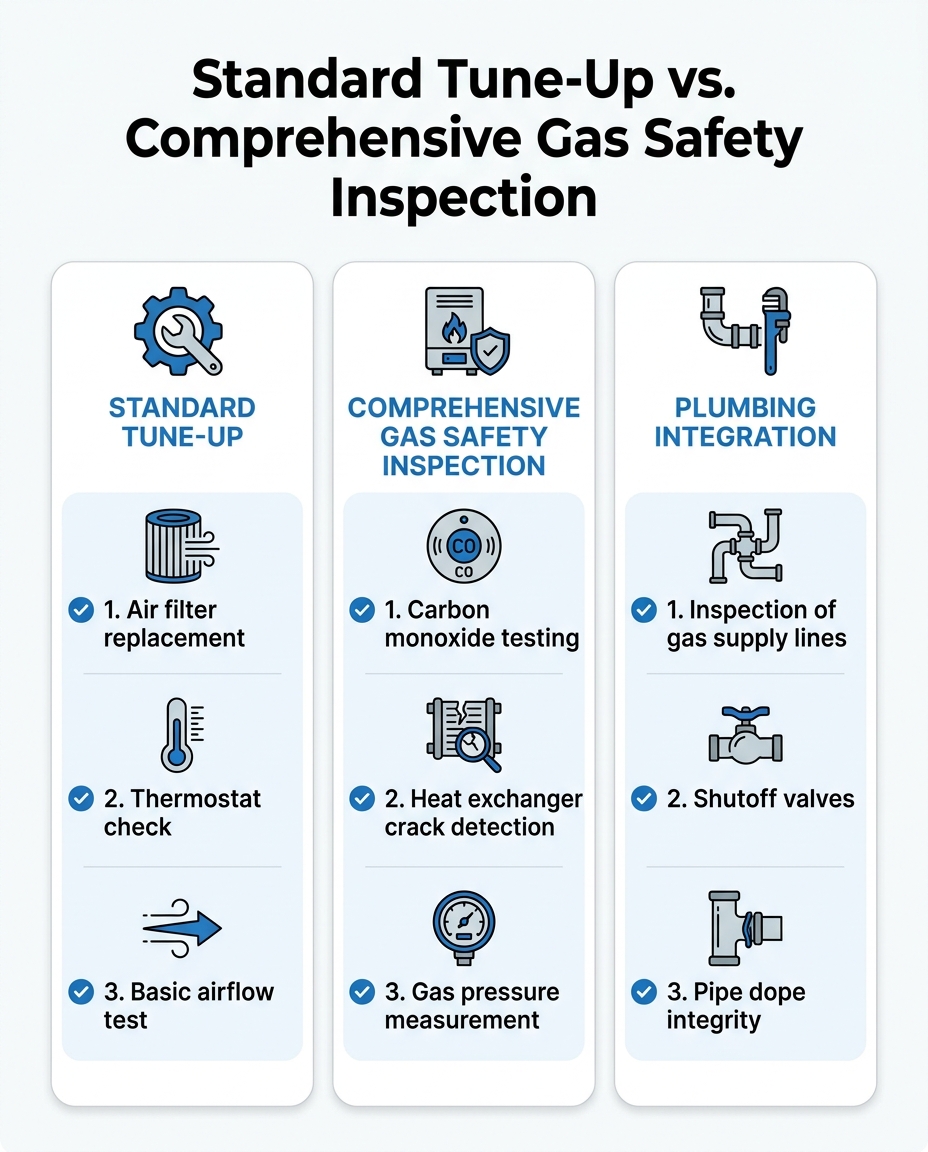
Not all tune-ups are created equal. There is a massive difference between a basic operational check and a comprehensive gas safety inspection. A standard check often involves simply turning the thermostat up, verifying that hot air blows out of the vents, and swapping out the air filter. While changing the filter is important, this surface-level approach completely ignores the mechanical and plumbing realities of a gas appliance.
A rigorous safety inspection goes much deeper. It involves evaluating the home's gas supply lines feeding the unit, testing the safety limit switches, measuring the exact gas pressure at the manifold, and verifying that the venting system is clear of obstructions (like bird nests built over the summer). This is exactly why our multi-trade expertise across Air, Electric, and Plumbing at Reliabee serves as your ultimate safety net. We holistically evaluate both the HVAC appliance itself and the complex gas plumbing feeding it, ensuring no critical connections are overlooked.
For example, when our technicians handled the complete replacement of both the AC and furnace systems for a local San Antonio customer recently, we made sure to explain every component of the new system and the thermostats, ensuring the homeowner understood exactly how their equipment operated safely. That level of thoroughness should be the standard for maintenance as well. Enrolling in a routine HVAC maintenance plan ensures these deep-dive safety checks happen automatically every fall.
Why Timing Matters: Scheduling Before the First Cold Snap
The timing of your furnace maintenance is just as important as the thoroughness of the inspection. The September pre-heating season is the optimal window for a safety check because of the sheer unpredictability of early fall weather transitions. Texas is notorious for sudden, dramatic temperature drops known as Blue Northers. In a matter of hours, the weather can shift from a mild 75°F afternoon to a freezing, windy night.
When a Blue Norther hits, your dormant furnace is suddenly forced to run continuously under a heavy operational load to combat the rapid heat loss in your home. If a gas valve is sticky, or a heat exchanger is compromised, this sudden shift from zero to 100% capacity is exactly when a catastrophic failure or emergency breakdown will occur.
Testing the system during mild weather prevents these dangerous scenarios. By scheduling proactively, a professional can test the burners, measure the gas pressure, and verify the heat exchanger's integrity while the system is under minimal stress. If a repair is needed, it can be handled calmly before your family is shivering in the dark waiting for an emergency repair team during the first major cold front of the year.
Warning Signs You Should Never Ignore
While a professional tune-up is the best preventative measure, homeowners in San Antonio must also know how to identify the active warning signs of a failing gas furnace. Natural gas in its raw state is completely odorless. To keep people safe, utility companies add a chemical compound called mercaptan to the gas supply. Mercaptan gives natural gas its distinct, unmistakable "rotten egg" or sulfur smell. If you ever detect this odor near your furnace, at the vents, or anywhere in your home, you must treat it as an immediate emergency.
Beyond odors, you should pay close attention to visual and auditory clues. If you hear unusual hissing sounds coming from the gas lines near the furnace cabinet, that is a strong indicator of a pressurized leak. Visually, you should inspect the area around the furnace for excessive soot buildup, which indicates poor combustion. Furthermore, a healthy gas furnace should always burn with a crisp, steady blue flame. If you look into the burner viewport and see yellow, orange, or flickering flames, the system is not combusting the gas properly and may be producing high levels of carbon monoxide.
Immediate Steps if You Suspect a Leak
If you notice any of these warning signs, safety must be your only priority. Never attempt to diagnose or fix a gas leak yourself. DIY gas leak detection methods—such as spraying soapy water on internal gas valves or circuit boards—can cause severe electrical damage, void your warranty, and put your life at risk. Instead, follow these steps:
• Evacuate immediately: Get all family members and pets out of the house without delay.
• Avoid sparks: Do not operate any electrical switches, unplug devices, or even adjust the thermostat, as a tiny spark can ignite accumulated gas.
• Call for help: Once you are a safe distance away from the property, call your local gas utility company and a licensed professional for emergency heating services.
Frequently Asked Questions About Furnace Gas Safety
Can a furnace tune up detect a gas leak?
Yes, a comprehensive furnace tune-up performed by a licensed professional is specifically designed to detect gas leaks. Technicians use specialized electronic combustible gas detectors and carbon monoxide monitors to check the fittings, valves, and heat exchangers. This equipment can identify microscopic leaks long before the concentration of gas is high enough for a homeowner to smell it.
Why would a furnace leak gas when turned off?
A furnace can leak gas when turned off because the supply lines feeding the unit remain pressurized year-round. Over the summer, extreme heat in attics or closets can dry out the pipe dope and thread sealants on these dormant supply lines. Additionally, the internal gas valve can suffer from dried-out lubrication, preventing it from maintaining a perfect, airtight seal during its months of inactivity.
What happens if my furnace has a gas leak?
If your furnace has a gas leak, the immediate risks include the potential for a catastrophic fire or explosion, as natural gas is highly combustible. Additionally, leaking combustion gases can introduce lethal carbon monoxide into your home's breathing air. If you suspect a leak, you must evacuate the premises immediately and contact your utility company from a safe distance.
How often should a gas furnace be inspected for safety?
A gas furnace should be professionally inspected for safety at least once every year, ideally during the September pre-heating season. Annual inspections ensure that any degradation or thermal stress damage that occurred over the summer is identified and repaired before the unit is subjected to the heavy workload of winter heating. Skipping these annual checks significantly increases the risk of sudden breakdowns and safety hazards.
How does summer heat affect dormant gas furnaces?
Extreme summer heat causes the metal components of a dormant furnace to continually expand and contract, leading to structural fatigue. This thermal stress is especially severe in unconditioned spaces like attics, where temperatures can exceed 130°F. The sustained heat also dries out rubber gaskets, synthetic seals, and plumbing thread sealants, compromising the system's ability to safely contain gas once it is turned back on.
What does a cracked heat exchanger smell like?
A cracked heat exchanger often produces a sharp, unpleasant odor similar to formaldehyde or metallic exhaust fumes. However, it is vital to know that the most dangerous byproduct of a cracked heat exchanger—carbon monoxide—is completely odorless and colorless. You should never rely on your sense of smell alone to detect a cracked heat exchanger; professional combustion analysis is required for true safety.
Secure Your Home for the Winter Heating Season
The transition from extreme San Antonio summer heat to sudden winter cold takes a massive, invisible toll on dormant gas furnaces. When your system sits unused in a sweltering attic for months, the thermal stress on gas fittings, valves, and heat exchangers is severe. True peace of mind does not come from simply hoping the system works when you flip the switch; it comes from a verified, professional safety check that ensures every component is intact and operating safely.
Do not wait for a sudden cold front to test the limits of your heating equipment. By taking action now, you can protect your family from the hidden dangers of gas leaks and carbon monoxide exposure. Schedule your comprehensive evaluation today to ensure your home remains safe, warm, and secure all winter long.

Ready to Transform Your Home?