The Logistics of a 24-Hour Emergency Heating Repair in Bexar County
Facing a Late-Night Breakdown: Navigating Heating Emergencies
The Logistics of a 24-Hour Emergency Heating Repair in Bexar County can seem mysterious, especially when an early fall cold front hits at 2 AM and your vents start blowing ice-cold air. Is your heating system actually broken, or is it just struggling to keep up with the sudden chill? You are probably wondering what actually happens when you search for after-hours help. Will someone actually show up and fix the unit, or are you just paying a fee for a technician to tell you they have to order a part on Monday?
At Reliabee Air Electric Plumbing, our team frequently sees the panic a sudden late-night breakdown causes, which is why we provide transparent professional heating services from the moment you pick up the phone.
A sudden heating failure creates immediate anxiety. The house is getting colder by the minute, and you are left wondering if the strange noise from your furnace is dangerous or just a nuisance. You need to know that a late-night call will result in actual heat restoration, not just a costly diagnostic visit. Choosing a provider with transparent logistics and fully stocked trucks is the only way to guarantee that your system gets back online before morning.
Common signs that your overnight issue is a true emergency:
• Total loss of heat: The blower is running, but the air coming from the vents is entirely cold.
• Electrical burning odors: A strong smell of melting plastic or ozone near your indoor unit.
• Loud, grinding noises: Metal-on-metal sounds indicating a failing blower motor.
• Constant short-cycling: The system turns on for a few seconds and immediately shuts off, failing to warm the house.
With the right operational preparation, immediate relief is completely possible. The key is understanding exactly how the emergency dispatch process works so you know what to expect when the technician arrives in your driveway.
Why South Texas Homes Lose Heat Rapidly During Blue Northers
To understand why emergency repairs are a safety necessity rather than a simple convenience, you have to look at how local homes are built. In our experience working on properties across San Antonio and Bexar County, we see firsthand that most are primarily constructed to dissipate extreme summer heat, which creates unique challenges when the weather suddenly turns freezing.
The Architectural Vulnerability of Local Homes
Most homes in our region feature lower insulation R-values in the walls compared to homes built in northern climates. During the long, blistering summers, this design helps prevent the house from trapping excess heat. However, when early fall unexpected cold fronts arrive, this architectural vulnerability becomes a serious problem.
Without heavy insulation to trap warm air inside, your home will experience rapid indoor temperature equalization with the outdoor freeze. If your heating system fails during a sudden drop, the indoor temperature can plummet to uncomfortable and unsafe levels in a matter of hours. This rapid heat loss is exactly why overnight intervention is critical before the home becomes dangerously cold.
The Speed of a Texas Blue Norther
A Texas "blue norther" is a fast-moving weather phenomenon where temperatures can drop 20 to 30 degrees in mere hours. One moment, you are enjoying a mild evening; the next, freezing winds are rattling your windows.
This sudden, extreme shift puts an immense strain on HVAC equipment. Unmaintained systems that have been sitting idle for months are suddenly forced to run at maximum capacity. The danger of these systems failing under a sudden, heavy load is incredibly high. When a blue norther hits, you do not have the luxury of waiting two or three days for a standard service appointment.
The 4-Step Dispatch Logistics of a 24-Hour Emergency Heating Repair
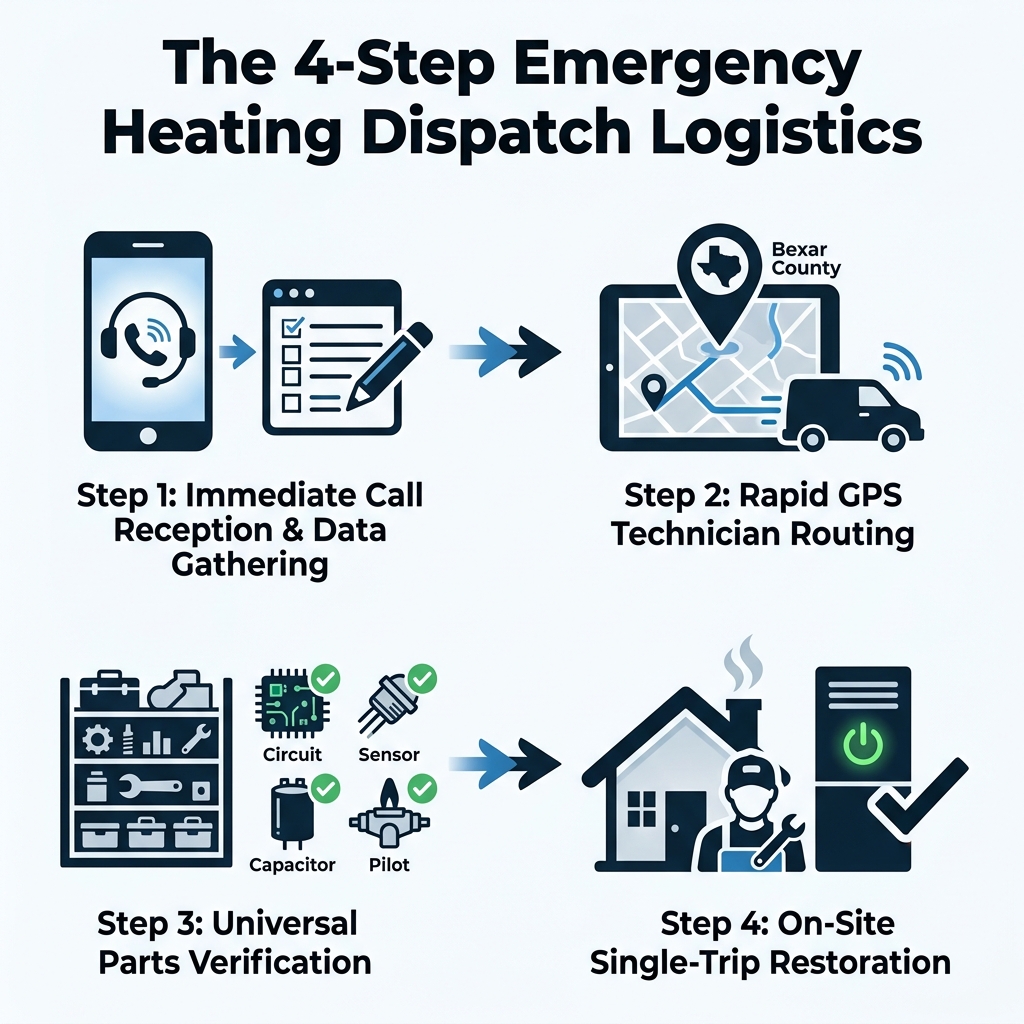
When you are shivering in your living room, the last thing you want is ambiguity. Here is the exact, step-by-step process our dispatchers follow when you request 24-hour emergency HVAC service during a late-night breakdown.
1. Call Reception and Data Gathering: Your call is answered immediately, not sent to a generic voicemail. The dispatcher will ask specific questions about your system's symptoms, the age of the unit, and any unusual sounds or smells. Gathering this critical system failure data upfront allows the team to prepare the right diagnostic approach before they even leave the shop.
2. Rapid Technician Routing: Using advanced GPS logistics, the dispatcher locates the nearest on-call expert to your Bexar County neighborhood. This ensures the fastest possible response time, cutting down the hours you spend waiting in the cold. You will receive clear communication about the estimated arrival time.
3. Universal Parts Verification: Before the technician arrives, they verify that their dispatched vehicle carries the necessary components for common overnight failures. Because standard supply houses are closed, having the right inventory on the truck is the only way to ensure a successful 24-hour emergency heating repair.
4. On-Site Restoration: The technician arrives fully equipped to diagnose and repair the issue immediately. They will perform a thorough inspection, identify the failed component, and work to restore your heat in a single visit.
Bypassing Closed Supply Houses: The Power of Universal Parts
One of the biggest fears homeowners have during a late-night breakdown is paying for a service call only to hear, "I know what is wrong, but I have to order the part on Monday." Standard HVAC supply houses across Bexar County are typically closed between 5 PM and 7 AM, and they certainly do not open on weekends or holidays. This is where the operational differentiator of stocking specific parts becomes crucial. Reliabee fully stocks our trucks with universal parts to handle emergencies without waiting for supply houses to open.
What Are Universal HVAC Parts?
Universal parts are specialized components designed to work safely and effectively across multiple system brands and models. While some complex repairs require factory-specific OEM (Original Equipment Manufacturer) components, our technicians consistently find that the vast majority of late-night heating failures trace back to a handful of common culprits.
Essential universal parts stocked for overnight fixes include:
• Universal control boards: The "brain" of your furnace that manages the sequence of operations.
• Flame sensors: A safety device that shuts the system down if it does not detect a flame.
• Hot surface ignitors: The component that actually lights the gas to create heat.
• Run capacitors: The electrical component that gives the blower motor the jolt of energy it needs to start.
Carrying these specific components is absolutely essential for overnight ignition and airflow fixes. If you want to know more about handling sudden failures, you can review the steps to take during an emergency furnace breakdown while you wait for the technician to arrive.
The After-Hours Inventory Advantage
By keeping vehicles stocked with universal parts, technicians eliminate the dreaded next-day wait times. This inventory strategy directly reduces your total downtime during freezing temperatures. Instead of huddling under blankets for 48 hours waiting for a supply house to open, your system is repaired on the spot. This provides incredible peace of mind when you are dealing with early fall unexpected cold fronts.
Clear Diagnostics and Straightforward Solutions
A heating emergency is stressful enough without having to decipher confusing technical jargon. Once the technician arrives at your home, the diagnostic process begins immediately. They will inspect the thermostat, check the electrical connections, test the ignition sequence, and evaluate the airflow.
Transparency is a critical part of this process. It is vital that the technician explains the root cause of the failure in simple, understandable terms. You should never feel pressured or confused about what is happening inside your own home.
During a recent fall temperature drop, a local homeowner reached out because their heating system developed a sudden, severe issue. The arriving technician thoroughly explained the heating issue in simple terms, ensuring the homeowner understood exactly what failed before proceeding with the work. Because the communication was clear and straightforward, the job was done right on the spot, addressing the heating problem without any lingering confusion.
A thorough, honest diagnostic process prevents recurring issues later in the season. The focus always remains on completing the job correctly the first time, ensuring your home stays warm long after the service truck pulls out of your driveway.
Achieving Single-Trip Heat Restoration When Temperatures Drop
The ultimate goal of any emergency call is single-trip heat restoration. Once the diagnostic phase is complete and you understand the solution, the technician transitions directly into the actual repair using those pre-stocked universal parts.
During a severe winter cold snap, another Bexar County homeowner found their heating system was not working properly just as they needed it most. The responding technician explained the problem clearly and fixed the heating system efficiently using stocked parts. The heating system was restored and working well before the house could freeze, proving the value of arriving fully equipped.
The repair phase includes vital safety checks:
• Carbon monoxide testing: Ensuring the heat exchanger is intact and no dangerous gases are leaking into the living space.
• Gas pressure verification: Confirming the gas valve is operating at the correct pressure for safe combustion.
• Electrical safety checks: Tightening connections and verifying that the system is not drawing excessive amperage.
Finally, the technician will run the system through a complete testing phase. They will verify that the home is actively warming up, the blower is distributing air evenly, and the thermostat is responding correctly before they ever consider departing. This efficient, one-trip resolution is exactly what you need during severe weather events.
Securing Your System After an Emergency Repair
Once the immediate crisis is resolved and your home is warm again, it is time to think about long-term solutions. An emergency repair fixes the immediate failure, but ongoing proactive care is what keeps the system running smoothly for years to come.
The Role of Routine Maintenance
Following up an emergency repair with comprehensive system care is the best way to prevent future late-night panics. Enrolling in a routine maintenance plan ensures that a professional inspects, cleans, and tunes your system before the heavy winter weather arrives. Routine maintenance catches basic wear and tear—like a dirty flame sensor or a weakening capacitor—before the next cold front hits. This proactive approach significantly extends the lifespan of your repaired system and keeps your energy bills predictable.
Evaluating Modern Heating Alternatives
If your aging system frequently breaks down, it might be time to introduce alternative heating solutions. When a furnace is past its prime and requires constant emergency interventions, upgrading to more efficient technology often makes the most sense. Modern heat pump systems are particularly beneficial for Texas climates, offering highly efficient heating during our mild winters and powerful cooling during the blistering summers. Additionally, generic federal tax credits or local utility incentives may apply to qualifying heat pump installations—just be sure to verify current programs with your utility provider or tax professional.
Frequently Asked Questions About After-Hours Heating Logistics
If you are considering upgrading to heat pump systems or just want to be prepared for the next cold snap, you likely have questions about how late-night logistics work. Here are direct answers to the most common queries regarding emergency HVAC services in Bexar County.
Do HVAC techs carry parts on their trucks?
Yes, professional technicians carry a wide range of universal parts specifically designed for after-hours repairs. These pre-stocked components include universal control boards, run capacitors, flame sensors, and hot surface ignitors. By carrying these critical items, technicians can bypass closed supply houses and complete the vast majority of heating repairs immediately on site.
What happens when I call for emergency HVAC repair?
When you call for an emergency repair, a dispatcher immediately gathers your system data and routes the nearest available technician to your home using GPS. The technician arrives in a fully stocked vehicle, performs a comprehensive diagnostic, and explains the problem in simple terms. They then use universal parts to restore your heat safely and efficiently in a single visit.
Can a furnace be fixed in one trip at night?
Yes, a furnace can absolutely be fixed in one trip at night if the responding company uses proper inventory logistics. Because standard supply houses are closed, the ability to finish the job relies entirely on the technician carrying the right universal parts on their truck. As long as the failure involves a standard component like an ignitor or capacitor, single-trip restoration is the standard expectation.
How long does an emergency furnace repair take?
The average emergency furnace repair takes between one and three hours from the moment the technician arrives at your home. The diagnostic phase typically takes 30 to 45 minutes, while the actual part replacement and safety testing make up the remainder of the visit. Complex electrical issues may take slightly longer, but the goal is always to restore heat as quickly and safely as possible.
Are local supply houses open during night emergencies in San Antonio?
No, standard local HVAC supply houses in San Antonio and Bexar County are typically closed between 5 PM and 7 AM, and they remain closed on weekends. This industry standard is exactly why choosing a service provider with fully stocked trucks is so important. Without pre-stocked universal parts, a late-night technician can only diagnose the problem and force you to wait until the next business day for the actual repair.
Restoring Warmth and Peace of Mind When You Need It Most
Dealing with early fall unexpected cold fronts is stressful, but understanding the logistics of an after-hours response takes the mystery out of the process. You deserve the reassurance of a clear dispatch timeline, transparent communication, and fully stocked trucks that arrive ready to work. Overnight heat restoration is entirely achievable without waiting for the next business day to roll around.
If your system is failing and the temperature is dropping, do not wait for the problem to worsen. Reach out to our professional team at Reliabee Air Electric Plumbing, ready to handle sudden temperature drops and restore the warmth and peace of mind you need. Secure your comfort today by scheduling a comprehensive diagnostic with our dedicated emergency response team.

Ready to Transform Your Home?