Transitioning from Cooling to Heating: The Dual-System Inspection
Navigating Unpredictable Fall Weather With Dual-System Readiness
Before the first major cold front arrives, Transitioning from Cooling to Heating: The Dual-System Inspection is the absolute best way to ensure your home remains comfortable through unpredictable weather swings. The September/October transition in South Texas is notoriously erratic; a single week can easily demand heavy, continuous cooling during the day and sudden, active heating overnight. If you rely on standard national advice that suggests simply shutting off your air conditioner in early September, you will quickly find yourself sweating through the lingering autumn heat. To secure your comfort, prioritizing professional HVAC services and a comprehensive HVAC maintenance plan is essential for preparing both sides of your climate control system.
Traditional "furnace-only" fall maintenance falls entirely short in this region. At Reliabee Air Electric Plumbing, our team sees firsthand how ignoring the cooling side of your equipment during a fall tune-up leaves San Antonio homeowners vulnerable to unexpected breakdowns, especially when your air conditioner is still running daily to combat 90+ degree afternoon temperatures. A dual-system inspection moves far past basic seasonal definitions and dives directly into advanced technician procedures that evaluate the entire home environment.
Instead of scheduling separate visits for your AC and your heater, a unified maintenance strategy covers both systems simultaneously. This approach recognizes that your central air and your furnace share critical components, ductwork, and electrical pathways. By evaluating the system as a whole, our technicians can identify compounding issues that might otherwise go unnoticed until extreme weather forces the system to fail.
Post-Summer Triage: The Critical AC Inspection
Your air conditioner has just endured a grueling summer of continuous, high-stress operation. Performing an AC inspection right now is vital because the system has accumulated significant wear and tear over four months of non-stop work. Bypassing this triage means you risk your cooling system failing right when a late-season heatwave strikes.
1. Verifying refrigerant levels: Technicians use advanced, calibrated gauges to measure the precise pressure and temperature of the refrigerant moving through your lines. If the system has developed a micro-leak during the summer, the refrigerant charge will be low, causing the compressor to overwork and potentially overheat during 90+ degree afternoon temperatures.
2. Assessing electrical connections: The intense heat and vibration of summer operation frequently loosen electrical terminals. Technicians carefully tighten these connections and measure the voltage and amperage drawing through the system.
3. Testing contactors and capacitors: Capacitors store the electrical energy needed to jump-start the heavy motors in your AC. Over a long summer, these components can bulge, leak, or lose their capacitance. Replacing a degraded capacitor now prevents a catastrophic motor failure later.
4. Clearing the condensate drain line: Months of pulling humidity out of your home leaves algae, dust, and sludge in the condensate drain. Flushing this line prevents water from backing up into your home and causing expensive structural damage.
Clearing the Condenser and Coils
The outdoor unit, or condenser, acts as the lungs of your cooling system. Throughout the summer, the aluminum fins surrounding the unit pull in massive amounts of air, along with grass clippings, dirt, pollen, and debris. Our technicians carefully remove this accumulated summer debris and use specialized, non-corrosive foaming cleaners to wash the condenser coils. Clean coils are absolutely essential for maintaining peak air conditioning performance. When the coils are heavily insulated by dirt, the system struggles to release heat into the outdoor air, forcing the compressor to run longer, consume more electricity, and degrade faster during those lingering hot autumn days.
Dormant Furnace Safety Verification for the First Cold Snap
While your AC requires triage, your heating system requires a meticulous safety verification. Firing up a heating system that has been completely dormant since February carries specific safety risks. Over the spring and summer, dust settles heavily across the burners and internal components. More concerning, insects and rodents often seek shelter inside the dark, quiet spaces of a dormant furnace flue or exhaust pipe. Turning the system on without a professional inspection can lead to burning odors, poor ignition, or even dangerous exhaust backdrafts into your living space.
No one wants to experience a sudden equipment failure when they need it most. Our emergency dispatch team frequently receives calls from local homeowners who find this out the hard way. For instance, we recently rescued a San Antonio family's hot Labor Day weekend when their overworked AC unit stopped working on a Friday night; fortunately, our technician provided prompt service, offered a portable cooling unit, and repaired the main system after hours. You want to avoid that exact same emergency scramble when the first freezing night arrives, which is why proactive heating system preparation is non-negotiable.
A qualified professional will thoroughly test the pilot lights, electronic ignition systems, and gas burners. They verify that the flame burns a crisp, steady blue, indicating complete and safe combustion. If the flame is yellow or wavering, it signals a dangerous mixture of gas and oxygen that requires immediate adjustment. These are advanced diagnostic steps that require specialized tools and training; they are never DIY tasks.
Carbon Monoxide and Heat Exchanger Diagnostics
The most critical safety check performed during the September/October transition in South Texas involves the heat exchanger. This metal chamber contains the toxic combustion gases while transferring safe heat into the air circulating through your home. Because the metal expands when heated and contracts when cooled, years of operation can cause microscopic cracks to form due to metal fatigue. Technicians use specialized equipment, including high-resolution infrared cameras and sensitive combustion analyzers, to detect these invisible fractures. Identifying a cracked heat exchanger before the winter season begins is a vital carbon monoxide safety check that protects your entire household.
Evaluating Shared Components: Airflow and Communication
The transition from cooling to heating relies heavily on the components that both systems share. The most critical of these is the blower motor, which is responsible for distributing both conditioned cold air in the summer and warm air in the winter. During a dual-system inspection, technicians measure the static pressure of the airflow and test the amperage of the blower motor to ensure it is not over-amping or struggling to push air through the ductwork.
Checking and replacing heavily soiled air filters is another mandatory step. The high volume of air moved during the summer means your current filter is likely packed with dust, pet dander, and allergens. A clogged filter creates severe airflow restrictions. When airflow drops, the AC coil can literally freeze into a block of ice, and the furnace heat exchanger can overheat and shut down on a high-limit safety switch. In our years of diagnosing HVAC systems across San Antonio, we've found that addressing airflow is often the first step in fixing heater short-cycling issues, where the system turns on and off rapidly without ever properly conditioning the space.
Furthermore, the thermostat serves as the brain of the entire operation. Technicians calibrate the thermostat to ensure it reads the indoor temperature accurately and correctly communicates with both the AC and the furnace. During rapid weather shifts, where 90+ degree afternoon temperatures give way to chilly nights, a miscalibrated thermostat can cause the systems to fight each other or fail to stage properly. Verifying the communication wiring and testing the system's response times prevents frustrating systemic issues down the line.
Protecting System Efficiency and Managing Energy Consumption
According to data from the U.S. Department of Energy, heating and cooling account for about half of a typical home's total energy usage. When your equipment is dirty, miscalibrated, or struggling against worn-out components, that energy consumption spikes dramatically. A dual-system inspection actively restores the efficiency lost during the grueling summer months and prevents costly energy waste as you move into the winter.
Efficiency often comes down to minor, precise calibrations. For example, our commercial service team recently worked with a local property manager who noticed performance issues with a newly installed commercial 5-ton AC unit this past spring; our technician identified that only a minor adjustment to the outdoor unit was needed, resolving the issue quickly and saving significant time and operational headache. The exact same principle applies to your residential dual-system setup. Minor adjustments made during the September/October transition in South Texas—like cleaning a flame sensor, balancing the blower fan, or tweaking the gas pressure—prolong the lifespan of the entire HVAC setup by reducing mechanical strain.
If the inspection reveals that certain components are highly inefficient, outdated, or unsafe to operate, upgrading them now can yield significant long-term savings. General energy rebates or federal tax credits may apply for upgrading to high-efficiency, variable-speed equipment. Taking advantage of these incentives while addressing your dual-system readiness allows you to manage your household energy consumption proactively.
What is Included in a Dual-System HVAC Inspection?
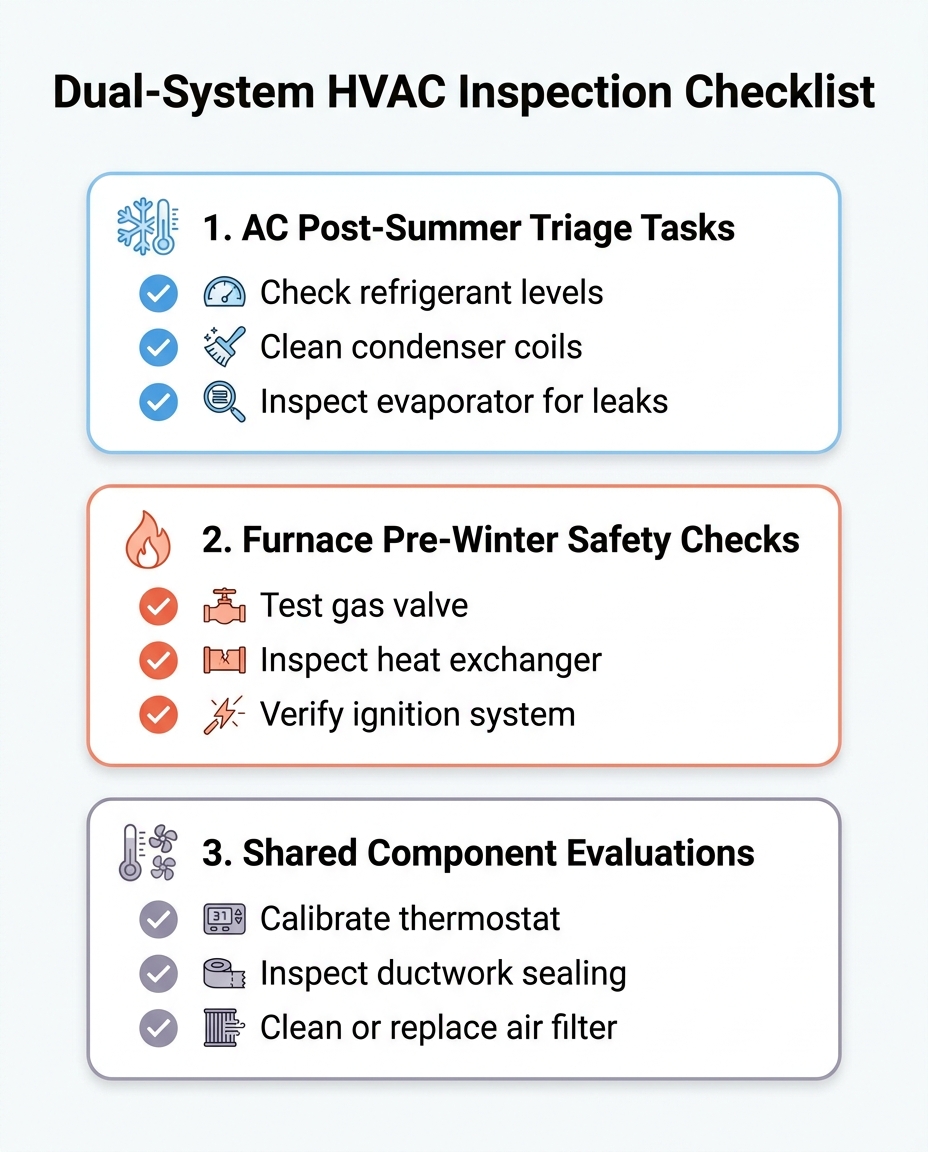
A comprehensive dual-system inspection bridges the gap between summer recovery and winter preparation. At Reliabee Air Electric Plumbing, we perform this complete, dual-system inspection in a single, time-saving visit, completely eliminating the need for separate spring and fall appointments. Here is exactly what our technicians evaluate to protect your home against erratic 90+ degree afternoon temperatures and sudden cold snaps:
• AC Post-Summer Triage:
— Measuring refrigerant pressure, subcooling, and superheat levels.
— Deep-cleaning the outdoor condenser coils to restore heat transfer.
— Testing capacitors, contactors, and tightening all electrical terminals.
— Clearing and flushing the primary and secondary condensate drain lines.
• Furnace Pre-Winter Safety Prep:
— Inspecting the heat exchanger for metal fatigue and microscopic cracks.
— Testing the ignition system, pilot light, and flame sensor for reliability.
— Verifying the gas pressure and ensuring a clean, safe burner combustion.
— Testing all high-limit safety switches and carbon monoxide safeguards.
• Shared Component Evaluations:
— Testing the blower motor amperage and inspecting the fan wheel.
— Replacing heavily soiled air filters to restore proper system static pressure.
— Calibrating the thermostat to ensure accurate communication during weather shifts.
Securing Your Comfort Before the Next Weather Shift
There is an undeniable peace of mind that comes from knowing both your air conditioner and your furnace are fully prepared for whatever the forecast holds. The September/October transition in South Texas does not offer a gentle, predictable shift between seasons; it demands robust, flexible equipment that can pivot from cooling to heating at a moment's notice. By addressing the wear and tear of the summer while verifying the safety of your dormant heating equipment, you protect your home, your family, and your wallet.
Do not wait until the first major cold front hits to discover your heater won't ignite, or until a late heatwave pushes your struggling AC to failure. Take proactive control of your indoor climate today. Reach out to our local experts at Reliabee Air Electric Plumbing to schedule your comprehensive dual-system evaluation and secure your seasonal comfort.
Frequently Asked Questions
What does an AC inspection include in the fall?
A fall AC inspection focuses on post-summer triage, including measuring refrigerant levels, cleaning the outdoor condenser coils, and testing electrical components like capacitors and contactors. Technicians also clear the condensate drain line to remove algae and sludge built up during months of heavy humidity removal. This process ensures the system can handle lingering hot days without failing from accumulated wear and tear.
Is fall HVAC maintenance necessary if I am still using my AC?
Yes, fall maintenance is highly necessary even if your air conditioner is still running daily. In fact, heavy late-season usage makes the inspection more critical, as the system is operating under maximum stress after months of continuous work. A dual-system check addresses this cooling fatigue while simultaneously prepping the dormant heating system for upcoming temperature drops.
Why does it smell like burning when turning on the heater for the first time?
The burning smell is usually caused by the furnace burning off dust and debris that settled on the burners and heat exchanger during the long dormant period. While a brief, mild odor is common and usually dissipates within an hour, persistent or strong burning smells can indicate a serious electrical issue or a blocked flue. Having a professional clean and inspect the system before turning it on eliminates this hazard.
Do I need to service my AC and furnace at the same time?
Servicing both systems at the same time is the most efficient and protective strategy for your home. Because your AC and furnace share critical components like the blower motor, ductwork, and thermostat, evaluating them together ensures seamless communication and proper airflow. A single dual-system appointment saves time and prevents one system's underlying issue from affecting the other.
Can a technician test the heater when it is still hot outside?
Yes, a qualified technician can safely test your heating system regardless of the outdoor temperature. They use specialized diagnostic tools to manually bypass temperature lockouts, ignite the burners, and verify the integrity of the heat exchanger and safety controls. The test is run just long enough to confirm safe operation without uncomfortably overheating your home.

Ready to Transform Your Home?