The Reality of 24-Hour Furnace Repair Availability in Early Fall
Facing a Furnace Breakdown During the First Fall Cold Snap
The September first cold front is finally moving in, but when you go to turn on the heat, nothing happens. The reality of 24-hour furnace repair availability in early fall is often vastly different from what you might expect. It is incredibly frustrating to experience an ignition failure the exact moment you need warmth, especially after months of relying on your air conditioning. What most homeowners do not realize is that thousands of others across the region are experiencing the exact same failure on the exact same day. This sudden spike in demand creates an immediate bottleneck for local service providers. At Reliabee Air Electric Plumbing, our team sees this exact scenario play out every September. Understanding how dispatch boards operate is critical to strategically navigating these repair requests and setting realistic expectations for your home. Whether you need comprehensive heating services to address an aging system or you are desperately searching for 24 hour emergency heating repair, knowing how the triage process works can save you hours of stress and uncertainty.
Why Early Fall Triggers an Immediate Surge in No-Heat Calls
The transition from summer to fall is rarely a smooth, gradual process in our region. In our experience serving the San Antonio metro area, a sudden transition from extreme summer heat to brisk, chilly evenings instantly exposes dormant furnace issues. For months, your heating system has sat completely idle while the air conditioner worked overtime. This prolonged period of inactivity is the primary reason why so many heating systems fail simultaneously when the weather finally turns.
The Impact of Prolonged System Dormancy
Sitting unused for months: When a mechanical system sits unused for six to eight months, its internal components are not being exercised. Lubrication settles, belts can stiffen, and electrical contacts may oxidize. Because there is no gradual testing phase during the brutal cooling season, these hidden vulnerabilities remain undetected until the exact moment you demand heat.
Simultaneous regional demand: The lack of gradual testing means components fail all at once across entire neighborhoods. When the temperature drops rapidly, thousands of thermostats switch from "cool" to "heat" within the same few hours. This synchronized demand instantly overwhelms local service companies, creating a massive backlog of repair requests that cannot be resolved in a single afternoon.
Common Ignition Failures in September
Dust accumulation on critical sensors: One of the most frequent culprits our technicians find for a sudden ignition failure is a dirty flame sensor. Over the summer, dust and debris settle inside the furnace cabinet. When the system finally attempts to ignite, that thin layer of dust prevents the sensor from detecting the flame. As a safety precaution, the furnace immediately shuts down to prevent raw gas from flooding your home. It is a simple mechanical safeguard, but it results in a total loss of heat.
Thermostat communication errors: After seasonal switching, thermostats sometimes fail to send the correct signal to the control board. Whether it is a dying battery, a loose wire, or a programming glitch from a recent power surge, a communication breakdown will leave your furnace completely unresponsive, even if the mechanical components are otherwise healthy.
Behind the Scenes: How HVAC Dispatch Boards Triage Emergency Calls
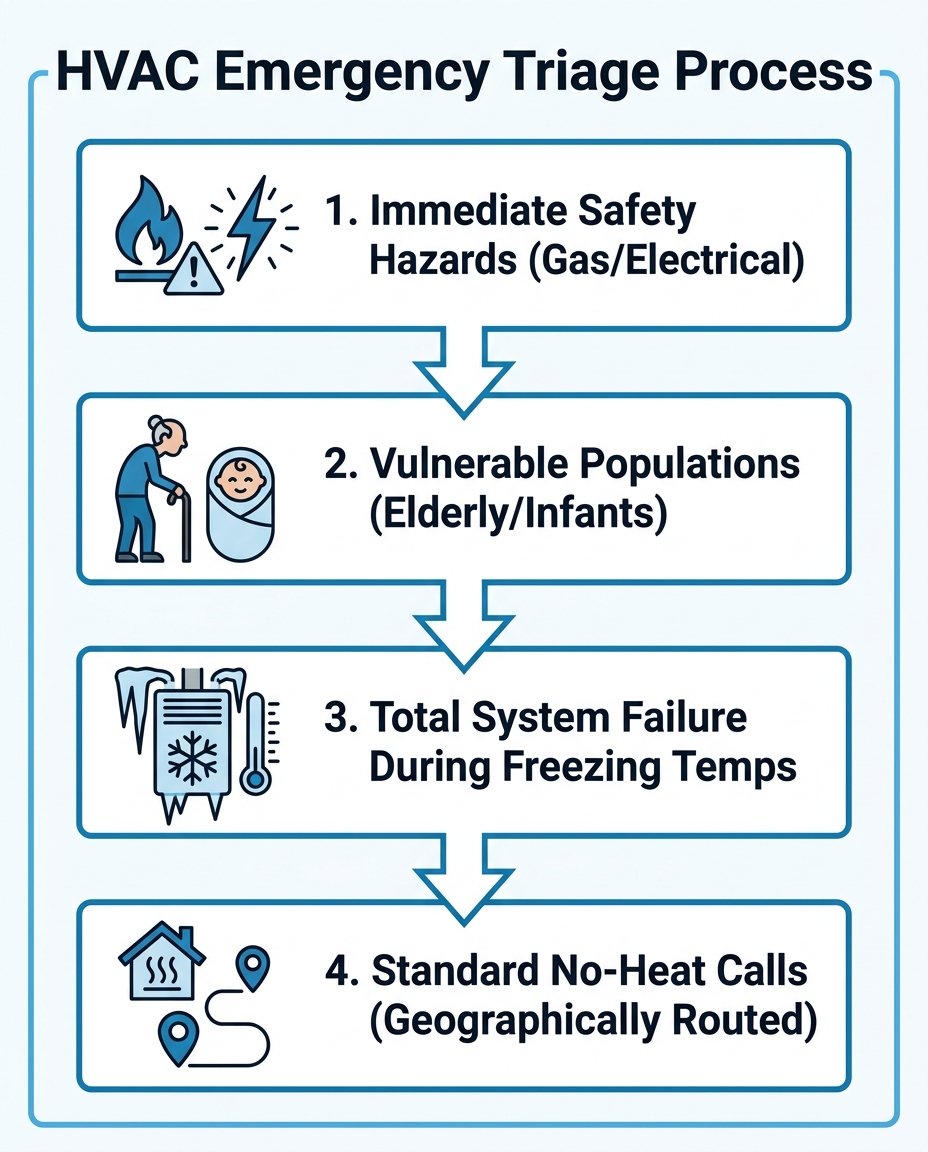
When the first major cold snap hits, a 24/7 availability guarantee does not automatically mean an instant arrival. During a massive regional weather event, dispatch boards light up with hundreds of calls simultaneously. To manage this overwhelming volume, dispatchers must implement a strict triage protocol to ensure that the most critical situations are handled first. Here is exactly how our dispatch team at Reliabee handles that process behind the scenes.
1. Identifying immediate safety hazards: The absolute highest priority goes to homes experiencing true safety emergencies. If a homeowner reports the smell of gas, sparking wires, or smoke coming from the vents, a technician is dispatched immediately. These situations pose an active threat to life and property, bypassing the standard queue entirely.
2. Prioritizing vulnerable populations: Dispatchers are trained to ask questions about the household. Homes with infants, elderly residents, or individuals with severe medical conditions are moved up the priority list. During a severe temperature drop, a lack of heat in these homes can quickly escalate from a discomfort to a serious health risk.
3. Addressing total system failures in freezing temperatures: If the outdoor temperature is plummeting and a home has absolutely no primary or secondary heat source, that call takes precedence over a home where the furnace is simply making a strange noise or heating unevenly. Total loss of function during extreme weather is treated as an urgent priority.
4. Geographic routing for maximum efficiency: For standard no-heat calls, dispatchers organize routes geographically. Rather than sending a technician back and forth across the city, they group calls by neighborhood. This strategic routing minimizes drive time, allowing a single technician to restore heat to more homes in a single shift.
Just last fall, a local homeowner reached out to us during a sudden cold snap when their heating system failed completely. Our technician arrived, clearly explained the mechanical issue, and restored the heat efficiently without unnecessary complications. This kind of focused, organized response is only possible when dispatchers carefully manage their routing boards during peak demand.
Identifying a True Heating Emergency vs. a Standard Repair
When your home is cold, it automatically feels like an emergency. However, distinguishing between a critical hazard and a standard repair request can help you set realistic expectations for when a technician will arrive. Across the San Antonio metro area, our dispatchers rely on homeowners to accurately report their symptoms so the triage process can work effectively.
• Temperature — True HVAC Emergency: Total failure during freezing outdoor temperatures. — Standard Repair Request: System is running but struggling to reach the set temperature.
• Safety Risks — True HVAC Emergency: Smell of raw gas, burning plastic, or visible electrical sparks. — Standard Repair Request: Strange rattling or squealing noises without smoke or smells.
• Airflow — True HVAC Emergency: Zero air coming from vents despite the thermostat calling for heat. — Standard Repair Request: Uneven heating across different rooms or weak airflow.
• Vulnerability — True HVAC Emergency: Loss of heat in a home with infants or elderly residents. — Standard Repair Request: Loss of heat in a generally healthy household during mild weather.
Before you pick up the phone, there are a few safe, basic checks you can perform. Verify that your thermostat is actually set to "heat" and that the batteries are fresh. Check your electrical panel to ensure the furnace breaker has not tripped. Finally, inspect your air filter; a completely clogged filter can restrict airflow so severely that the furnace overheats and shuts down as a safety measure. If you have verified these basics and the system still will not run, review the steps to take during a furnace breakdown to ensure you are prepared when the technician arrives. Never attempt to open the furnace cabinet or modify internal wiring yourself, as this requires a licensed professional.
Why Transparent Arrival Timelines Matter During a Surge
In the HVAC industry, it is common to see marketing materials promising "instant arrival" or "guaranteed 30-minute service." While these promises sound comforting, they are logistically impossible to uphold during the first major cold front of the year. When hundreds of systems fail simultaneously, a company that promises immediate service to everyone will inevitably leave dozens of homeowners sitting in the cold, waiting for a truck that is hours away.
This is where transparent communication becomes incredibly valuable. Being honest about dispatch logistics and wait times dramatically reduces homeowner stress. If our dispatcher tells you that it will be six hours before a technician can arrive due to a regional weather event, you have the accurate information you need to make safe alternative plans. You can pull out space heaters, bundle up, or relocate vulnerable family members temporarily. False promises only prevent you from taking appropriate action.
During a recent fall breakdown, one of our technicians took the time to explain the heating issue in simple terms to the homeowner, ensuring the repair was done right the first time rather than rushing to the next call. That level of dedication is a core focus for us at Reliabee Air Electric Plumbing. We prioritize transparent communication and realistic arrival timelines over impossible instantaneous service promises. We believe that an informed homeowner is an empowered homeowner, and providing an honest assessment of our routing schedule is the best way to earn your trust.
Bypassing the Wait: The Value of Proactive Fall Preparation
The most effective way to handle the reality of 24-hour furnace repair availability in early fall is to avoid the emergency queue entirely. Bridging the gap between emergency triage and preventative strategies is all about timing. If you address dormant system issues before the temperature actually drops across the San Antonio metro area, you guarantee your system's reliability when you need it most.
Clearing the dust before it causes a failure: Preventative maintenance directly targets the most common causes of early fall breakdowns. A licensed technician will safely clean the dust and debris off the flame sensor, ensuring it can accurately detect ignition. They will also inspect the electrical contacts, test the capacitor, and verify the entire ignition sequence while the weather is still mild.
Identifying weak components early: Parts that endured heavy stress during previous winters often fail upon startup the following year. A thorough inspection catches weakened belts, failing blower motors, and cracked heat exchangers before they result in a total system shutdown. Catching these issues early means you can schedule a repair at your convenience, rather than waiting for an emergency dispatch in the middle of the night.
In our years of maintaining local HVAC systems, we've found that positioning proactive scheduling as your primary strategy is the smartest move a homeowner can make. By investing in preventative heating maintenance, you secure peace of mind and ensure your equipment operates safely and efficiently throughout the entire winter season.
Frequently Asked Questions About Fall Furnace Repairs
Why are furnace repair wait times longer during the first cold front?
Wait times increase dramatically because thousands of heating systems have been sitting dormant for months. When the September first cold front arrives, everyone turns on their heat at the exact same time. This simultaneous failure of dormant systems across the region creates an immediate bottleneck for local dispatchers.
How do HVAC companies prioritize emergency calls?
Dispatchers use a strict triage system to manage high call volumes. They prioritize true safety risks, such as gas leaks or electrical hazards, followed by vulnerable household members like infants and the elderly. After critical emergencies are handled, standard no-heat calls are routed geographically to maximize efficiency.
What constitutes a true heating emergency in early fall?
A true emergency involves a total loss of heat during a severe temperature drop, leaving the home dangerously cold. It also includes any signs of electrical or gas hazards, such as sparking, smoke, or the smell of raw gas. If your system is simply running loudly or heating unevenly without safety risks, it is typically considered a standard repair.
Will an HVAC company come out at night?
Yes, reputable companies will dispatch technicians at night for true emergencies. However, realistic wait times still apply during massive regional surges. If your situation is not an immediate safety hazard, you may be scheduled for the first available standard routing the following morning.
Why is my furnace not igniting after summer?
Ignition failure after a long summer is typically due to dust accumulation on the flame sensor. When the sensor is dirty, it cannot detect the flame, causing the system to shut down as a safety precaution. Other common causes include dormant ignition components failing upon first use or thermostat communication errors.
Secure Your Home's Comfort Before the Temperatures Drop
Understanding how dispatch boards operate and why wait times fluctuate during the first major cold snap empowers you to make better decisions for your home. By recognizing the difference between a standard repair and a true emergency, you can navigate the busy season with confidence. The reality of 24-hour furnace repair availability in early fall requires patience, but transparency and realistic expectations make the process much smoother. Don't wait until the San Antonio metro area freezes over to test your system. Reach out today to schedule a thorough inspection or request emergency service, and ensure your home remains warm and comfortable all season long.

Ready to Transform Your Home?